| Author |
 Replies: 9 / Views: 1,859 Replies: 9 / Views: 1,859 |
|
|
Pillar of the Community
Australia
3841 Posts |
|
|
|
|
Pillar of the Community
Belgium
2895 Posts |
probably some kind of Lucky charm
|
|
Pillar of the Community
United States
6130 Posts |
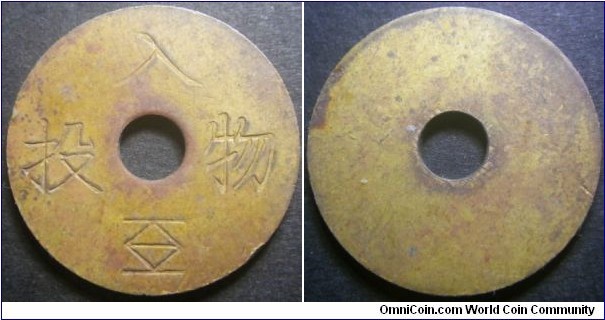
Agreed, it's a charm or tourist item--the edges are too smooth to be a cast cash-type coin... I suspect somebody turned a $0.01 washer into a $1 tourist item. Pretty sure the language is Japanese; I'll let one of the resident experts translate.
|
|
Pillar of the Community
United States
864 Posts |
If you read the two characters horizontally on each side the hole from left to right, which would require a modern date, you get "throwing thing". The top character means "human", & the sign at the bottom isn't a standard Japanese character at all, but probably some kind of sign. I suspect that it was made to be pitched into something very like a wishing well, at a shrine or temple identified by the mysterious fourth symbol. Purchasing such an item, then offering it to the resident deity, would not be unusual.
|
|
Valued Member
Japan
349 Posts |
|
|
Valued Member
Japan
349 Posts |
#25237;#20837;#29289; (tou-nyuu-butsu) means simply "thing to be inserted" #25237;#20837; (tou-nyuu) is insert, and #29289; (butsu) is thing. the upper character is #20837; (iri) - to enter, "human" is different: #20154; (hito) Final edit (Japanese isn't showing up): here is an old Osaka Gas manhole cover 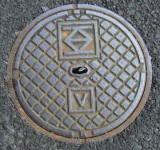 The mark looks like the first character of "gas" written in kanji. Edited by bungle
04/25/2015 3:28 pm
|
|
Pillar of the Community
 Australia
3841 Posts |
Very interesting! Thanks for identifying it!
Just for interest, this token is exactly the same size as a 5 yen coin. The hole is the same size as well. Only difference is the weight, which is at 4.54g instead of the technical weight of a 5 yen coin at 3.75g.
Btw bungle, do you have a rough idea when this was made? 1960s?
My partial coin collection http://www.omnicoin.com/collection/gxseriesMy numismatics articles and collection: http://www.gxseries.com/numis/numis_index.htmRegularly updated at least once a month. |
|
Valued Member
Japan
349 Posts |
I think the meters could be configured to accept 10 yen coins, which also weigh 4.5g. I don't know much about the mechanism of such things, but I guess you could at first accept anything with the correct weight, and then reject 10 yen coins, or anything without a hole, by driving a rod through the center. If that is the reason, then 10 yen coins were made starting in 1951, so perhaps 1950s-1960s. This page has a picture of one (Japanese site): http://www.keiyogas.co.jp/home/park.../index4.htmlsearch for "40" on the page, then the picture is the pic below that where it says Showa 40. It says that it was used in a hospital, so that patients could cook their own meals etc. and that it was used around Showa 40, which is 1965. |
|
Pillar of the Community
United States
864 Posts |
|
|
Pillar of the Community
Belgium
2895 Posts |
I have learned again!
Never thought it would be a gas token!
|
| |
Replies: 9 / Views: 1,859 |
|











 Posted 04/25/2015 2:18 pm


