| Author |
 Replies: 13 / Views: 3,605 Replies: 13 / Views: 3,605 |
|
|
New Member
Slovenia
3 Posts |
Hello, I'm new in coins. I just got some old european coins and they were not stored properly so they are dirty. One of them is this nice Austro-Hungerian 2 florin coin (see pictures). How do I clean them? There is a lot of dirt on some of them. Can I put them under warm wather? What other cleaning products can I use? Thanks for help!  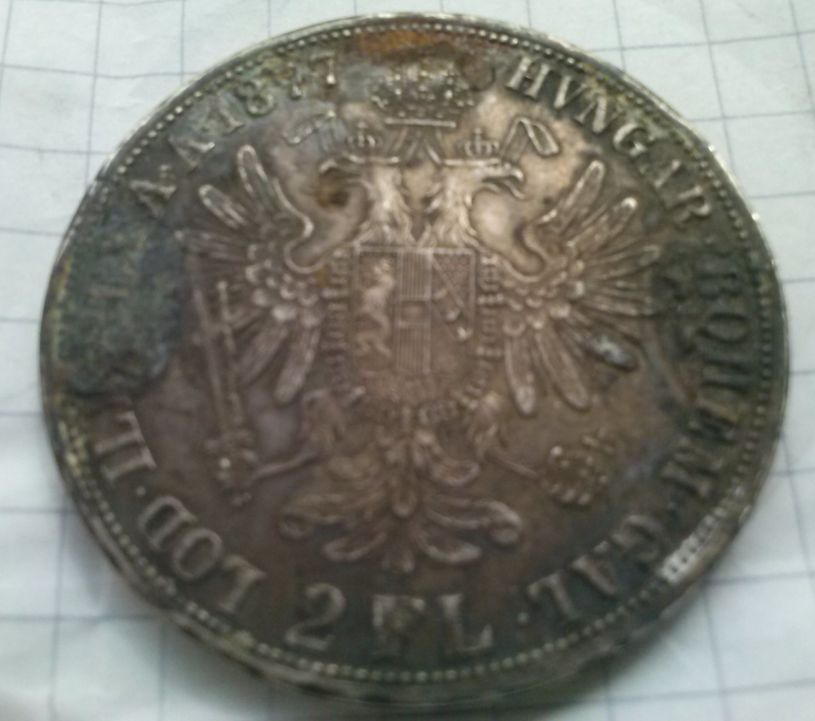 |
|
|
|
Pillar of the Community
United States
1037 Posts |
I'd leave the coin alone. It has character.
If you must, maybe a quick bath in some acetone.
|
|
Bedrock of the Community
United States
20753 Posts |
 Not sure if where your at Acetone is available. Here in the USA it is available at almost any place that sells paint. IF you can find some, it usually comes in a quart sized container. Read about the usages of Acetone on this forum by using the Search tab and looking for Acetone, coin cleaning, cleaning coins, etc. If not available where your at, try some distilled water. Just soak such coins in either Acetone or distilled water for a while. DO NOT use things such as soaps of any kind, anything that contains an acid such as Tomato juices, Lemon Juices, etc. Some people may suggest trying some Olive Oils but those too leave an oily substance on the coins. Other than those suggestions, sometimes it is better to leave coins alone if you are not aware of safe methods of cleaning. |
|
Pillar of the Community
 United States
4610 Posts |
First rule is do NOTHING. Cleaning coins is a very risky activity - there is a very fine line between conservation (ok if done by a professional) and cleaning which destroys the numismatic value. How much is the coin worth? If it's worth a non-trivial amount, it's definitely worth the professional treatment. If it's worth nearly nothing, then we can guide you through the first couple of very low risk steps. Regardless, understand the risk. That gunk may have been there a long time and may be protecting the original surface of the coin. The part that wasn't covered has toned over time due to exposure to the elements. So if you remove it, you now have a large white patch against a dark body - and that will have a much less desirable look. Also -----Burton 50+ year / Life / Emeritus ANA member (joined 12/1/1973) Life member: Numismatics International, CONECA Member: TNA, FtWCC, NETCC, EveryCountry (online) coin club Owned by three cats and a wife of 40+ years (joined 1983) Author: 3rd Edition of the Sample Slabs book, https://www.sampleslabs.info/ |
|
New Member
 Slovenia
3 Posts |
Thank you all :) Coin is worth 30$-40$, I think. Acetone is widely available here. I will read some more topics about that and try to properly clean inexpensive coins first. This one will probably stay the way it is.
|
|
Pillar of the Community
United States
1158 Posts |
One thing is that you might pull off the gunk and find that the area under the gunk has been preserved better than the rest of the coin. Then it looks cleaned and uneven and much less natural than it does now as a dirty coin. It's just a gamble, even with "safe" cleaning like water and acetone.
|
|
Valued Member
United States
75 Posts |
Tkbslc is right. By the looks of it, the gunk has been there quite some time. I get where you are coming from of wanting to remove it. It looks quite invasive. I myself would probably remove it, but do so with caution. You have a huge chance of it being discolored forever, but I would rather have the gunk off. My general rule is that if the gunk is protruding from the coin (you can feel it and it isn't just toning) then I'll remove it.
Ultimately up to you of course, but just somethings to keep in mind.
|
|
Pillar of the Community
United Kingdom
856 Posts |
I was going to say "NO, don't do it!" but having seen the coin it is pretty ugly!
I know some of my contacts have had success with soaking older silver coins in olive oil. The kind you put on salads will do!
It is a slow process and you can check it every now and then by taking it out, giving it a rinse in water (distilled if you have it) and then acetone to remove last traces. If you don't feel it's cleaned enough .. back into the olive oil. If you take a photo each time you can check the progress.
It can take several weeks if not months to make a difference but it will loosen surface dirt and can work on more stubborn residues. Pop the coin in a small pot, ideally with a lid, add enough oil to cover and occasionally swirl it a bit. You never know, it might help.
Good luck and welcome!
.
|
|
Bedrock of the Community
United States
20753 Posts |
When it comes to Olive Oils, remember they contain Acids. Might not be strong, but could really do some damage. IF Acetone wouldn't work, I'd just leave well enough alone.
|
|
Moderator
 United States
23522 Posts |
Welcome to Coin Community, king90. This one's going to be difficult; I'm not sure anything will bring it back from where it is. And even if you can remove what's on it, the result will inevitably show that it's been worked on. The less-covered surfaces will have aged at a different rate, so the result will show "cleaned" patches. This is a judgment you'll have to make, and you'll have to consider whether any of that is still actively eating at the silver, which will force your hand. Sometimes you have no choice but to clean, in order to save what's left. I worry the most about the greenish patches and the top of the obverse. That latter looks like environmental rust from elsewhere that attached itself to the coin, ugly but not dangerous, and possibly removable at the cost of a clean surface underneath.
You've already figured out the right thing to do regarding acetone, and in this case I'm going to strongly recommend that you make use of it and worry less than you might normally about the coin looking "cleaned." There's too much chance of continued harm, from what I see, to not intervene.
But you have to make these decisions on a coin-by-coin basis. We'll be happy to offer input regarding the others.
|
|
New Member
Slovenia
3 Posts |
Thanks for great response. I really appreciate it! Tomorrow I will buy acetone and try to do some magic with it =)
|
|
Moderator
United States
23522 Posts |
OK. Shoot for a glass container around 60-75ml (I use large shot glasses), and I cover them with a small pane of glass for a good seal. Threaded baby food jars are another good one, but you may need more acetone. That setup will give you reasonable assurance of an overnight soak without much evaporation, with most efficient use of acetone. Try to use that quantity - 2-3 US oz - as your "standard," because in any given application you may use that much half a dozen times, and it adds up. Even for the "rinsing" swish afterwards. Some are more or less susceptible to irritation from acetone. Me, I can suspend fingertips in it to grab a coin with my fingernails and move it around a bit without being bothered. If you're more sensitive, it won't physically hurt you but you'll sure think it is. Set your soaking station on a kitchen windowsill with the window cracked, or a similar area where the inevitable evaporation can't reach any flammable concentration. This is an abundance of caution, not a firm safety step. 75ml of acetone won't contaminate a whole room even to smellable concentration - and you'll smell it if it concentrates enough. I'm perfectly happy using it in a bathroom with the door closed and a window cracked an inch. OK. The coin wants to remain vertical so both faces can be exposed to the acetone. That's one of the reason I use the rounded-bottom liquor glass as a flat-bottom container makes this much more difficult. Give it overnight - for this one, if evaporation allows give it 24 hours for the long soaks - and then swish upon removal in fresh solution. No water ever, either to rinse the coin or the container. Soap and water on the container after you're done, of course. Soon as you're done with the rinse, attack that upper obverse stuff with a toothpick to see if you loosened it. It will be encouraging if it does. Anything else on the coin that has "thickness," hit with a toothpick. If you have roses, thorns are ideal. Even better if you have a porcupine in the household, but he may not like you removing his quills and it's never advisable to anger a porcupine. Don't "scribble" with the toothpick - directed point-first shots either down into the center or working at the edge. Don't smear things. Give it as much as three consecutive long soaks of this nature. If that does not make a visible difference in the coin, your troubles are likely beyond the acetone. Come back here with "after" pics and we'll consider the next move. I'm far from out of suggestions.  |
|
Moderator
United States
23522 Posts |
It occurs to me I didn't do the standard boilerplate attempt to scare the heck out of you regarding acetone's flammability, and I'm going to fix that now.
This stuff's flammable like to make gasoline behave like orange juice. Gas has a combination of more- and less-volatile/flammable molecules; it's the more volatile ones that seep most quickly into the atmosphere and give the smell.
Acetone is 100% those more volatile molecules. That's why everyone is talking about it evaporating so quickly. If you have a gas stove, for safety reasons don't take my suggestion of a kitchen window. If you smoke....quit while you're in the same room as acetone. Seriously. This stuff is beyond flammable and beyond volatile (ability to evaporate). Water volatility is 17.5hPa, acetone's is 240hPa....
It gets into the atmosphere now. And by standard, something with a flash point of under 100F is considered "flammable;" acetone's flash point is -4F....
Oh, yeah, one more thing. Remember me mentioning you might be more or less sensitive to getting this stuff on your skin? That's cool, because it evaporates instantly (volatile, remember?). But, um, acetone is an organic solvent and you're organic. Soak the coin, not your fingers.
|
|
Pillar of the Community
United States
4963 Posts |
Most importantly- DON'T CLEAN IT! 99% of the time, it's best to leave a coin as you found it. Cleaning chemicals cause microscopic damage to the metal. A cleaned coin is very obvious to dealers and collectors, I found a 1909-S wheatie in an album with a Red Book value of about $135. Unfortunately, it was cleaned, and at a major show, I couldn't get offers over $55. It's a shame so many people don't know this and ruin old and valuable coins. Anyway, that coin is fine as it is. Unless a bit of water can rinse that crud off, just leave it alone. |
| |
Replies: 13 / Views: 3,605 |
|










 Posted 05/05/2015 11:14 am


