Modern Coin Wholesale - Last week PCGS announced that it was changing its grading nomenclature for W-Mint American Silver Eagles from MS (Mint State) to SP (Specimen). The timing of the announcement may come as a shock to collectors of the series, as W-Mint Eagles have been around since 2006. Generally, I think the decision makes sense and, in the long run, will benefit the series.
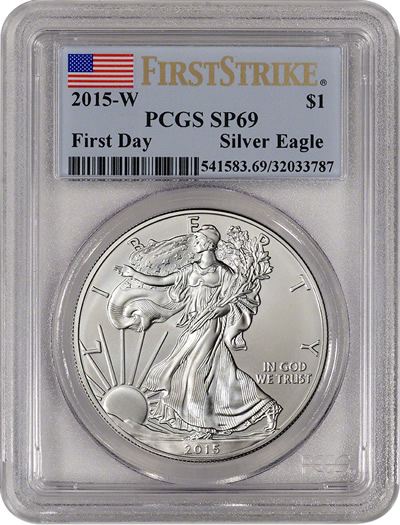
In this week's blog entry, I'll clear the air about the W-Mint Eagles, how they are different from the standard bullion strike coin, and explain what it means to you if you've already been collecting W-Mint coins in MS holders.
First, let me answer the most important question: What's the difference?
The simple answer is, the coin's finish is different. The long answer requires a little understanding of the coin's history.
In 1986, when the American Silver Eagle series debuted, the coins were struck in two configurations for two distinctly different customers. Bullion coins, sold in 500-coin "Monster Boxes", were produced for bullion investors; while Proof versions, sold individually and housed in deluxe packaging, were sold to collectors.
Over the course of the first twenty years of the coins production, interest in U.S. Mint-produced bullion products waxed and waned. The certified secondary market for the coins had yet to develop, and most of the coin's buyers were into the coin for its silver content- and not for the condition or beauty of the coin.
This started to change when companies like ICG began to make a good business in certifying bullion coins for telemarketers and cable TV coin shows. Later, NGC and PCGS cast aside their numismatic elitism and took a pragmatic approach. If MS and Proof 69 and 70 Eagles were what the collecting public want, why not give it to them.
This led to a momentous shift in the coin market.
With third party coin certification, even modern coins. even bullion coins. could have a viable place in the secondary market. Dealers either embraced this shift or they were left on the sidelines as hundreds of millions of dollars were made by the industry as it catered to a new class of coin collector. For the coin industry, the Silver Eagle became the second coming of the
Morgan dollar.
You know as well as I do that collectors love big silver coins. They are attractive and affordable. And while your typical collector could never complete a collection of
Morgan dollars thanks to the rare dates, nothing really prevents someone from putting a set of Silver Eagles together - I realize, now, that things might have changed thanks to the 1995-W, but still. you get my point.
By 2006, the U.S. Mint had fully embraced the concept of the Silver Eagle as a collectible coin and developed new purchasing options for collectors.
They offered a three-coin 20th Anniversary, which featured a standard Proof Silver Eagle, a Reverse Proof Silver Eagle (Cameo on fields, mirrors on devices), and a burnished uncirculated coin struck at the West Point Mint. The mint also offered the W-Mint burnished uncirculated coin as a standalone ordering option.
The West Point coin was the first uncirculated Eagle ever struck with the "W" mintmark. It wouldn't be the last one. From 2006 to 2008, the Mint offered the W-Mint burnished coins alongside their traditional offerings of Proof and bullion strike coins. After a two-year hiatus in 2009 and 2010, production of W-Mint burnished coins resumed.
While the burnished coins and the bullion strikes are both technically uncirculated coins, the two are very different. Think of the bullion strike as a slightly satiny uncirculated coin, where as the burnished coin features a distinctive matte finish. This matte finish is similar to the finish found on the 1998 matte
Kennedy half dollar or the 1994 and 1997 matte Jeffersons.
Taking it back a bit farther, the W-Mint coin's matte finish is also similar to the 1972 through 1974 blue pack
Ike dollar.
Of the coins I've mentioned, the services already use the SP designation on the
Jefferson nickels and the
Kennedy half dollar. Neither service has adopted the same nomenclature for the Ike Proofs, although maybe it's time that they do.
What does this mean for collectors?
The answer to this question depends on how much of a Type A personality you have. On the surface, the shift in nomenclature means nothing. No one should confuse a W-Mint coin as being non-burnished, just because the holder says MS69 instead of SP69. All W-Mint "uncirculated" strikes are burnished.
For dealers, the change in terminology makes it easier to market the coin's three (er, four- if you count where the bullion coins were struck) annual releases.
For numismatists, the change goes beyond dollars and cents, it goes to the very core of what the services are supposed to do. to look at a coin, evaluate it for what it is, and make the right call. even if that right call comes nine years too late.







 Posted 06/02/2015 3:17 pm





