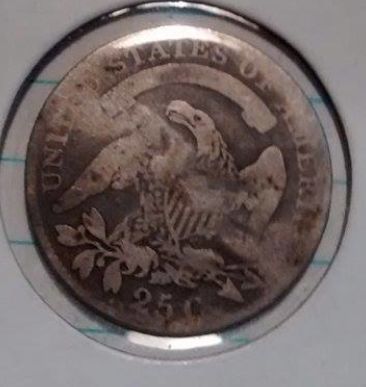
Thought I'd chime in on this, my favorite topic! But before I address the OP's question, I want to address what I see as a misrepresentation of facts; this, as I've experienced in my many years of studying counterstamps.
Quote:
There were three peak periods of countermarking activity in the United States: "Hard Times" of 1833-1843, Civil War, and the Nation's Centennial.
The Civil War was NOT a peak period of counterstamping activity. From the early 1800's on, there was a fairly steady increase in the counterstamping of coins by U.S. merchants. This fad exploded in the 1850's, as the country left the "hard times" era and merchants prospered. The Civil War resulted in the hoarding of hard money, and alternative currency like tokens, scrip, etc. became the necessity money of daily trade. So, counterstamping came to a virtual standstill, during the Civil War years. While the practice resumed to a modest degree after the war, it never really did return to the level of the 1850's. That decade, 1850's, was THE peak.
Following the Civil War, advertisers were more prone to use trade cards and place newspaper and magazine ads. Having seen the success of Civil War storecards, merchants had their own tokens struck, good-fors, to advertise their business. A great many of the post Civil War counterstamps were issued for reasons other than being conversational pieces, aimed promoting word-of-mouth advertising.
While I don't see any particular surge in the issuance of counterstamps as a consequence of the centennial celebration, I do see the use of patent, fraternal and machinist marks being significant during that era. It was a time when everyone and their brother seemed to be inventing devices to make it rich.
Quote:
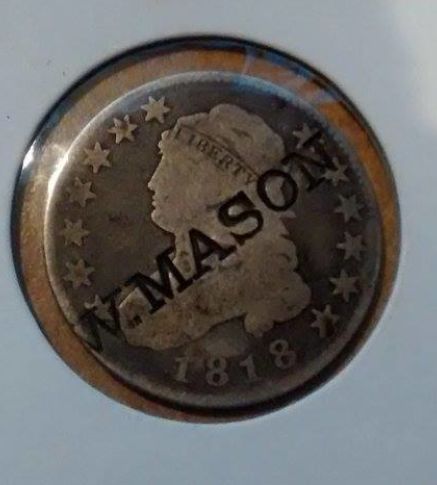
Can anyone tell me what I should value this at? A reputable dealer said $80+ any thoughts?
IMHO, the $80 quote is reasonable for this piece. While many dealers probably wouldn't pay half that amount for a "damaged coin", these counterstamps that boast names tend to generally offer more appeal to collectors than simple initials or random numbers. Then too, there seems to be more demand for counterstamped silver coins; and, especially so, these earlier bust coins. That said, there are some collectors who would readily pay over $100 for this piece ... the mystery of it.
While this counterstamp was most likely an 1850's application, it could have been done some years later. To my eye, the letter style suggests 1850's. Brunk doesn't list this counterstamp. Unlike coins, being unlisted is more the rule than the exception, when it comes to counterstamps in general.
In this case, the name, W. MASON, is very common. The "W" likely stands for William, but other possibilities exist. Taking a look at the 1859 NY City Directory for example, there are six men listed by the name William Mason; those, having no middle initial. There are seven who have a middle initial. The "value added" when it comes to counterstamps is dependent upon attribution. So, unless this OP's piece can somehow be matched to another identifiable counterstamp, or better yet, a product like a firearm or patented item, there will never be that added value. Lacking a town, address or occupation stamp, only unusual or uncommon names tend to offer a better prospect for attribution.
P.S. - Rusty ...










 Posted 06/03/2015 9:33 pm