Perth Mint -
This month sees the introduction of our 12th Australian coin inspired by Earth's southernmost continent - Antarctica.History of Australia in AntarcticaAustralia is one of seven nations that have claimed territory in Antarctica. At approximately 5,800,000 km², or 42 per cent of the total, the
Australian Antarctic Territory is the largest claim over the remote and harsh polar continent.

The Australian claim is based on a long historical association with the eastern section of Antarctica. Several notable Australian explorers and scientists were responsible for establishing a connection with the continent during the early 20th century, including Douglas Mawson, whose famous achievements included reaching the South Magnetic Pole with Edgeworth David and Scotsman Alistair Mackay on 16 January 1909.
Today, the
Australian Antarctic Division is responsible for the advancement of Australia's strategic, scientific, environmental and economic interests in the Antarctic.
Australian Antarctic Territory Silver Proof Coin SeriesLaunched in 2004, the
Australian Antarctic Territory Coin Series features designs related to the continent's exploration and its awe-inspiring wildlife and environment. Prior to the latest release, the coins have featured:

2004 Mawson Station
2005 Leopard Seal
2006 Edgeworth David Base
2007 Davis Station
2008 Humpback Whale
2009 South Magnetic Pole
2010 Husky
2011 Killer Whale
2012 Emperor Penguin
2013 Aurora Australis
2014 Wandering Albatross
2015 Elephant Seal 1oz Silver Proof CoinThe latest addition to the
Australian Antarctic Territory portrays an Elephant Seal, the largest seal in the world.
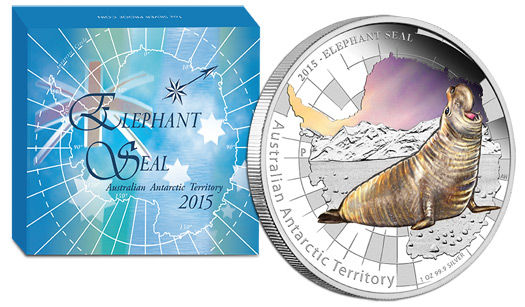
Male Elephant Seals can grow to more than six metres in length and weigh up to 4,000 kilograms. The species takes its name from the adult male's large proboscis, a trunk-like inflatable snout which is used to make extraordinarily loud roaring noises, especially during the mating season.
Southern Elephant Seals live in the brutally cold Antarctic and sub-Antarctic waters of the Southern Ocean, feeding at sea on a diet that consists mainly of fish and squid. Although cumbersome on land, they are superb swimmers and divers. Scientists have recorded them at depths of up to two kilometres and holding their breath under water for up to two hours! Their torpedo-shape helps them swim enormous distances while foraging for food.
Elephant Seals breed on sub-Antarctic islands from late September to early November. South Georgia Island is home to the largest population, hosting more than half of the world's numbers. Other notable colonies are found at Tasmania's Macquarie Island, the Australian external territory of Heard Island, the Falkland and the Kerguelen Islands, and at widespread islands near the Antarctic Peninsula.
The female of the species usually gives birth within ten days after coming ashore and does not leave the beach to feed until her pup is weaned. During this time she depends on her stored fat reserves to sustain her and loses an average of 35 percent of her body weight, a loss of eight kilograms per day!
The
Perth Mint will release no more than 7,500 of these coin celebrating one of Antarctica's most remarkable and precious creatures.







 Posted 06/05/2015 2:52 pm


