| Author |
 Replies: 55 / Views: 4,379 Replies: 55 / Views: 4,379 |
|
|
|
Pillar of the Community
United States
7390 Posts |
I'm not a metallurgist kid but I would think the alloys could change that so you may have made an error in your thinking process from the beginning. I'm not saying your wrong, I dont know how hard one alloy is to the other or how it relates with their specific strike pressures, just that you're being too generic with the foundation of your hypothesis  Edited by Cascade
06/25/2015 2:10 pm
|
|
Valued Member
United States
51 Posts |
Exactly, It is like a fully formed nickel was put into the quarter dies after the fact and struck again. Definitely not mirrored and I don't know why we have to point fingers over speculation over pictures on the internet. Whether or not this is worth that kinda $$ is my main question. Ho Lee Cow
|
|
Pillar of the Community
United States
6478 Posts |
Ok, ok. I understand. I just assumed that it took more pressure to make nickels. I will do more resaerch into that. And on the mirrored design, I actually do not know. The design is not mirrored. It is upside down relative to the face, but it is in regular orientation. If you flip the image you can read it loud and clear. It is not mirrored. I have looked at this coin. I am sorry for arguing, honestly. Flip the image and see that the design is not flipped.
|
|
Pillar of the Community
United States
6478 Posts |
2007. Read it like this and you will understand. 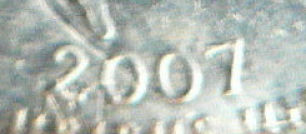 |
|
Forum Dad
 United States
24236 Posts |
Sorry I deleted my post right away, didn't think anyone could have seen it yet. You're right, it's not mirrored. The "strike" is terribly bothersome, were talking many tons of pressure.
|
|
Pillar of the Community
United States
6478 Posts |
Thank you, I don't know a lot of people who would have admitted that. Now I need to continue my research into malleability of metals.
|
|
Pillar of the Community
United States
6478 Posts |
Quote:
It is just slightly larger than a normal nickel and on the edges you can see the result of the double strike. Thank you kindly for asking. I sent the seller a message asking if it was slightly larger, this was their answer. |
|
Bedrock of the Community
United States
17884 Posts |
It looks good to me. At first I was surprised more the the nickel design was not removed by the quarter reverse but that may be expalined by the extremely shallow no detail reverse of the WY quarter. On the obverse (quarter) side the nickel design shows strongest in those areas of relief from the quarter. Exactly what would be expected. The coin is slightly larger in diameter than a nickel, again what would be expected.
As to the hardness of the compositions, the outer clad layer of a quarter and a nickel are bother the same composition and hardness. The copper core of the quarter may it a bit softer, I don't know. If it is softer that would mean a lower striking pressure. However the quarter is larger in diameter which requires a higher pressure. The two probably cancel each other out and the nickel and quarter probably use about the same striking force from the press. But the previously struck nickel would be work hardened and would be harder than an unstruck quarter planchet.
|
|
Pillar of the Community
 United States
2189 Posts |
WOW! Looks like I missed a lot.I've either been asleep or at work. I can't explain it in words but I just felt it was a genuine error and no I'm not bidding on it.It passed my budget a while back.
All though it is a very unique & rare type of error for some reason it does not have that great eye appeal to me. At these prices that is definitely a must have. Eye appeal
|
|
Pillar of the Community
United States
6478 Posts |
This is what my research has concluded too. Nickel on the Mohs scale is 4, copper is 3. The higher on the Mohs scale the harder. Because the mint really wants to use the ATB dies for as long as possible, they have a shallow relief and low pressure strike. This would mean that the nickel has to have a higher pressure strike. In addition, the nickel was not annealed before the second strike causing the metal to harden. This is just a hypothesis. Just throwing some ideas out there. Maybe you can pick up on it? |
|
Pillar of the Community
United States
2752 Posts |
It could be genuine, but it would require a second error -- a weak strike. It's highly unlikely that such a rare double-denomination error would occur with a striking error of this nature. In all other quarter-on-nickel errors I've seen, the nickel design is almost completely obliterated, in part because nickels are thicker than quarters. I suspect a pair of counterfeit dies were used.
Error coin writer and researcher.
|
|
Pillar of the Community
 United States
5828 Posts |
And there you have it, folks. Most likely fake.
|
|
Pillar of the Community
United States
7390 Posts |
I was thinking counterfit dies mike. Nice to know you think the same thing
|
|
Pillar of the Community
United States
6478 Posts |
Mike, were those State Quarters on top of nickels? Do you think that because of the lower pressure strike and shallow relief of the State Quarters (to preserve the life of the dies) that the designs would not be totally obliterated? Could we see some pics of a legit error? |
|
Pillar of the Community
United States
2752 Posts |
I've seen a few State Quarters on nickels and the nickel design is largely effaced. The shallower design of the State Quarters would, if anything, increase the likelihood that the nickel details would be obliterated. I don't have any images stored on my computer. Error coin writer and researcher.
|
| |
Replies: 55 / Views: 4,379 |





 First Page
 Previous Page


 Posted 06/25/2015 2:11 pm


