| Author |
 Replies: 13 / Views: 1,003 Replies: 13 / Views: 1,003 |
|
|
Valued Member
United States
140 Posts |
Ok...This looks like Machine Doubling to me, but it goes all around the perimeter devices...And very wide seperation...also, the bottom line of the Memorial is doubled as well. So...someone help me out.   |
|
|
|
Pillar of the Community
United States
3507 Posts |
Machine doubling. There is no separation. What you are calling separation is metal that has been moved.
|
|
Valued Member
 United States
140 Posts |
No..what I was calling seperation maybe incorrectly was the distance from device line to device line. But, what confuses me on this example is how the "doubling" is not consistant on an area....example=the bottom of the "R", the curl is different in curve than the raised device...and the bottom horizontal on the "E" is not consistant but narrows toward the back of the device. The way I understand Machine Doubling is its a result of either "die chatter" or over strike(unsure if this is worded correct) or the planchet shifts slightly. I would think the doubling would be consistant not throughout the entire coin but at least the entire device. |
|
Pillar of the Community
United States
1571 Posts |
Machine doubling, also known as "shelf doubling", due to the shelf-like flat area adjacent to the raised areas. I agree, it is confusing, but you will see many examples of MD, and swear that it is a "goodie", but like the rest of us, you will learn to detect the difference, and go on to the next troubling question.
Dick
|
|
Valued Member
United States
140 Posts |
Perhaps I am not explaining myself very well...I said in my original post that I thought this was Machine Doubling, my question is about the differences that show in consistency...Like the bottom right curl on the "R". The raised curl is a different curve than the doubled curl and the way that the bottom horizontal of the "E" narrows back....I was mainly asking how this happens? I am a visual person, if I can picture in my mind it happening, then I understand what I see better. |
|
Pillar of the Community
United States
3507 Posts |
This is one of the most difficult things to visualize. It used to drive me nuts too so don't feel bad:-) Machine Doubling can be incredibly inconsistent. The condition of the die, the amount of die chatter, the direction of the die chatter, whether or not the direction of the die chatter is clockwise, counterclockwise or both...etc. all effect the eventual outcome of the appearance of the coin. It is sometimes one of those things where the way to describe it is that it is consistently inconsistent:-) For folks like me who are also visual, and like things to make sense, we have to get used to the inconsistencies. Edited by foundinrolls
01/04/2008 6:02 pm
|
|
Valued Member
United States
140 Posts |
When I think I am getting a level of understanding, someone will post or say something that kinda throws a monkey wrench in all of it. Like this. To me, this looks like Machine Doubling...it has the shelf look...but then again, maybe better isolation and zoom may reveal what I am not seeing. 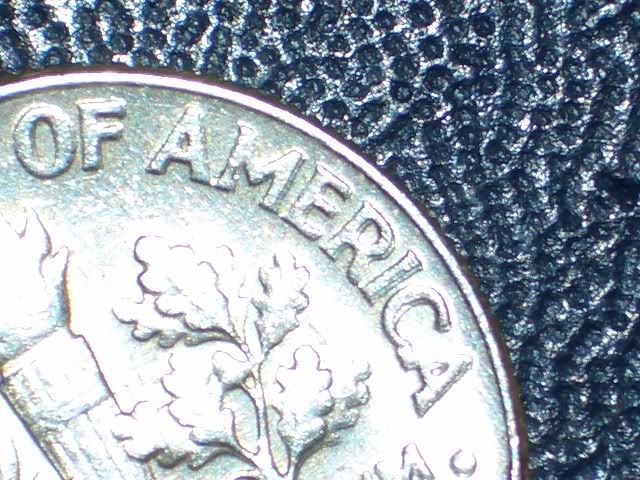 |
|
Pillar of the Community
United States
3507 Posts |
This coin is a known variety. The picture doesn't really give you the third dimension that you need to see what you would see if the coin were in hand. I am going to try to do some simple sketches, photograph them then post them here. It may take a half hour or so. Don't go away, I'll be right back:-)
|
|
Pillar of the Community
United States
3507 Posts |
OK, First let me say that I am no artist but this should give you the idea. The I on the left represents Machine Doubling. The I on the right represents a doubled die. If you look at them head on as you would see it in a photo or even through a lens, They both have what appears to be doubling. On the Machine doubled coin, there are a few things to point out. One is that the appearance of doubling is caused by the metal being pushed over the top surface of the device that is effected. The doubling is what we call shelf-like. Imagine now that you can shrink yourself and lay down flat on the surface of the coin. If you imagine that you are looking at the very bottom of the letter I that is Machine doubled, It would have the appearance of a step. Going further, the appearance of doubling often is the result of a distortion of the letter by virtue of the metal being scraped into place. The shape of the letter will sometimes appear to be thinner than the same letter on a coin where no Machine Doubling is present. Now...The one on the right. The doubling (when you have enough experience identifying the shapes of the lettering specifically) appears wider than the same letter on another coin that has no doubling present. If you lay yourself down on the surface of the coin, and look again at the bottom of the letter, You will see what appears to be a minute groove between the images that create the doubling. That is what we look for on doubled dies. The groove between the images. The groove on a doubled die looks different than the step on a Machine doubled coin. This is a simple explanation but it is what we look for. When you get used to seeing the groove, you don't usually mistake it for the step. It just takes a lot of experience to learn the difference between the two. What I just described would be the appearance of what we call a doubled die with a close spread. My avatar with the 1972 DDO cent is a doubled die with a wider spread. The distinct gaps between the numerals is what we refer to as separation. I hope this helps. Picture is below. Please remember that the artwork is not brilliant:-) Bill  Edited by foundinrolls
01/04/2008 10:11 pm
|
|
Pillar of the Community
United States
2177 Posts |
Okay. I like your theme Bill. I changed it around a little so that if I were a little person on a coin a Machine Doubling is like a step (stair) vs a true doubling which can be a sort of stepping stone. |
|
Valued Member
United States
140 Posts |
ok...you said something that I had not heard yet.."groove".
The dime that was posted was confusing me because I could not see split serifs, but I am guessing that in hand, under a glass, I would be able to see a groove between the devices? So, you don't have to have split serifs to determine doubling but the seperation(groove) between the images? Are those correct statements?
See, the dime was confusing me because it looked like a "shelf" maching double, but closer inspection would show that the "shelf" is in fact seperated from the main device?
|
|
Pillar of the Community
United States
3507 Posts |
Split serifs help when two things happen. One is the coin has nice serifs like let's say, the lettering on a Kennedy half Obverse (LIBERTY).... and Two, the doubling on the die is offset enough to the north or south to result in nice , clean split serifs. When the serifs are not very much a part of the lettering and the doubling is perfectly to the east or west and the spread is very close, you will see grooves at the upper parts of the letters where the doubling is present but you may not see clearly split serifs. The lettering on the dime, for example, doesn't really have strong serifs so you won't have any split serifs since serifs are not really there in the first place. What we look for in the case of letters with no serifs is what we call notching. The groove carries down (or up) along the edge of a letter to where the "corner" of a letter would be and you would see a little notch at the corner, so to speak. I was going to include notches when I drew the sketch and then figured that I would wait for the question. The arrow I drew on the upper right of the I on the right points to a notch. So a lot depends on the shape of the lettering and the direction and extent of the die doubling. There's a lot more to it than just the appearance of doubling and I am trying to explain it the best way I can in a visual sense. I work in that direction myself. You have grooves, separation, notches, split serifs (when serifs exist)wide spread , close spread, etc. as terms that all pertain to the things we look for on Doubled dies. Machine Doubling can mimic some of these things so we look for the right combination of effects to determine what we are looking at. We also have, (I know Chuck does as well as me ) Examples of many of the known Doubled dies to compare with anything we might come across. It took some work and experience to get really comfortable with what to look for and there are still some coins that can be tricky to figure out. The more you learn and look at these things, the more easily you can pick up on Machine Doubling vs. die doubling. |
|
Valued Member
United States
140 Posts |
ok....I think I with you. I had gotten ahold of the "shelf" like image, but the dime example threw me because it had the shelf look but was quickly announced a DD...I guess knowledge in the variety was key for that call.
I appreciate your time and replies because I am sure that I am not the only one who is trying to learn this stuff here....Appreciate all "expert" insight available.
|
|
Pillar of the Community
United States
3507 Posts |
We try to help and I know personally, that I like to teach. I suspect very strongly that others here feel the same way.
|
| |
Replies: 13 / Views: 1,003 |
|










 Posted 01/04/2008 12:28 am


