Heritage Auctions -
"The officers of the Mint in our city marked the opening of the New Year by very appropriately making a new issue of American coin. How extensive that was we are unable to say, but the twenty dollar gold piece and silver half dollar laid on our table for examination, as the product of the massive stamping machinery on the first day of the year, 1853, were admirable specimens of elegant design and finish."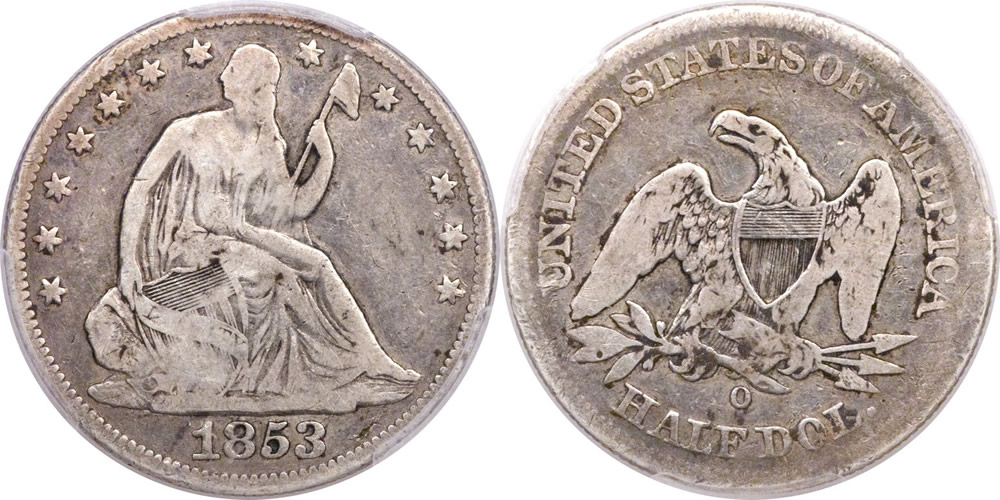
That report appeared in the January 2, 1853 issue of The Daily Picayune, published at the New Orleans newspaper offices of the Times-Picayune. The report is certainly definitive, for Congress passed the Act of 1853 reducing the weight of silver coins more than a month later on February 21. The half dollar mentioned in the report was the 1853-O No Arrows, the variety offered here. The actual mintage is unknown as none were reported in contemporary mint records. However, the production was likely several hundred pieces, or perhaps a few thousand examples. Some estimates have suggested that as many as 3,000 to 4,000 pieces may have been struck.
For the first time, Heritage has the pleasure of offering an example of this rarity, a PCGS graded VG8 example appearing in Platinum Night of the August 12 - 16
ANA US coins Signature Auction in Chicago. Although modestly graded, it is the second finest of the four known examples.
The history of this rarity has its beginnings with the California gold rush. The massive influx of gold in the world markets influenced the price of silver. In a few short years, the value of the silver in the nation's coinage was higher than the face value, and those coins were hoarded and melted, creating rarities for later collectors.
The first appearance of an 1853-O No Arrows half dollar in a public auction occurred in 1885, 32 years after the coins were struck. That itself is not unusual or surprising, as few collectors recognized mintmarks prior to the 1893 Augustus Heaton work, Coinage of the United States Branch Mints. A second example appeared in the April 1892 Chapman Brothers sale of the Colin E. King Collection, and the third was found a short time later, its pedigree originating with H.O. Granberg (1860-1947), acquired earlier in the 20th century after its circa 1909 discovery in Chicago. More than 100 years passed before a fourth example was found, and it will likely be a long time again, if ever, that others will turn up. Since 1885, only 16 auction appearances are recorded for all four examples, an average of one appearance every eight years.
This coin has the natural appearance of a well-circulated
Seated half dollar of most any date, with light gray devices and deeper bluish pewter-gray patina in the fields. Old surface buildup remains in places on the reverse, as accumulated through many years in commerce and later storage. Both sides have trivial handling marks that are usual and ordinary for the grade. This piece is the definition of the VG8 grade, with the L and TY of LIBERTY mostly visible on the shield. The major drapery folds are evident, as are many of the eagle's feathers. The obverse border is complete, and the reverse border is nearly so, showing weakness from 2 o'clock to 6 o'clock.





 Posted 07/30/2015 2:19 pm





