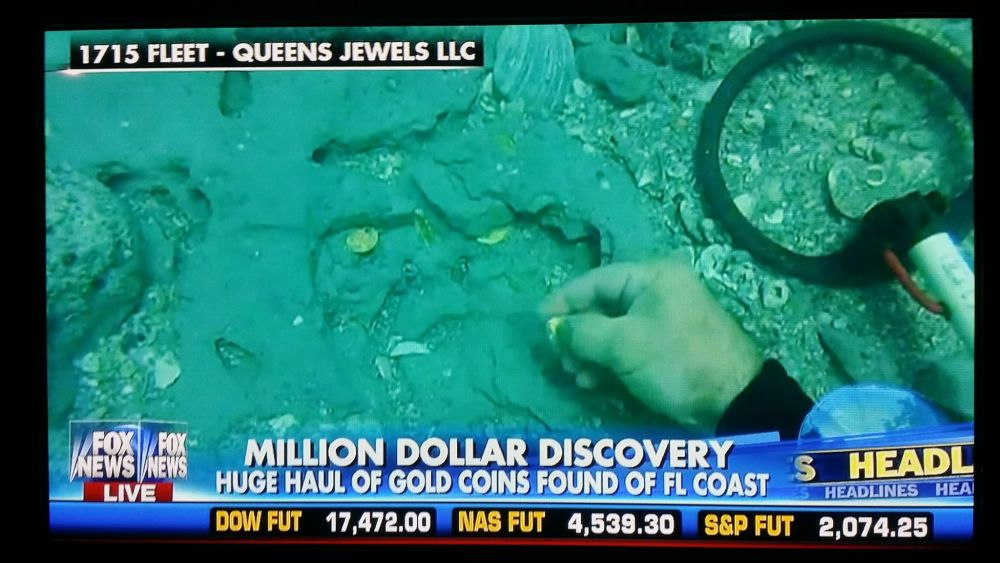
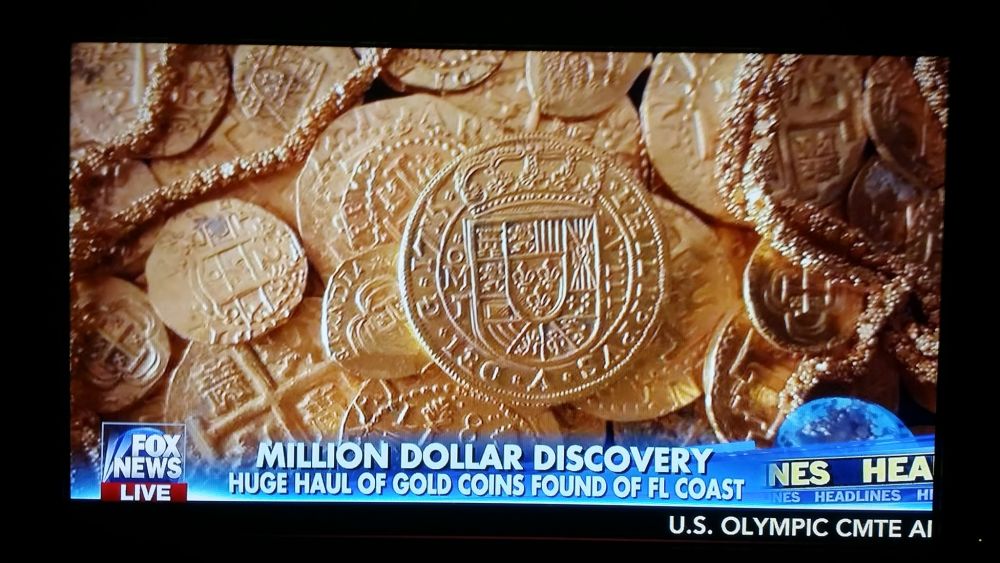
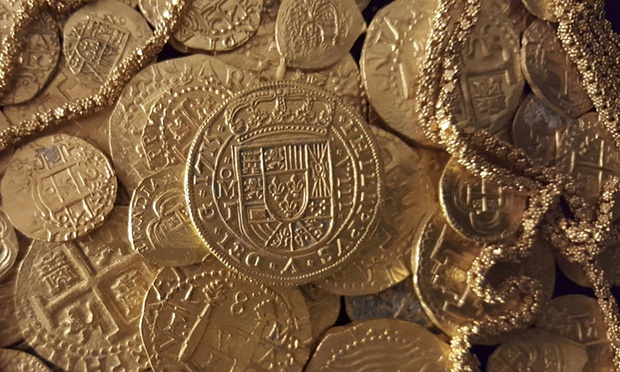
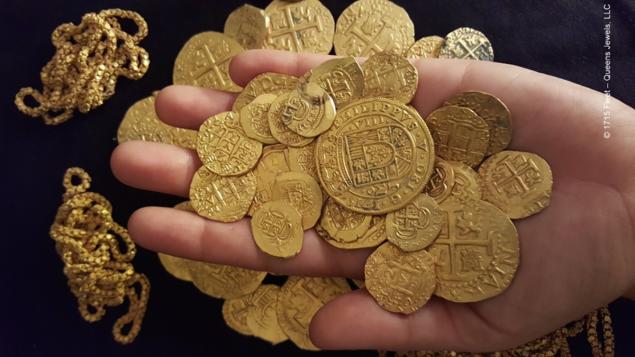
"The find included 51 gold coins of various denominations and 40ft (12m) of ornate gold chain, said Brent Brisben, whose company, 1715 Fleet - Queens Jewels LLC, owns the rights to the wreckage"
It makes my skin crawl to see the guy wipe his thumb across the face of the dirty coins, wonder how many grading points he just lost doing that. Other than that, what a great find. I have been diving in that area on those wrecks and found silver coins but never any gold like this.
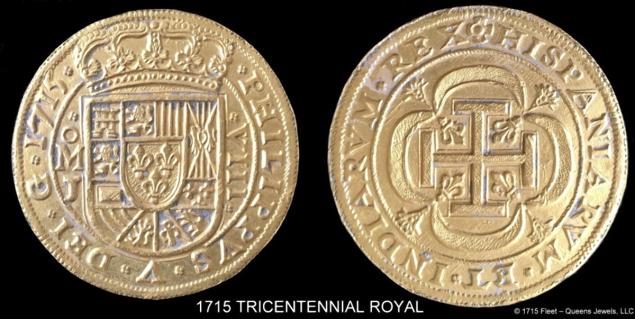
There isn't really any such coin as a "Tricentennial Royal". The proper name for the coin is an 8 escudos from the Mexico mint, "royal" coinage. They're just calling it that for marketing reasons.
The Mexico City mint in the early 1700s churned out tons of low-quality "cob" coins, struck on very coarsely prepared planchets. Getting the weight right was the only thing that mattered; these coins were the equivalent of modern bullion pieces. But a very small number of coins were struck on carefully prepared planchets. It is usually assumed that these coins were dispatched to the Viceroy, and then on to the King himself, as examples of the high quality coinage which the mint could make if they wanted to.
As for value, the Krause catalogue lists all but the smallest of the Royal coin series (they come in silver 1/2, 1, 2, 4 and 8 reales as well as gold 1, 2, 4 and 8 escudos) simply as "rare". THey don;t come up for sale anywhere near often enough for a "market value" to have any real meaning.
Don't say "infinitely" when you mean "very"; otherwise, you'll have no word left when you want to talk about something really infinite. - C. S. Lewis
Here is a synopsis of the laws regarding salvage and shipwreck treasure...
The Law of Salvage The law of salvage encourages those on the sea to help one another. Accordingly, a person who helps a vessel that is in trouble is often entitled to a reward for risking his own safety to help his fellow seamen. The law of salvage may apply if there is a vessel in trouble or if a ship is already submerged in the water. The person who discovers the troubled vessel and helps to recover its passengers or contents is known as the salvor. The salvor has the responsibility to surrender the ship and its contents to the vessel's lawful owner as long as the owner compensates the salvor for his or her actions. If the owner refuses to compensate the salvor then the salvor must surrender the ship or its contents to the United States Marshal and seek a maritime lien against the owner. The amount of the salvage award is based on several factors including: · The degree of risk undertaken by the salvor; · The difficulty of the rescue or recovery operation; and · The value of the goods and / or vessel that are recovered. Typically, the salvage award is approximately 10 -25% of the total value of property that the salvor recovers. However, in certain circumstances the percentage of the value awarded to the salvor may be as high as 50% of the total value of property recovered.
The Law of Finds Sometimes, a different set of laws apply when a shipwreck is discovered. If the shipwreck has been submerged for a period of years during which the vessel's legal owners have not been actively trying to retrieve its contents then the law of finds may apply. A discoverer who finds a shipwreck pursuant to the law of finds is entitled to the full value of all of the goods that are recovered. Since the owner of the vessel has given up trying to recover the shipwreck, the discoverer is deemed to have full rights to the content. This is different than the law of salvage which views the discoverer as one who recovers the contents of the shipwreck for the owner and is therefore entitled to a percentage but not all of the value of the goods recovered. Exceptions to the Law of Finds The United States passed the Abandoned Shipwrecked Act in 1987. That Act gives title of all shipwrecks within U.S. waters to the United States and not to the discoverer of the shipwreck. U.S. territorial waters extend at least three miles from the coast line. Further, if the remains of a United States or a foreign government's ship are recovered then the law of finds does not apply since it is generally accepted that governments never abandon the search and recovery efforts for their own vessels. It can be exciting and profitable to discover a previously hidden treasure under the sea. However, discoverers should be aware of their potential awards and their responsibilities when they uncover a shipwreck treasure.
Thanks for the information Cascade. If I understand correctly, a person finding submerged gold within 3 miles of the US coast would better profit by melting the rare coins and selling as scrap, rather than report the historical find and have it confiscated. Did I understand that correctly?
Sure seems that way. My guess is after the Atocha find in 85 they wanted a piece of the action. My question is, did they ID the ship or just found the gold? That could have an impact I think.
My ultimate takeaway is if you're deciding which field of law to practice, maritime salvage is the way to go.
Disclaimer: While a tremendous amount of effort goes into ensuring the accuracy of the information contained in this site, Coin Community assumes no liability for errors. Copyright 2005 - 2026 Coin Community Family- all rights reserved worldwide. Use of any images or content on this website without prior written permission of Coin Community or the original lender is strictly prohibited. Contact Us | Advertise Here | Privacy Policy / Terms of Use









 Posted 07/28/2015 08:57 am