| Author |
 Replies: 34 / Views: 5,553 Replies: 34 / Views: 5,553 |
|
Pillar of the Community
2087 Posts |
I have been going through Swamperbobs Unreal Reales. Specifically I wanted to check how the edge of an Old-Sheffield plate(the correct term in the UK, Aussi and New Zealand used to differentiate it from Later electroplate which was also called "Sheffield" no matter where it was made) coin was covered. On page 66 is a picture of what a Silver edge ribbon seam looks like. The picture showed something very familiar to me with genuine thalers struck by the Austrian Habsburgs. I had always been told it was an artifact of a spindle press, I have coins( currently in the bank) that are silver all the way through that have that same ridging effect that is described in the book as teh edge Ribbon seam.
I will mark this one down to check with the Vienna mint experts and teh University Numismatic department( who originally told me the "Seam" was a striking artifact) in the New Year.....May be later in the week I will get one of the genuine coins out of the bank and post a Photo. At the moment I am open to being convinced otherwise but I have serious doubts that what is that picture is actually an edge seam. I know from handling Old-Sheffield plate table ware years again the seams were much finer on Table where than that picture shows. I am well aware that two different processes can result in the same effect but I still have to express my doubts
|
|
|
|
Pillar of the Community
Hong Kong
1270 Posts |
Ian, I look up my 30+ Mexican portrait 8 R and 10-20 old MTT restrikes or originals, no such "seam" observed. I am looking forward to seeing your example.
|
|
Pillar of the Community
 2087 Posts |
I din't need to go to the bank I found an old photo buried away: 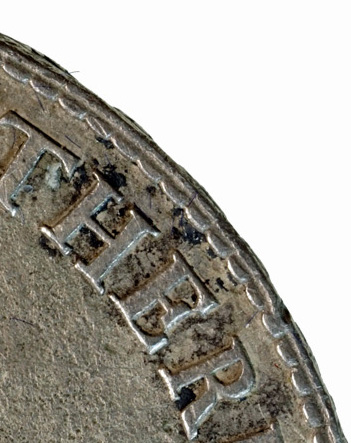 What I am questioning is the claimed edge seam on a counterfeit reales pictured in the book. If you look at the picture above check the rim saw tooth pattern. You will see a circumferential line dividing the "teeth" In the book its claimed to be the point that Silver wire has been attached to the counterfeit to hide the copper core. Problem is my picture is of a genuine coin struck in 1777. I had been told the line was an artifact of the striking process. I have been doing some more digging by going through my old antique silver references. Old Sheffield plate was a premium product only the rich could afford table ware made with it. In some cases Old Sheffield plate sold new was more expensive than sterling silver, the reason being was that the proper sterling silver required less man hours to produce goods from it. I am starting to find it hard understanding the economics of using old Sheffield plate for counterfeits. Certainly in the 1790s and early 19th century when silver prices had dropped Old Sheffield plate counterfeits would most likely cost more than just producing the coins from the correct alloy. That said Old Sheffield plate would produce extremely high quality counterfeits. I could imagine for a specific deal/Con prior to the 1790s that with large scale production the economics might be good. |
|
Pillar of the Community
United States
1761 Posts |
Bob - is the expert here but in my examples within my collection of Sheffield Plate CC8Rs this seam appears only on a small percentage of Sheffield Plated coins and is just another indicator that the piece is a contemporary counterfeit. Its not universal ... we suspect these high quality Sheffields were made at The Royal Mint but there is "no direct proof." So we call them Birmingham pieces ... as I mention in my introduction these are the best contemporary counterfeits produced I have ever handled in any time era and country even with these modern off-base Chinese CC pieces. Obviously when we see this seam we thing of the coin's weight and XRF analysis of any area showing the underlying debased core. Its just a signal WITHIN this CC8R series. Bob ... will add more soon ... he is BUSY on other matters. Does this seam enter into other series ... not sure ... I have not seen it ... YET. Interesting piece. Just a thought ... John Lorenzo Numismatist United States |
|
Pillar of the Community
2087 Posts |
Thanks for the comments. I started this query because I am looking at buying a very nice counterfeit eight reales at the moment( not e bay) I was checking the book and then saw the picture. The coin I am looking at is late 18th century and from the photos appears to be brass. From my understanding of Old Sheffield plate brass doesn't work. Also the plating has worn of in ways that doesn't match my experience with Old Sheffield plate( has a very distinct patina), however my experience with OSP is with antique tableware. Most silver specialists will tell people off for replating OSP in much the same way we tell people off for using brass cleaner on coins.
BTW the counterfeit on the bottom of page 251 of the book is most likely of North African ( Egypt or Sudan) Manufacture very similar to an MTT counterfeit I have. which dates to early 19th century, for me the key is the S instead of an 8( it could also be Ethiopian but I would put my bet on Sudan). It is also similar in style to the Counterfeit Venetian ducats from that area and time period
.
Edited by austrokiwi
11/17/2015 12:05 pm
|
|
Pillar of the Community
United States
1761 Posts |
Just a FYI - indeed after XRF analyzing many so-called Birmingham Sheffield's (i.e., probably Royal Mint as previously suggested but no written proof and since we are dealing with contemporary counterfeits of the period - of course it just remains a high probability - in our minds anyway). Most core areas are of course COPPER - easily over 95% of the time. However some issues did show elevated zinc levels above 1% so some displayed a low Zn brass core and some even had Zn >10% - but very few. These could be for various reasons and you could argue these are inferior Sheffield's. Silver as with Sheffield cookware or antiquities binds with copper very well and as you already know and is the metal of choice for the core. Literature is FULL of such historical verification's. But what of brass and low zinc brass cored Sheffield's. With contemporary counterfeits is anything ever homogeneous or EXACT with these counterfeiters from all walks of life and regions? ... NEVER. John Lorenzo Numismatist United States |
|
Pillar of the Community
2087 Posts |
I Think it is incredibly unlikely The Royal Mint would produce counterfeits, the legal situation and punishments for such an action just makes it seem a ridiculous idea. Just the reputational damage to The Royal Mint, and His majesty's coin would rule against The Royal Mint as a producer. It would have been financial suicide for the nation for The Royal Mint to be found counterfeiting coin. Even if gvt approval for such an action was taken the work would have been done by some other producer so as to keep The Royal Mint "clean" Much more likely would be one( or a number) of the numerous die sinking firms in Birmingham who supported the Soho mint and the later Birmingham mint. I am reasonably confident of the improbability of the London mint producing fakes as I am with the Soho, and Birmingham mints. For all three their success was dependent on their reputation. I researched literature statements about the Birmingham mint producing counterfeit 8 reales and found in the original documents that were cited the term was "firms in Birmingham", subsequent authors just assumed it was the Birmingham mint |
|
Pillar of the Community
United States
1761 Posts |
It's a good argument which is why unless there was written confirmation ... the authors could never go there ... my new book has a whole chapter on Foreign Counterfeits ... if you contact me privately perhaps you may wish to review it for errors and further recommendations. I plan to release the book at the end of 2016. Just supply me your E-Mail privately. I have a feeling your quite DEEP in your knowledge on Foreign CCs ...
It's the WORKMANSHIP of these so-called silver plated Birmingham issues that EXCEED all others I have seen by a SIGNIFICANT margin ... it may have been BACKDOOR but they sure had top-end skill and equipment.
JPL
Edited by colonialjohn
11/19/2015 6:41 pm
|
|
Pillar of the Community
United Kingdom
2490 Posts |
Ian, your doubts as to The Royal Mint's culpability are understandable, but this was in the line of economic warfare. Pretty much on the lines of Operation Bernhard. |
|
Pillar of the Community
Canada
5342 Posts |
Just the terrible email explanation to me would have justified some kind of vouchers or something, just my opinion for customer service at least.
|
|
Pillar of the Community
2087 Posts |
My doubts( I was being polite) are based on numerous visits to the national Archives in the UK, the national library and to the mints historical services in wales. I will be heaps more blunt now the idea is improbable in all realistic scenarios. You are confusing money types( bullion and Managed money) and cultural ( time based) attitudes with your reference to Bernhardt . Bernhardt was a means to destabilize the UK using forged notes. it occurred at a time when each country had identifiably different money. At the much earlier time and very different era when these OSP counterfeit were made the Spanish dollar was in use in the UK; a time when no country would counterfeit a coin they used. Your comment suggests to me you don't have a feel for the different historical contexts.( I suggest you, at the barest minimum, read the first chapter of Kelly's "Spanish Dollars and Silver Tokens I think then you might understand how out of sync your economic warfare comment is) If the British gvt decided to issue counterfeit coin, they would have isolated the Bank of England and the mint from any possible fallout. In such a scenario the production would have been conducted by some other manufacturer. I still find such a scenario hard to imagine but it is a lot more realistic than suspecting The Royal Mint of being the source of the counterfeits. Producing OSP in the quantities required required unique tooling and skills, The Royal Mint did not have the equipment to produce it and to buy in the OSP sheets would have left a trail of evidence that would have been impossible to hide. Edited by austrokiwi
11/20/2015 12:37 am
|
|
Pillar of the Community
United States
1761 Posts |
Ian ... on a separate idea ... in your opinion who INITIALLY struck the St. Patrick's Coppers? Just your thoughts ... if any.
JPL
|
|
Pillar of the Community
2087 Posts |
The St Patrick coppers ( I have no idea who produced them and they are outside of my field of interest) were produced in the 17th century and are generally regarded( as most likely being produced in Dublin 1674-1675. But for the sake of your argument (at least the one you seem to be leading up to) lets assume they were produced at the London mint. In that case it does not do anything to support the suspicions that OSP 8 reale counterfeits were produced at The Royal Mint. But lets just make this clear the attitude The Royal Mint had, in the 17th and 18th centuries, to copper coin does make it hard to imagine that the London mint produced the St Patricks coppers, it is my understanding that why they are thought to have been produced in Dublin Quote:
We are looking at a specific context in time and culture In the 18th century and later it is improbable that The Royal Mint produced such counterfeits. the Historical, and economic factors tend (strongly) to suggest against it. If you look at the likely time period of the OSP counterfeiting( Old Sheffield plate produced from 1740- cica 1840/50) we know the UK was suffering a shortage of small change to the point Birmingham mint manufacturers were producing tradesman's tokens to fill the gap. Using Occam's razor it is far more likely manufacturers of those tokens produced the counterfeits That is certainly the case in the 1880s when counterfeit Dollars ( spanish type) were produced in Birmingham for use in Lagos Nigeria: Colonial Office file number: CO/147/41, Griffiths to Ussher, April 29 1880. IN this time frame a number of Birmingham die sinkers were producing tradesman Tokens for New Zealand and Australia. FYI: I found that file hunting for information on the Maria Theresa thaler, it had been claimed in another reference that the file stated it was Maria Theresa thalers but when I accessed the original Document, to my disappointment: it stated clearly "Spanish dollars") EDIT: I have done some checking apart from some French plate makers who made an interesting mix of Gold and silver plate one of the key identifiers of Old Sheffield plate is a copper core. Edited by austrokiwi
11/20/2015 2:04 pm
|
|
Pillar of the Community
United States
1761 Posts |
My take on the St. Patrick's to you was just that you indicate you personally did go through many U.K. records - so just wanted your idea of these spurious issue - if any. TO me it could have even been the Vatican either supplying funds or the motivation for these pieces in the Irish Rebellion. Its complex to say the least ... there are hundreds of farthing varieties all in the R7+-R9 range - which alone begs the question - why? What happen here? Like Protestant Communion Tokens. Many varieties are rare - in general. Actually in my new book I show France was more prone to use brass as the core in their silver plated (Sheffield) items in the late 17thC/early 18thC (early) - from memory as this chapter was completed a year ago. With time they realized that their U.K. counterparts hit on the best core material - copper - BUT - they continued with the cored BRASS. I even include a paper or two substantiating this fact. Using brass or copper is no real issue until the piece becomes around 100+ years old - then we see problems which is probably why French Sheffield pieces remained with a brass core as with its contemporary counterfeit coins of this PERIOD. This is why again (from memory) that silver plated (Sheffield) French antiquities (coins - antiquities) which are "heavily" silvered are v.rare. Noted in my book from several antiquity French Sheffield references. As an example show me a French Ecu CC which is heavily silvered (i.e.,over 80%) on E-Bay over the next six months. To be clear I like your idea - perhaps The Royal Mint MAY HAVE commissioned these pieces OUTSIDE for economic warfare ... remember an entire book on contemporary counterfeits of the period will cite debates among the numismatic community ... this is GOOD. We keep moving forward in a positive manner. JPL Edited by colonialjohn
11/20/2015 5:11 pm
|
|
Pillar of the Community
2087 Posts |
My huge question is what economic Warfare? and a lesser question how was it targeted?
In my understanding of the Historical, social, and economic landscape of the time, the actual concept of deliberately planned Economic warfare seems out of place.
I j now have another question. Are you sure the french used OSP, because they used another method which the English called French plating ( which would work on brass). Have a look at the counterfeit on the top of page 344. the de-lamination of the plate is what one might see from eroding French plate ( silver leaf laid over the surface of the base metal and then "fused" (not quite the right word) by hand rubbing and the addition of heat). OSP sheets when rolled out often had bubbles.. if they could, manufacturers would just avoid using that part of the sheet, If they couldn't they would burst the bubble sand back the blister to good metal and then fill the depression using French plating. on some OSP table ware you can spot such repaired areas by a subtle color change.
{ Not to be confused with the Square,rectangular or round areas of color change which indicate a point of thickened plating to allow for engraving of family crests and monograms}
So it could be that coin was made from a repaired sheet of OSP( noting the copper core) Or it could have been produced from French plate produced perhaps in France.
Edited by austrokiwi
11/22/2015 02:51 am
|
|
Pillar of the Community
United States
1761 Posts |
Yes - French Plating - like Sheffield plating but using brass as the core alloy instead of copper alloy core. Unquestionably. This is the correct term.
HOWEVER - not sure at the moment if French Plating was AS COMPLEX in its manufacturing application method as the English plating process. It appears so other than its use of a different core alloy (i.e., brass vs. copper alloy).
One thing is for certain - its not even close in terms of both the French CC coins and French antiquities that silver loss is MUCH GREATER on these pieces than English Sheffield pieces which used a copper alloy - predominately. XRF verified in dozens of examples in my new book due out in late 2016.
Look at it this way for now - the Mexican marketplace is still so NAIVE on contemporary counterfeits that even the top dealers consider them just a nuisance to OWN ... as was the case with English and Irish halfpence CCs in the American Colonial early market when Newman wrote his 1975 BUNGTOWN paper ... to be clear ... all Mexican dealers TODAY ... are still in the DARK ages when it comes to selling/understanding/APPRECIATING CCs. So Ian - guys like you and me will keep banging this around until we can come up with more ANSWERS. When Newman, Anton and Vlack started on these English/Irish CC's they thought the more crude a piece the more likely it was made in the American colonies. Today we know they were 99% IMPORTED from England after a quarter century of MORE research.
Mex CCs are still in the DARK AGES as was American CCs like Machins Mills in 1975. They (mex CC's) are probably a FULL quarter century BEHIND American CC research writings of the British/Irish 1/2d and 1/4ds.
In the interim Ian we will both have our reservations/questions and frustrations of bring bringing the Mexican Numismatic Association - UP TO SPEED.
LOL
JPL
Edited by colonialjohn
11/22/2015 1:39 pm
|
| |
Replies: 34 / Views: 5,553 |










 Posted 11/17/2015 08:50 am


