Coin Community Family of Web Sites Join Thousands of Coin, Bullion, & Money Collectors
Specializing in Modern Numismatics Coin, Banknote and Medal Collectors's Online Mall Royal Estate Auctions - $1 Coin AuctionsVancouvers #1 Coin and Paper Money Dealer Join Thousands of Coin, Bullion, & Money Collectors Royal Canadian Mint products, Canadian, Polish, American, and world coins and banknotes. 300,000 items to help build your collection!


Username:
Password:
Save Password
Forgot your Password?


This page may contain links that result in small commissions to keep this free site up and running.

Welcome Guest! Registering and/or logging in will remove the anchor (bottom) ads. It's Free!

Edge Ribbon Seam. A Doubt

To participate in the forum you must log in or register.
Author Previous TopicReplies: 34 / Views: 5,409Next Topic
Page: of 3
Pillar of the Community
austrokiwi's Avatar
2087 Posts
 Posted 11/23/2015  12:50 am  Show Profile   Bookmark this reply Add austrokiwi to your friends list Get a Link to this Reply
Contemporary counterfiets are, IMHO, extremely important numismatically they can tell us a heap about the genuine articles. I know PCGS and NGC have great problems with the idea of encapsulting such items and it will be collectors in the long run who ultimately vote for or against such things but to recount one story in my field:

Some years ago I was really intrigued to obtain a crude sand cast CC of a 1780 Maria Theresa Thaler. from its style it was definitely of middle eastern/North African manufacture. Two different varieties of MTT had been used to create the mold. The Obverse was of a type that was cataloged as being produced in the 1780s-to mid 1790s, while the reverse was of a type attributed, wrongly, to post 1815 Milan or Venice. knowing how the coin circulated the CC didn't make sense. It stuck out in the "landscape" like a 1930s race car in a photo of the winner of the 2014 Indianapolis 500.

That counterfeit just told me something was wrong..... Counterfeiters even as educationally ignorant as a middle eastern black smith/silver smith would instinctively know the important features of a coin that would need to be on the CC. So the find had to be produced at a time that both MTT types co-circulated, yet the still current, but incorrect, cataloging combined with the known life cycle of Circulating MTT made that improbable.

In 2014 I found the answer in the Austrian State Archives..... the MTT type currently accepted as from Venice and MIlan was actually from Guenzburg and dated to the 1790s. This gave a circulation overlap of the two types namely 1793 - 1802. That shift in time and minting place saw that CC fit very comfortably in the "new Landscape"
Edited by austrokiwi
11/23/2015 01:10 am
Pillar of the Community
colonialjohn's Avatar
United States
1757 Posts
 Posted 11/23/2015  5:54 pm  Show Profile   Bookmark this reply Add colonialjohn to your friends list Get a Link to this Reply
Absolutely - it will take decades with these top Mexican collectors and dealers to change their mindset CCs are worth buying and studying. I will admit and this I hate these Chinese imports ... they do POISON this area and keep a lot of people away from buying CCs as we call the so-called GNL Class 1's for these Spanish American denomination of 8R's - even the British counter-marked 8R CC types - IMO the most DESIRABLE.

We keep moving forward ...

JPL
Pillar of the Community
swamperbob's Avatar
United States
5362 Posts
 Posted 11/24/2015  03:05 am  Show Profile   Bookmark this reply Add swamperbob to your friends list Get a Link to this Reply
Sorry to be jumping in late to this discussion but both Austrokiwi and Colonel John have made a few factual errors in their presentations which dispute a core premise of my book and I feel the statements must be corrected. There has also been some other discussion in the subsequent comments where Austrokiwi and I are in complete agreement. I will try to be as tactful as possible with the replies. My wife likes to say I am as tactful as a bull in a china shop.

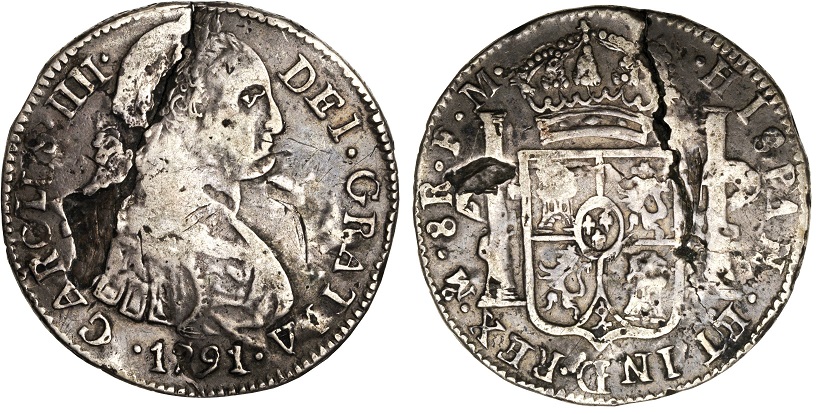
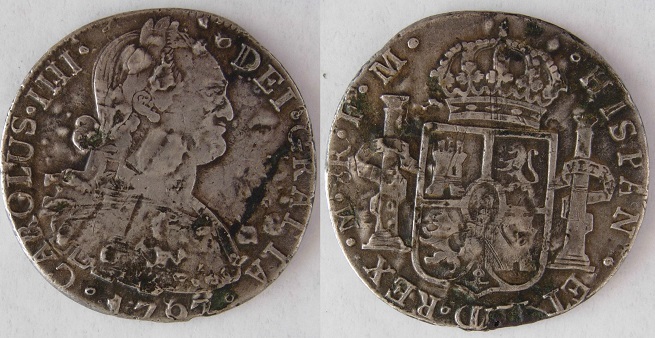
To start with, the coin in question is a 1791 counterfeit, which I believe was made ca 1796, which has been studied by three different professional testing laboratories and it is a 90% silver plate over essentially pure copper core. This of course rules out electroplate since electro-deposition of silver results in a 999 fine silver surface. Electroplate can be distinguished from Sheffield plate using a hand held XRF device. The Sheffield plate surface having a variable silver content can be easily distinguished by a device accurate to 1%.

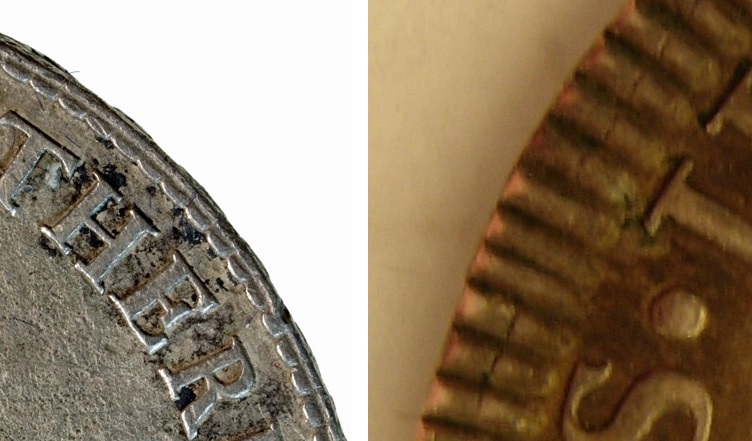
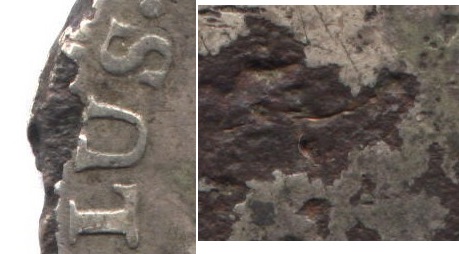
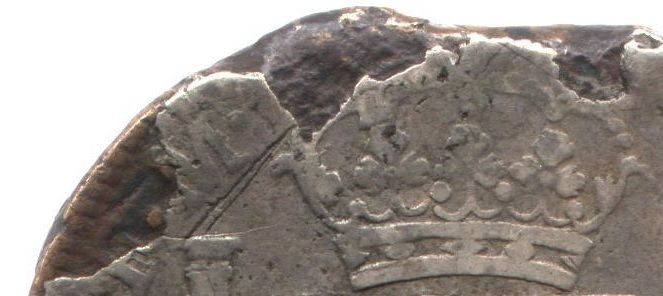
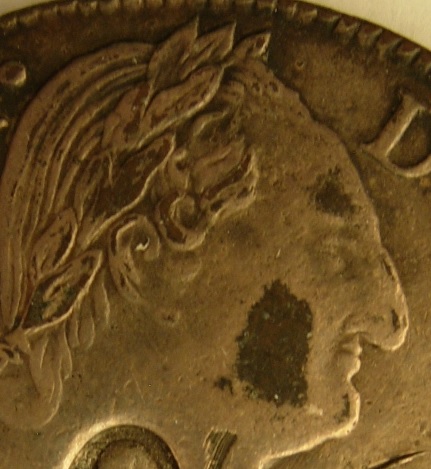
The fact that this is a very early Sheffield Plate coin is in my opinion a key point and well established by facts. In the picture below, I illustrate the top of the right column. This is the largest break in the silver plate on the entire coin about 3mm x 0.5mm. Point XRF tests (lab level analysis not hand held) were made of this precise spot to determine that the core was essentially pure copper.
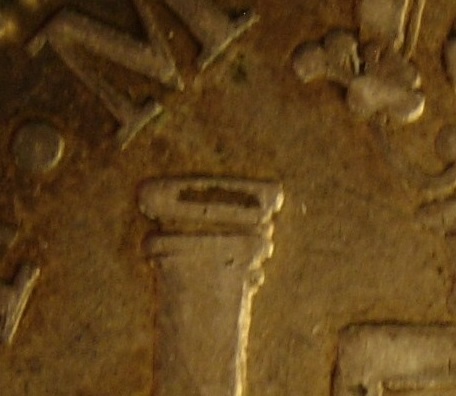
Edge-Ribbon-Seam.--A-Doubt

Most Sheffield Plate that survives today is not this early form of Sheffield Plate. The earliest forms were silver alloyed with copper over nearly pure copper. This was the only combination of metals known to work at the outset and for about 50 years subsequent to the discovery of the process. Silver alloy (sterling) on copper was the first combination discovered accidentally by Thomas Boulsover in 1743. In 1765 it was discovered that both sides of a copper ingot could be covered with silver. By 1788 silver wire was being soldered to raw edges to cover the copper. The silver ribbon method of edging using pressure to cold roll a thin silver ribbon to the raw edge was discovered by Boulton. Dates for the introduction of this process between 1785 and 1795 are reported but Boulton was noted for secrecy and for retaining methods using patents. I tend to believe the latter date to be closer to the time when counterfeiters started using it. By 1820 other core alloys were being bonded with silver (mostly white metals to minimize the contrast in color) but the earliest form of Sheffield Plate was always over COPPER.

Austrokiwi says:


Quote:
I have serious doubts that what is that picture is actually an edge seam. I know from handling Old-Sheffield plate table ware years again the seams were much finer on Table where than that picture shows.


The use of a silver ribbon to cover the raw edge of Sheffield Plate was, as noted above, first invented by Mathew Boulton in Birmingham, England between 1785 and 1795. At the time, the process was a novel and FAST method that replaced soldering the exposed copper edge. The fact that a coin needed an edge design was perfect for this kind of application. The colonial edge design was used to roll the silver ribbon onto the edge. This created a cold welded seam. When the coin was subsequently struck with the face dies in a screw press -the ribbon that had been rolled over onto the faces was struck into the dentils.

The coin in question was made in rather close proximity to the date of discovery of the ribbon method. The counterfeiting effort at Birmingham began in 1796 which is within 11 years of the first invention of the method and closer in time to the use of the method by counterfeiters.

I want to correct any misunderstanding that I believe the Soho mint, Royal Mint or Mathew Boulton himself were directly involved in the forgery effort. I do not hold that position and do not make any claim of that nature in my book. I have read two biographies of Boulton and the story of the Soho mint and he seems to have been a vocal opponent of the counterfeiters operating in the Birmingham area.

The fact that the seam is so clearly visible is in my opinion proof that it was very early. Most Sheffield Plate examples in the book show no such seam at all. As time progressed, the techniques used to cover the raw edge did result in less visible much smaller seams. That is totally correct and matches general experience with how technological innovation improves over time.

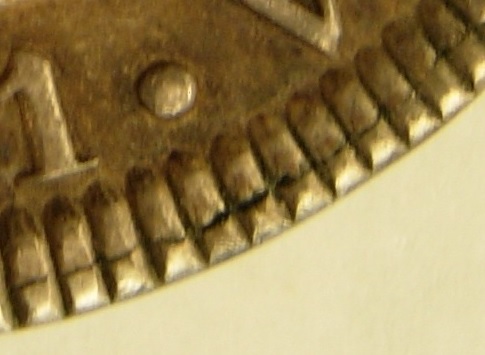
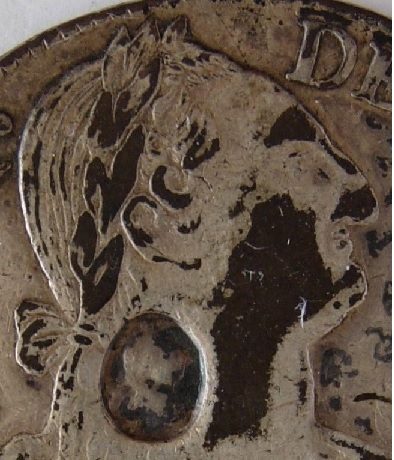
I would postulate that you need to examine the seam in person under magnification to see there is a clear gap at some places and a clear overlay of metal layers. In a couple places small chips have broken away from the outer layer exposing the under layer of silver.
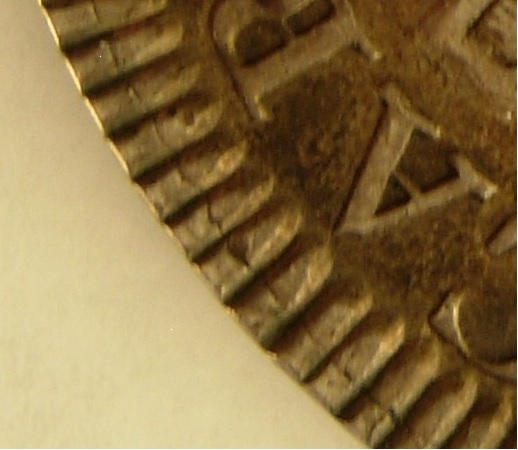
Edge-Ribbon-Seam.--A-Doubt

This picture shows one of the small chips of the silver ribbon that dislodged when the coin was hit in the dentils. Note the small impact crater next to the dentil with the missing silver chip. This is, for me at least, proof of an overlap in metal. It is a cold welded seam pure and simple.

Austrokiwi also said:


Quote:
Specifically I wanted to check how the edge of an Old-Sheffield plate(the correct term in the UK, Aussi and New Zealand used to differentiate it from Later electroplate which was also called "Sheffield" no matter where it was made) coin was covered. On page 66 is a picture of what a Silver edge ribbon seam looks like. The picture showed something very familiar to me with genuine thalers struck by the Austrian Habsburgs. I had always been told it was an artifact of a spindle press,


There are a couple elements in this quote which I wish to correct. The first is the definition of Sheffield Plate.

Textbook "Sheffield Plate" which is how I am using the term in the book, refers to a material that employs the process of hot or cold welding of three metallic layers into a metal sandwich that can be rolled, bent and formed as a unit and which behaves as if it was a solid alloy. It was a product that was an inexpensive alternative to solid silver for flatware and other manufactured articles in the 1780's. Forgers adopted Sheffield Plate because it was a small fraction of the cost of real silver. Counterfeits made with Sheffield Plate were the correct color and the weight was easily adjusted by adding thickness.

There is really no "old Sheffield" versus an electroplate Sheffield unless you are referring to the present state of the antique business. The use of the name Sheffield with reference to electroplate was originally a deceptive marketing term. It was employed to defraud buyers of cheap flatware and it is of course a technical misnomer.

The second contention above is that the seam on my coin looks like a feature that appears on "spindle press" coins of the Hapsburgs. I presume the reference is to what I would call a roller press. A roller press uses dies cut into a pair of circular rollers (like a wringer washer). A metal strip is fed between the rollers applying the design and the coin is cut out of the strip later with a cookie cutter like press.

Austrokiwi did post a picture of his "seam" but I do not believe it resembles the seam shown on page 66 at all.

His "seam" looks less like a cold welded seam and more like a roll in a single alloy. It may also (just thinking out loud) be a feature transferred by the press used to cut the coin from the strip.

Austrokiwi comments in his second post:


Quote:
The coin I am looking at is late 18th century and from the photos appears to be brass. From my understanding of Old Sheffield plate brass doesn't work.


The point here is that brass did not work as a core for Sheffield plate and that is absolutely correct. Brass does not expand at the same rate as a silver alloy resulting in a bond that can be broken by striking or forming. Typically silvered brass counterfeits date to the last half of the 19th century. Tinned brass on the other hand dates much earlier and could be contemporary. Again a hand held XRF can make this determination. Lab level XRF is not required to do this.

Regarding where "Birmingham" coins were made I am in complete agreement that unknown firms in the Birmingham area seem to have been responsible. I tried to state it like that in the book. The contention that the "government" looked the other way was first made by the Spanish and French in the earliest reports about the counterfeiting in 1796 - 1797. I do believe that The Royal Mint stayed out of the spotlight but the fact that the coins were brought to China and the orient by the British East India Company seems to implicate some upper level knowledge of the undertaking. The fact it was a war effort against Spain seems generally plausible at least to me.

The BEI had added reasons for importing fake dollars as well. They wanted to get an advantage over the Spanish traders in the orient since only the Charles III and IIII 8 reales were completely acceptable to the Chinese. The objective was to make the Chinese believe the Spanish dollar could not be trusted. This was of course a total failure - but it did seem to give us "chop marks".

I do not think that forging coin was off limits as a war effort even when the same type coins circulated at home - as long as the coins were not themselves British. The fact that many of these fakes re-emerged in the emergency of 1797-1804 with BofE counterstamps proves that the technical capabilities of Birmingham and independent London forgers of the period were up to handling the job.

Austrokiwi also says:


Quote:
My huge question is what economic Warfare? and a lesser question how was it targeted?

In my understanding of the Historical, social, and economic landscape of the time, the actual concept of deliberately planned Economic warfare seems out of place.


We in the US know that Britain engaged in massive counterfeiting of US Continental dollars (paper) in an effort to destabilize the US government's ability to maintain finance during the period of the 1780s. Their efforts were very successful in causing massive deflation in the value of the currency. So it was used as an economic tool of warfare roughly 10 years earlier - absolute fact.

Coloneljohn says:


Quote:
we suspect these high quality Sheffields were made at The Royal Mint


The "we" does not include myself. The Royal Mint before the time that Boulton got involved in modernizing it was not capable of making counterfeits of the quality of the Birmingham factories. The best die sinkers in the UK were located in Birmingham. The best of the identified period forgers seems to be Booth whose Counterfeit 1804 Bank of England Dollars are on a par with Boulton's strikes.

Pillar of the Community
swamperbob's Avatar
United States
5362 Posts
 Posted 11/24/2015  03:35 am  Show Profile   Bookmark this reply Add swamperbob to your friends list Get a Link to this Reply
One last comment. Austrokiwi states that:


Quote:
Old Sheffield plate was a premium product only the rich could afford table ware made with it. In some cases Old Sheffield plate sold new was more expensive than sterling silver, the reason being was that the proper sterling silver required less man hours to produce goods from it. I am starting to find it hard understanding the economics of using old Sheffield plate for counterfeits. Certainly in the 1790s and early 19th century when silver prices had dropped Old Sheffield plate counterfeits would most likely cost more than just producing the coins from the correct alloy.


That is a statement I have never seen before. So I checked on-line to see if I could confirm it.

I found on

http://www.rauantiques.com/library/...ver-509.html


Quote:
Two hundred and fifty years ago, Sheffield Plate offered consumers a more affordable alternative to sterling silver. Today, these early works of silver plate often command as high or sometimes higher prices than their sterling counterparts.


This sounds correct - Sheffield Plate (genuine early SP) can be as expensive today as Sterling but when it was made it was an "affordable alternative".

I located on Google books a copy of a 1912 edition of Old Sheffield Plate and there is no mention of early examples being more expensive, in fact on the contrary many statements are made regarding massive demand for the less expensive substitute.
Pillar of the Community
austrokiwi's Avatar
2087 Posts
 Posted 11/26/2015  08:34 am  Show Profile   Bookmark this reply Add austrokiwi to your friends list Get a Link to this Reply
Well an interesting read of swamper bobs response.

Some aspects I agree with, others just don't sit well.

First of all:
For much of the 20th century in the antique silver trade Old Sheffield plate is the proper term to distinguish Fused/forge-welded copper cored silver plate from the later electro-plate( also produced in Sheffield).

I remember the lectures from Antique silver specialists when I was fool enough to refer to fused plate as just Sheffield plate. I note I did not see one authoritative reference in teh bibliography about OSP( did I miss it). We all know you can find anything to support any argument on the internet.... For those interested do a search on Old Sheffield plate and see what comes up. I think you will see the term Old Sheffield plate is a much less confusing term

So I repeat in 20th and 21st century speak "Sheffield plate" means electro-plate.

On cost of OSP ware. It was in the later parts of the 18th century ( when the Silver price had dropped that OSP cost more than proper silver this was due to the manufacturing costs good OSP included solid silver moldings and hand applied decoration. Of course in the 1740s it was cheaper. However my initial argument was still wrong as the OSP for coins would not have required the such intensive craftsmanship.


Now on economic warfare. My understanding:
In an economy that bases its money on gold and silver counterfeiting bank notes or securities is a very effective weapon. The reason being is the "paper money" is based on the trust that it can be redeemed for real coin. In times of war Gvts often resorted to issuing paper. By producing counterfeit paper the enemy can create such distrust that the general population insists on real coin which invariably is in short supply. this drives up inflation and makes the purchasing of supplies and paying soldiers a major headache.

So: I can't dispute that counterfeiting bank notes has been used effectively in Warfare. But how in the world can counterfeiting Silver coin be equally effective? Please give me a proved example from the 17th-20th centuries where counterfeiting silver coin has been effectively and deliberately used in such a manner. Obviously I am not aware of any such occurrence, so it would be intriguing to learn of such an example. I would have to reassess everything I understand about economic warfare( pre 20th century)
At the moment arguing that counterfeiting paper is the same as counterfeiting coin just seems silly. Most governments and traders always checked coin by weighing it( something that doesn't apply to bank notes). Those traders who didn't probably didn't remain traders for long. In the simplest analysis it is just far too simple to identify counterfeit silver for it to be effective in economic war fare. Counterfiet silver coin would be a nuisance rather than devastating

To illustrate my point. During the period 1656-1669 the Ottoman Levant was flooded by Luigino( 5 sols) from about 1664 merchants had increasingly debased versions made. European powers ignored the situation until the coins ( exported in the 100s of thousands if not millions) returned to Europe. the producing mints and states were roundly criticized, tto the point for a number of decades the coins of Monaco( as one example) were distrusted. To cope with the criticism the producing mints marked the coins so that European consumers were not confused.
My argument is this Silver coin effectively counterfeited by a gvt would hurt that gvt as much as it would hurt the target. As stated already it would be much easier to spot than counterfeit bank notes. Bank notes bills of exchange, and other paper securities have always been much more effective tools in economic warfare than counterfeit coin

Here is one of those Marked "Luigino". The Fosdinovo mint, to ensure literate Europeans did not mistake it for good silver coin, added the motto "PER TOTAM ASIAM CVRRENS" ( Current in all of Asia) to the coin. Asia at that time in in this context referred to the middle east

Edge-Ribbon-Seam.--A-Doubt

As you can see from my repitition I do have great difficulty seeing how counterfeiting Spanish silver coin would have assisted the British with their only conflict with spain at the time, we seem to be discussing, the Anglo - Spanish war. As far as I understand it the most effective economic warfare tool used was blockade. Yes private companies probably counterfeited coin but for profit not battle.


Now on the original issue Spindle press = screw press I was not referring to a roller press (Used as late as the end of the 17th century machine). The scew press was typically used in Habsburg mints in the 18th century . I have other examples in my collection. What you say is a possibility but XRF only measures the surface. How many such coins did you test with XRF to prove the hypothesis? I will be convinced when you can show my a cross section of that Edge ribbon seam. The photo in the book seems to show very definite signs that the "seam" was struck and is not necessarily indicative of silver wire being attached to the counterfeits edge. I posted the only picture I have on file but in my safety deposit box I have at least three other genuine coins with exactly the same sort of "seam"(at least one much closer in form to the counterfeit in the book)
Edited by austrokiwi
11/26/2015 10:39 am
Pillar of the Community
colonialjohn's Avatar
United States
1757 Posts
 Posted 11/26/2015  8:53 pm  Show Profile   Bookmark this reply Add colonialjohn to your friends list Get a Link to this Reply
I still need to confirm/view in hand/educate myself on these later electroplated silver counterfeits as suspected in the Cap and Rays. There is really nothing in the assay (it seems) that can differentiate it from the earlier forms of Sheffield - so it may have to be done using a SEM on simply in its microstructure. Cyanide from this process seems to escape detection from Material Analysis.

Ian - read this book - A Manual of Electro-Metallurgy (The Application of the Art to Manufacturing Processes.) By John Napier. 1867.

Sheffield and electroplating of Ag are two distinct processes. You are correct - by the middle of 19th C it seems electroplating was REPLACING the old Sheffield plate process due to its versatility and the ability to plate different surfaces and moving away from a need of a copper core. There are more advantages ... revealed in this book.

JPL
Edited by colonialjohn
11/26/2015 8:57 pm
Pillar of the Community
swamperbob's Avatar
United States
5362 Posts
 Posted 11/27/2015  03:38 am  Show Profile   Bookmark this reply Add swamperbob to your friends list Get a Link to this Reply
In reading the two previous comments to my earlier reply I wonder if I am saying things clearly because my points are being ignored.

First of all to John Lorenzo - you say
Quote:
There is really nothing in the assay (it seems) that can differentiate it from the earlier forms of Sheffield


John all silver electro-plate surfaces involve easy to identify pure elemental silver. Only pure silver can be deposited in this way. The Sheffield Plates are NEVER pure silver - they are silver alloys. All that is needed to separate electro-plate from Sheffield Plate is a hand held XRF accurate to 1%.

Regarding the comments of Austrokiwi I will answer differently. I will add my comments to a copy of his reply. My comments will be underlined.

********************************


Quote:
Well an interesting read of swamper bobs response.

Some aspects I agree with, others just don't sit well.

First of all:
For much of the 20th century in the antique silver trade Old Sheffield plate is the proper term to distinguish Fused/forge-welded copper cored silver plate from the later electro-plate( also produced in Sheffield).

I remember the lectures from Antique silver specialists when I was fool enough to refer to fused plate as just Sheffield plate. I note I did not see one authoritative reference in teh bibliography about OSP( did I miss it). We all know you can find anything to support any argument on the internet.... For those interested do a search on Old Sheffield plate and see what comes up. I think you will see the term Old Sheffield plate is a much less confusing term

So I repeat in 20th and 21st century speak "Sheffield plate" means electro-plate.


First of all, I resent being referred to as a "fool" even in this indirect reference, especially when I am being asked to refer to an electroplated counterfeit as "Sheffield Plate" just because some "Antique Silver Specialists" choose to use a completely INCORRECT TERM in conducting their affairs. I utterly reject the final premise that "Sheffield Plate means electro-plate," in the context of Counterfeit coins. The statement that equates Sheffield Plate with electro-plate is incorrect from a scientific and historic perspective - period. It is like calling the white metal numismatic forgeries made in China - Chinese silver or Tibetan silver. Both terms are well known and have been used by many people selling these cheap fakes for a long period of time but by any name they are still base metal and they contain no elemental silver at all. Electro-plated counterfeits are made by electro-deposition of pure silver over a base metal core which can include brass. Sheffield Plate is a totally different process which involves hot or cold welding (fusing or bonding) of an alloy of silver to a core of base metal which does NOT include brass. Electro-plating is done AFTER the object is fabricated. Sheffield Plate is a metal sandwich created before any fabrication that can be rolled and formed using standardized silver working techniques. Sheffield Plate and electro-plate are simply not interchangeable terms.
Second, I do not appreciate the backhanded slap in the face contained in the sentence that follows:


Quote:
I note I did not see one authoritative reference in the bibliography about OSP ( did I miss it).


DID I MISS IT? That is very offensive, at least in the US. My references for Sheffield Plate came from the AUTHORITATIVE biographies of Mathew Boulton. Have you read them? Are they wrong? Are the dates of my timeline wrong? I ask, because we also seem to disagree on the timeline itself. The initial discovery by Boulsover was made in 1743 - not 1740. This was a single sided method and it was used for small objects called "toys" for a period of years. Toys were items like buttons, decorative knife handles, etc.. Two sided fusing of silver to copper dates only from 1765. There was no fabrication of Sheffield Plated silverware coated on two sides before that period of time. Am I incorrect? Edging methods initially involved rolled seams where an inward bend concealed the raw edge. This was followed at a somewhat later date by soldering the raw edge. My, apparently non-authortative references, place the development of the silver ribbon edging method by Mathew Boulton between 1785 and 1795. Is that date wrong according to more authoritative sources?

Thirdly a general indictment of my work by indicating it is somehow INTRENET based and therefore worthless, even in the context of an indirect argument, makes me very angry. I have read thousands of pages of documents some on-line from google books which are photographic reprints of rare works others from printed books. Are Google Books being altered? Am I reading incorrect texts? Who determines what is "authoritative"? Is my opinion as good as yours?

Insistence that using an incorrect term is required for clarity makes little or no sense to me. I would not mind adding a footnote to the effect that "Some collecting disciplines (for instance antique silverware) incorrectly apply the term "Sheffield plate" to electro-plating done at Sheffield, England, UK." However, in doing this I would ask how one can determine where an electro-plated object was made since from what I have read - silver guilds actively objected to the marking of Sheffield Plate and that many electro-plated items indicate no place of origin whatsoever.


Quote:
On cost of OSP ware. It was in the later parts of the 18th century (when the Silver price had dropped that OSP cost more than proper silver this was due to the manufacturing costs good OSP included solid silver moldings and hand applied decoration. Of course in the 1740s it was cheaper. However my initial argument was still wrong as the OSP for coins would not have required the such intensive craftsmanship.


The drop in silver prices you refer to sounds like something out of recent history- a large scale swing of several dollars per ounce. However the drop in silver prices was actually not very great during the period cited (roughly 1740 to 1820). This drop in silver prices would barely effect the margin for forgers making their coins with Sheffield Plate. When compared to the savings in material value of the counterfeit coins, the drop of raw silver prices was a mere pittance. The average Sheffield Plate counterfeit coin made in 1796 contained 12% or less silver. The counterfeiter stood to gain 78% profit less production costs. Costs of production using London mint and Boulton's records was less than 3%. So after costs the counterfeiters could produce a profit over 70% using Sheffield Plate. The London "fix" is well known as is the ratio between silver and gold for the entire period. (See: Lawrence H. Officer and Samuel H. Williamson, "The Price of Gold, 1257-Present," MeasuringWorth, 2015.) From this reference the value of silver can be calculated by dividing the fixed price of gold by the ratio of gold to silver prices. The result of this calculation shows an increase of silver prices from 1740 to 1784 followed by a period of reduction from 1784 to 1820. However, the percentage of the decrease never exceeded 5% at any time when compared to 1740. To me that does not seem to be critical when compared to a 70% profit. The argument that silver prices were a critical issue has no validity with relation to counterfeiting operations. I have to wonder if it actually has credence for fabricated Sheffield Plate. I personally do not see how the very minimal labor costs of the 1790s could overcome the enormous savings in raw silver which Sheffield Plate offered.


Quote:
Now on economic warfare. My understanding:
In an economy that bases its money on gold and silver counterfeiting bank notes or securities is a very effective weapon. The reason being is the "paper money" is based on the trust that it can be redeemed for real coin. In times of war Gvts often resorted to issuing paper. By producing counterfeit paper the enemy can create such distrust that the general population insists on real coin which invariably is in short supply. this drives up inflation and makes the purchasing of supplies and paying soldiers a major headache.

So: I can't dispute that counterfeiting bank notes has been used effectively in Warfare. But how in the world can counterfeiting Silver coin be equally effective? Please give me a proved example from the 17th-20th centuries where counterfeiting silver coin has been effectively and deliberately used in such a manner. Obviously I am not aware of any such occurrence, so it would be intriguing to learn of such an example. I would have to reassess everything I understand about economic warfare( pre 20th century)

At the moment arguing that counterfeiting paper is the same as counterfeiting coin just seems silly. Most governments and traders always checked coin by weighing it( something that doesn't apply to bank notes). Those traders who didn't probably didn't remain traders for long. In the simplest analysis it is just far too simple to identify counterfeit silver for it to be effective in economic war fare. Counterfiet silver coin would be a nuisance rather than devastating.


Initially, in earlier posts, as I re-read your earlier comments, you seemed to be saying that economic warfare was not used in the eighteenth century by England.


Quote:
In my understanding of the Historical, social, and economic landscape of the time, the actual concept of deliberately planned Economic warfare seems out of place.


So I pointed out the case of the American Revolution in which economic warfare was practiced. Then your argument switches to say using paper money in economic warfare is very effective but using coin in the same way would not be. On top of that unsupported statement, you once again, indicate my research is "silly".


Quote:
At the moment arguing that counterfeiting paper is the same as counterfeiting coin just seems silly.


I disagree completely. Did you read Appendix 2? It contains a document written by M. Paul Bordeaux in 1903 (reprinted by Spink in 1915 in English). This document contains original reports written in 1796 and 1797 for Spanish authorities. One was prepared by a Spanish physician (spy) in England. The claim of economic warfare is raised for the first time by Bordeaux and he finds support in the earlier documents. Is this NOT authoritative documentation? How do you read the first three paragraphs of Bordeaux's report to indicate anything other than a politically charged action?

You say


Quote:
Most governments and traders always checked coin by weighing it( something that doesn't apply to bank notes).


Now I am going to say that your counter point is in fact silly. Of course no one weighs banknotes, but a thickened Sheffield Plate coin often weighed EXACTLY the correct amount. They were NOT detectable by weighing alone. That was precisely why they were successful. Acid tests did not work because the surface was the correct alloy. Touchstones did not work for the same reason. Only two methods were effective against Sheffield Plate (1) Specific Gravity testing and (2) Chopping. Bordeaux believed and I concur that Chopping coins was first developed in China in response to the influx of counterfeits from Birmingham in the 1790s. Some Sheffield Plated coins using a very thick plate went undetected even by Chinese chops according to British Numismatist Ackerman in the 1830s. So contrary to your assertion that counterfeits were easy to identify:


Quote:
In the simplest analysis it is just far too simple to identify counterfeit silver for it to be effective in economic war fare.


I would assert to the contrary that there are numerous examples that passed review for decades even centuries. The coin on the cover of my book was being sold as Genuine by a very reputable European Auction Gallery very recently. So that one Sheffield Plate coin passed muster for over 210 years. Is that easy to spot?


Quote:
To illustrate my point. During the period 1656-1669 the Ottoman Levant was flooded by Luigino( 5 sols) from about 1664 merchants had increasingly debased versions made. European powers ignored the situation until the coins ( exported in the 100s of thousands if not millions) returned to Europe. the producing mints and states were roundly criticized, tto the point for a number of decades the coins of Monaco( as one example) were distrusted. To cope with the criticism the producing mints marked the coins so that European consumers were not confused.

My argument is this Silver coin effectively counterfeited by a gvt would hurt that gvt as much as it would hurt the target. As stated already it would be much easier to spot than counterfeit bank notes. Bank notes bills of exchange, and other paper securities have always been much more effective tools in economic warfare than counterfeit coin


The illustration points out a valid criticism but only if the coins were returned to Europe. You need to read not only Bordeaux's report but Chinese economic history particularly by Guangzou. Silver coin was not returned to Europe until AFTER the introduction of Opium created a shift in the balance of payments. China retained silver and paid international debt in gold prior to that. Chinese experts in economy estimated that the vast majority of silver Spanish Dollars were actually melted into Saycee ingots and therefore could never have returned. The situation did not change until about 1850. So in 1796 economic warfare using coin seemed not only possible but highly advantageous to the English in particular the British East India Company. Remember that England actually went to War with China to force them to allow the opium trade even though it was VERY HARMFUL to the Chinese who became addicted. So what exactly makes it difficult to believe that England would not turn a blind eye towards the actions of private manufacturers and the British East India Company to give them a trading advantage over the Spanish. I see that as very likely not difficult to envision at all.


Quote:
Here is one of those Marked "Luigino". The Fosdinovo mint, to ensure literate Europeans did not mistake it for good silver coin, added the motto "PER TOTAM ASIAM CVRRENS" ( Current in all of Asia) to the coin. Asia at that time in in this context referred to the middle east


I did not replicate pictures in the post.


Quote:
As you can see from my repitition I do have great difficulty seeing how counterfeiting Spanish silver coin would have assisted the British with their only conflict with spain at the time, we seem to be discussing, the Anglo - Spanish war. As far as I understand it the most effective economic warfare tool used was blockade. Yes private companies probably counterfeited coin but for profit not battle.


What are you referring to by saying "we seem to be discussing, the Anglo - Spanish war."? Blockade would not work in the port of Canton because at the time it was a neutral port where both entities Spain and the BEI company traded with China.


Quote:
Now on the original issue Spindle press = screw press I was not referring to a roller press (Used as late as the end of the 17th century machine). The scew press was typically used in Habsburg mints in the 18th century . I have other examples in my collection.

What you say is a possibility but XRF only measures the surface. How many such coins did you test with XRF to prove the hypothesis? I will be convinced when you can show my a cross section of that Edge ribbon seam. The photo in the book seems to show very definite signs that the "seam" was struck and is not necessarily indicative of silver wire being attached to the counterfeits edge. I posted the only picture I have on file but in my safety deposit box I have at least three other genuine coins with exactly the same sort of "seam"(at least one much closer in form to the counterfeit in the book).


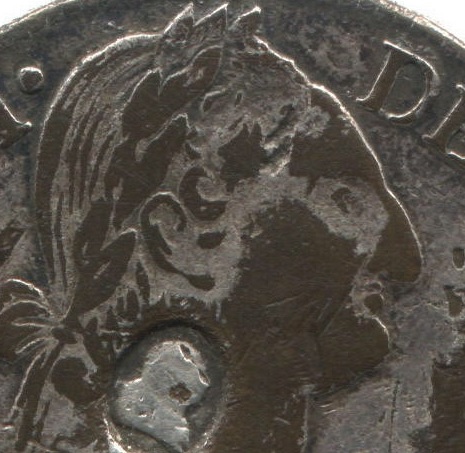
Okay so we are discussing a screw press - spindle press seems less precise to me since there are several different forms of spindle presses used for different things and spindle is rarely encountered in the literature about Spanish American Portrait 8 Reales. But that is all a side point. I would like the readers to compare your picture with a segment of mine and note the serious differences.


Edge-Ribbon-Seam.--A-Doubt

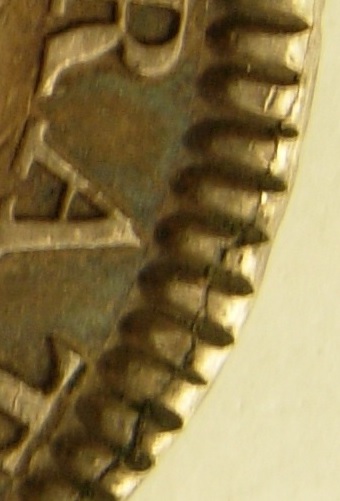
You say that my photo ".seems to show very definite signs that the "seam" was struck." I would absolutely say that only your photo does that. Yours shows a clearly struck feature something that appeared on the die itself. The Spanish American dies were different, as I would hope you would know. They had wide dentil margins that created a die face that exceeded the planchet size by several mm. This was a practical introduction that was necessary since the Spanish did not use a centering collar. Note in the preceeding picture, mine at the right, that the feature you refer to as struck is discontinuous and not concentric with the die face. The edge of the ribbon (not wire as you refer to) exhibits folds and tiny chips along its length where the seam has opened. At other places the seam is not even visible in the picture because the seam remains tightly welded shut.


Edge-Ribbon-Seam.--A-Doubt

Here is another picture a close up of the ribbon seam. The dark area is INCUSE but tests as silver over the entire length just as it should with a lap of two silver layers. I will of course not cut my coin to show a cross section any more than you would do the same to your coin to "prove" it is a die feature. I accept your ability to discern the difference between a struck in feature and a feature created as a result of striking a second layer into the face of the coin (for example a retained sprue). Why my ability to do the same is being called into question is like calling me a liar. Is that your implication? Am I lying when I say that in person under binocular magnification I see a clear overlap of silver surfaces? Are you actually so much better that from a photo alone you can see what I cannot see in person?


Edge-Ribbon-Seam.--A-Doubt

Does this even vaguely resemble your coin? In particular where does the struck in seam on your coin cross over to the edge of the coin? I think there is no comparison because we are looking at different things.


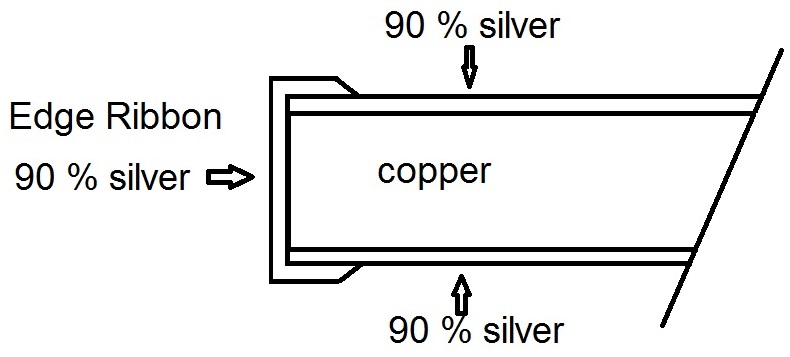
Edge-Ribbon-Seam.--A-Doubt

This picture shows a schematic of what I envision the edge ribbon must have looked like before the face dies struck the coin. The edge ribbon was attached to the edge of the coin and rolled over the corners at the time the planchet was edged with a colonial edge design. The pressure of rolling on the edge design created a cold weld along the edge of the coin. Failure of this edge seam is well known to me and when it occurs the copper is often eroded leaving a coin with a hollowed out edge.

Immediately after striking the coin, the seam did not show until the cold weld caused by the final strike started to break down.

Next you say: "What you say is a possibility but XRF only measures the surface. How many such coins did you test with XRF to prove the hypothesis?" The depth of penetration of XRF varies with the power used. Hand held devices read to a depth of 1 or 2 microns. Laboratory units test to 100 microns. That is not far but it is deep enough to at times penetrate a worn silver layer and pick up the copper beneath. We have at present tested over 200 examples with XRF at a laboratory standard. I would ask you exactly which hypothesis are you referring to? That Sheffield Plate coins exist? We have tested many coins for many different reasons. Testing is very expensive and if we had an unlimited budget we could test all 4,000 plus examples I am now aware of. That would cost roughly one half million US dollars which I do not have.

I would simply say that other worn examples of Sheffield Plate coins prove my hypothesis about the existence of such forgeries without the need for expensive XRF tests.


Edge-Ribbon-Seam.--A-Doubt


Edge-Ribbon-Seam.--A-Doubt


Edge-Ribbon-Seam.--A-Doubt


Edge-Ribbon-Seam.--A-Doubt

Finally here is one where the Sheffield Plate layer has bubbled away from the surface but has not yet broken.


Edge-Ribbon-Seam.--A-Doubt

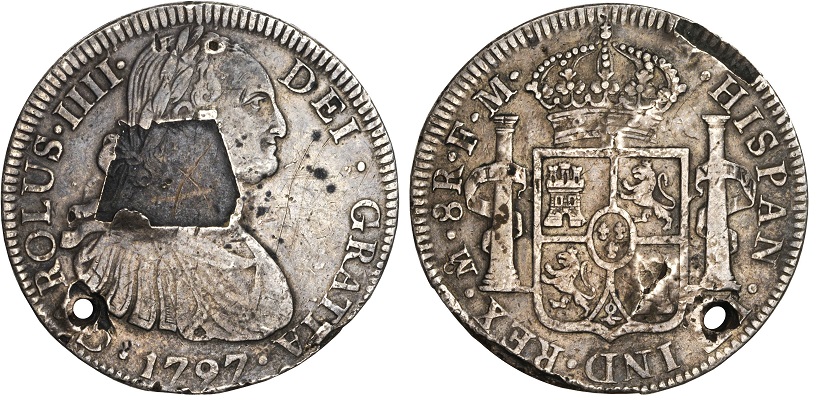
I would also submit as proof that Sheffield Plate coins exist the following pictures of one type of coin pictured in various states of wear.


Edge-Ribbon-Seam.--A-Doubt


Edge-Ribbon-Seam.--A-Doubt


Edge-Ribbon-Seam.--A-Doubt

I would think from this series of three pictures that anyone familiar with Sheffield Plate and how it wears over time would recognize the unmistakable wear patterns.

Finally I would like to point out that all of the pictures I used in my reply were available with the book, if you purchased the pair of discs. In fact I started from the files contained on Disc one to compile all of the extracts shown above. None of these represent new photographs or examples of coins located after the book was printed.
Pillar of the Community
austrokiwi's Avatar
2087 Posts
 Posted 11/27/2015  05:02 am  Show Profile   Bookmark this reply Add austrokiwi to your friends list Get a Link to this Reply
I read your first phrase so I have ignored the rest of your post. Any further response to your tirade is not going to be productive. as you are obviously over sensitive on this matter. Lets make it clear the fool was me and I was told so to my face at the time.

The term sheffield plate is extremly confusing. Before the 1740s the term was applied to solid silver, then to Fused plate and then to Electroplate. So tenchincally the most accurate term to describe Fused plate is "OLD SHEFFIELD PLATE"
Here is the definitive reference( as I was taught) on old sheifield plate

https://archive.org/stream/historyo...394/mode/2up

See page 395 on coins and edging.

It seems to support what I was thinking on the edging( which I have not and now will not voice).


Edited by austrokiwi
11/27/2015 05:13 am
Pillar of the Community
colonialjohn's Avatar
United States
1757 Posts
 Posted 11/27/2015  2:40 pm  Show Profile   Bookmark this reply Add colonialjohn to your friends list Get a Link to this Reply
Bob - I agree that electroplating had replaced the Sheffield Plate form of applying silver to the CC8R coin in moving forward during the 19thC. What I meant was spotting a Cap and Ray piece which was electroplated. I believe the electroplated silver on a Cap and Ray would be THINNER and to date I believe I have one or two but as you know I do not collect C&R CC8Rs. So moving forward when you submit some to me for Material Analysis I can get a BETTER idea of their diagnostics. As you say most will have the same type of make-up as a Sheffield with silver over a copper core. But as the book I reference earlier in this thread electroplating with cyanide can IMPART a silver film on ANY substrate (i.e., copper, brass, bronze or a combination of copper,zinc or tin). My point was that to date I am unable to find a chemical XRF assay signature for electroplating CC8Rs of the Cap and Ray in terms of its being an electroplating signature since cyanide is LOST during the process (as one example). This may also be due to my small sample size, not fully being certain I possess one and other factors. It seems the electroplated types will have a thinner Ag layer over copper rather than this thicker cumbersome Sheffield type plate - if you see my point. We should also see that there was probably no need to change the copper core but with electroplating this would give the counterfeiter the ability to use any substrate (i.e., copper, brass or bronze) with possibly equal success in the end product from my understanding of this process and the writings of Napier - if the counterfeiter did not have a ready supply of copper.

In terms of your debate with Ian I am sure at this point everybody is entitled to their opinion in terms of HOW MUCH (if any) The Royal Mint had with these issues and moving forward more answers will come down the pike as it did when Newman, Vlack and Anton proposed that the more crude a British 18th Century CC 1/2d and 1/4d's was the more LIKELY they were American than being British Imports. It took some time and it was not till 2002 (I believe) when Byron Weston introduced the Evasion Hybrid theory and the rest was history. See here:

http://www.copperclem.com/Articles/...st%20Ten.pdf

Today these three numismatic greats from their 1970/1980 writings were DEAD WRONG on many issues they thought were American even resulting is some Machins Mills being delisted. IMO there should be MORE delisted but their high prices and their set in stone U.S. Red Book listings PREVENT THIS FROM HAPPENING. This book IMO is just like these various writings of these (3) greats in the era of the 1970/1980's - its JUST the start of another great FRONTIER where some of the i's and t's need to be dotted and crossed - properly like The Royal Mint involvement (if any) with these so-called Birmingham Sheffields.

So if Ian wants to give his OPINION this is GOOD. History in the end always holds the Truth to the next generation of collectors. Like I said what does these so-called expert Mexican collectors know about contemporary counterfeits today anyway ... at this point only C4 members collect Kleebergs and I have been cherry-picking these at the NYITL from European dealers for years ... LOL. It will take YEARS for the MNA members to appreciate CCs of a Spanish-American flavor anyway.

Keep me posted on Book #2 ...

John Lorenzo
Numismatist
United States

Edited by colonialjohn
11/27/2015 3:18 pm
Pillar of the Community
swamperbob's Avatar
United States
5362 Posts
 Posted 11/27/2015  9:02 pm  Show Profile   Bookmark this reply Add swamperbob to your friends list Get a Link to this Reply
I thought I had already replied to the posts but must not have saved it.

I am very bothered by the tone used in replies to my comments. Once again, I did not start name calling but I will not stand for it.

The reason I replied as I did was because the discussion tone was altered by Austrokiwi when he used the terms fool - silly etc to refer to my positions. That is insulting. Indicating that he was simply calling himself a fool is disingenuous. The wording was clear - by using the term Sheffield Plate I was being the fool now. There is NO other way to read that. There was no need for the comment except to show how little I understood about the topic.

That tone persisted.

The addition of comments about no authoritative texts on Sheffield Plate (did I miss it). That is the same.

The accusation that my book is somehow an internet search product and worthless as a result - is similar as well. It comes across as condescending.

I have endured enough condescension. Present facts that support alternative positions but not feelings or suppositions based on a somehow inherently superior position.

By the way, I own Bradbury's book on "Old Sheffield Plate" and I have read it cover to cover. It has exactly one paragraph relating to coins and counterfeiting - page 395 as listed in the post. That is hardly an authoritative text on the topic when the topic is counterfeit coins. All of the "historic" information is available in much briefer forms in other literature such as the two biographies of Mathew Boulton and other works on numismatic issues. None of the information in Bradbury makes one iota of difference to the discussion of using Sheffield Plate for producing counterfeit coins.

I also checked the actual definition of Sheffield Plate and it is a legally defined term referring to the fused plate method only. None of the definitions I located referred to "Old" Sheffield Plate. The fact that Sheffield Plate is not the same as electro-plate was a decision made by the courts in England in 1911.

But the most telling point of the debate is really contained in the last line:


Quote:
It seems to support what I was thinking on the edging( which I have not and now will not voice).


Are we still on a school yard playground? Shall we explain ideas and debate them or all take our footballs and go home.
Pillar of the Community
swamperbob's Avatar
United States
5362 Posts
 Posted 11/27/2015  9:22 pm  Show Profile   Bookmark this reply Add swamperbob to your friends list Get a Link to this Reply
John - I want to make sure you understand my primary comment to you.

You said the alloy could not distinguish a silver plate from a Sheffield Plate. That is not true.

There is a very simple way to distinguish between an electro-plate and a Sheffield Plate using a hand held XRF. The hand held XRF penetrates only 1 or 2 microns - the thinnest electro-plate is typically 10 to 20 times thicker so the hand held XRF does not pick up the under layer and does not effect the results. A lab XRF often penetrates through a thin layer and may produce confusing results because it picks up elements UNDER the surface to a depth of 100 microns.

So when dealing with a purely surface reading:

Electro-plate will show pure silver 99.9%.

Sheffield Plate will show a silver alloy 90-92.5%.

This was the heart of the comment I made to you. I wanted to make sure you agreed and understood my comment.

Regarding substrates - there are three primary substrates that will work well with silver. Copper and German silver of course predominate. Electro-plate as you not can be used with almost anything. So even with a nearly worn off plate - some can be identified by the substrate.

I see this as a dating method. A brass core with just a thin trace of silver plate remaining would NOT BE Sheffield.

A copper core could be either.
Pillar of the Community
colonialjohn's Avatar
United States
1757 Posts
 Posted 11/28/2015  11:02 am  Show Profile   Bookmark this reply Add colonialjohn to your friends list Get a Link to this Reply
Electro-plate will show pure silver 99.9%.

I LIKE this statement.

Bob - Thanks - I will keep this is mind. Moving forward whenever you get the chance send me a few examples ... please do.

Since this is a new territory to me it will be INTERESTING to explore the different substrates ... it would not surprise me to be predominated by copper as with Sheffield Plate.

Using that private company you use it would be a good idea to see what the other 0.1% or trace signature elements would be? It seems you submitted some specimens - already?

I have a feeling that the so-called CC C&R brass,bronze and copper issues we see or that dealers sell now will have trace silver on the surfaces more often than not moving forward on these CC8R's Cap and Rays after XRF analysis - for any denomination. As an example I recently purchased a 1 Reale Cap and Ray from the noted NYC CC collector Don Erickson ... it showed silver around 10%. Its been my experience that sometimes when silver is ~ <or = to 10% it sometimes does not become visible to the eye or even under a glass to the collector but is hidden in the oxidized surface of a copper or copper/zinc/tin issue. Since as I suspect that the electroplated silver film is THINNER it was worn off quicker/easier and after a short circulation period its silver FILM was removed to a large degree - just speculating here that these were not just made in copper or brass and then circulated/distributed as most MNA members currently believe. How else do you explain Erickson's 10% silver brass 1R for this C&R? When you debase a CC with copper tin and/or zinc maybe 10-30% ... not 90%. Why a 90% debasement - will this pass to the unsuspecting individual when this issue was brand new? Unlikely.

It's a new territory here ... for me anyway ... it would be quite FASCINATING for me anyway to obtain a electroplated silver CC8R C&R over a german silver host!

I will keep an open mind in this NEW FRONTIER with C&Rs!

John Lorenzo
Numismatist
United States
Edited by colonialjohn
11/28/2015 11:10 am
Pillar of the Community
swamperbob's Avatar
United States
5362 Posts
 Posted 11/28/2015  10:17 pm  Show Profile   Bookmark this reply Add swamperbob to your friends list Get a Link to this Reply
John - I believe I know the coin you got from Don - he had several 1Rs dated in the early 1860's that came from a discovery made in northern Mexico about 1999. These coins appear to be stripped cores. I say this because they were found in a dump at an abandoned refinery. The latest date coin I have seen is a 1913 and the oldest an 1839. There were thousands of counterfeits in this hoard and more are coming to market. I had heard that the hoard was still being uncovered and smuggled out. I got 103 coins out of the first sale at $3 each in 1999. They are different base metals with small traces of silver. Most are porous. It is my belief based on the rough location of the facility that the coins were stripped by amalgamation. Mercury would remove the majority of the silver and leave the copper porous as long as the counterfeits were not "cooked" too long. I think that is the likely answer for your question of the trace of silver that is not visible.

Brass seems somewhat more common than copper at least in the group I have. I think you will find some German silver present as well but I think they went into the tank in error.
Pillar of the Community
colonialjohn's Avatar
United States
1757 Posts
 Posted 11/29/2015  12:09 pm  Show Profile   Bookmark this reply Add colonialjohn to your friends list Get a Link to this Reply
WOW! Seriously - I have analyzed almost all of the coins and as you mentioned and two of the specimens (of the dozen pieces) showed Hg at the 6-8 % level on the surface. So I originally thought this was of a Patio process by-product with the coin not being properly annealed as this has happened before but these levels are INDEED WAY HIGH (i.e., sometimes we see Hg just above 1% for poorly annealed Patio products). I was CONFUSED on why this was happening! In other words - this rumor or fact of using Mercury to strip the silver off these pieces does make scientific sense as most know here this is the same way of stripping silver from the ore during normal manufacturing operations in the day. If you do use your XRF company I am sure you will hit upon this phenomenon (if not already). Of the pieces analyzed so far of just a dozen C&Rs in my collection ) of various denominations) and I know you have THOUSANDS the base metals so far have been low zinc brass (Zn: 3-8%) and high copper (98%+). This is a small population so these results are meaningless at this point IMO. I do suspect moving forward the alloy bronze and German silver will be LESS COMMON than high copper or brass (whether at this low zinc or an average zinc level (i.e., 10-20%). Just a gut feeling at this point. With other Mexican issues being sold they like to use the word bronze (Cu/Sn) very often but in a few examples these turned out to be brass after in my possession and XRF analyses ... just saying with a lot of coins currently cataloged as being a bronze alloy. Why? I do not know ...

Was this Hg stripping operation published anywhere or is it from a numismatic underground rumor mill?

Maybe we should start E-Mailing each other more often now as we proceed into Book #2 (LOL).

John Lorenzo
United States
Edited by colonialjohn
11/29/2015 8:39 pm
Pillar of the Community
swamperbob's Avatar
United States
5362 Posts
 Posted 11/29/2015  8:56 pm  Show Profile   Bookmark this reply Add swamperbob to your friends list Get a Link to this Reply
I have been in contact with some of the discoverers of the lot since 1999. The location has never been specifically disclosed but it has been described as being located in a Government owned area adjacent to ruins dating back to no later than the early part of the 20th century. The terrain is dry and mountainous. The location was a former mine refinery. I have attempted research on how counterfeits were disposed of and how many thousands of them could end up buried in one place. The search has been fruitless. All I do know is that electroplated counterfeits were extremely common in the late second republic period. With large numbers of counterfeits in circulation the central bank must have collected them for disposal. It is not likely they were buried intact.

I would love to have documentary evidence but my grasp of Spanish is minimal - too minimal to translate written documents. So I am searching through printed documents and English language versions.

However, I also see it as scientifically logical that a central processing point (or even several such points) would have used mercury amalgamation as the process for silver removal until well after 1900. The the majority of mine refineries still used the patio process because reliable power sources were still limited in the mountains. So the logical method to strip pure silver from base metal copies would be immersion in heated mercury. A dangerous and deadly process for those breathing the fumes.

This also comports well with the site being restricted - fenced off and patrolled - as I have been lead to believe it is. This site is a hazardous waste dump and these counterfeit cores are contaminated with free mercury. These counterfeits are dangerous to handle in large amounts. The surface readings of 6-8% Hg support a "hazardous materials" classification.

We are still early in the process of understanding all of the details surrounding counterfeit 8 reales - who made them, how, why and where. I am trying to build a unified theory that brings all of the dispersed facts together and postulates a supportive theory. I am a long way from done, but some sectors have theories that make sense. No one has a better answer to explain what has been found (thousands of buried cores stripped of silver). So it is an operating scientific theory and it will stand until dis-proven and then it will be revised. The hard facts that gave rise to the theory do not change. However, rejecting a theory with no counter proof at all is illogical - it is anti-scientific. Supposition does not disprove a theory. Feelings do not disprove a theory. Only facts that can be replicated can disprove a theory. I postulated that the cores were stripped with mercury amalgamation before any tests were done. The prediction is now supported by your tests. This is the heart of the scientific method. Theory and test.

The scientific method seems to bother those in the establishment most because it challenges their authority to make definitive pronouncements off the top of their heads with no real facts to support them.

I would be willing to share facts with you, however many are still essentially isolated. They are without context. I have hundreds of isolated facts I have never discussed because they lack enough data to form a valid scientific theory.

For example of my process the existence of Class 2 Silver Contemporary Circulating Counterfeits was something I was made aware of in 1960. I heard about it from a counterfeiter who made the coins. Everyone I knew dealers, collectors and "experts" all were dismissive. They knew how to recognize fakes and they would be able to spot them easily. It took me decades to become convinced that there actually was a solid factual basis for the Class. That is the central thesis of my book.

I will hold it until valid scientific facts (proof) exists to explain why these silver coins exist which have little or no silver content. How patio amalgamation could remove only silver from ores that are proven to be contaminated with gold or arsenic. How a small trace of gold could be removed from raw silver economically in a location devoid of a natural power source or nitric acid. Etc., etc..

An expert of any ilk, with any degrees or credentials saying "it does not set well" or "I can see it happening with no records" or "I do not believe it" will be ignored by me unless actual facts disproving the thesis are found. Asking me for added proof is like asking someone to prove Energy equals Mass times the speed of light squared. That theory stands until dis-proven. It is not dis-proven for lack of additional supportive facts an expert migh like to have because it does not feel right that at the speed of light mass approaches zero.
  Previous TopicReplies: 34 / Views: 5,409Next Topic
Page: of 3

To participate in the forum you must log in or register.


Disclaimer: While a tremendous amount of effort goes into ensuring the accuracy of the information contained in this site, Coin Community assumes no liability for errors. Copyright 2005 - 2026 Coin Community Family- all rights reserved worldwide. Use of any images or content on this website without prior written permission of Coin Community or the original lender is strictly prohibited.
Contact Us  |  Advertise Here  |  Privacy Policy / Terms of Use

Coin Community Forum © 2005 - 2026 Coin Community Forums
It took 0.81 seconds to rattle this change. Forums