| Author |
 Replies: 11 / Views: 6,217 Replies: 11 / Views: 6,217 |
|
|
Pillar of the Community
Australia
877 Posts |
Pre-decimal, many coins had common nicknames but come St Valentines day, 1966 they all faded away. Only common one I can think of now is 'buck' for dollar and that is American anyway  My wife and I had a think and came up with these nearly forgotten gems; - bob (and two bob)
- deena
- quid
- trey
- zac
- swy
I won't spoil the fun by giving explanations here. How many more can you remember? How many are in common use for decimal currency? Australian slang please, not borrowed from OS. Here's a handy glossary with all our terms (and more). http://www.australianstamp.com/Coin...ry/slang.htmcheers Jeff PS "Bluey" is ten dollars (also a speeding ticket  ) -just remembered, but haven't heard that for some years now. Edited to ad PS and correct typos 30/01/2008.Edited by Jeff
01/30/2008 01:47 am
|
|
|
|
Moderator
 United States
6563 Posts |
Only one I've heard of outta those is "quid" for a pound
In the US the only ones I hear now are
Buck
Penny (200 years ya'd think someone would catch on to "cent")
C-Note
Ike and Sac are used but since they aren't spent...it doesn't come up much
|
|
Pillar of the Community
Australia
2830 Posts |
G'day,
"swy" = zwei, German for "two":
I've only ever heard this as an alternative name for "two-up".
I've never heard it applied to a particular coin.
I have heard it said that purists of swy insist on KG5 Australian pennies, because they give the purest result.
It is said that all other pennies tend to favour one side.
The $20-note is often referred to as a "rock lobster".
At a funeral earlier this month, the deceased's grandson reminisced that whenever he got selected to represent the Territory in football, "Grandpa was always at the airport to see me off, and always put a golden pineapple in my hand" ... referring to a $50-note. He and hisrothers all went to have successful football careers, so the incentive was possibly valuable.
I can't recall any names for other notes, except for the obvious "fiver" and "tenner".
The Poms called their sixpence a "tanner", but in Oz, that term was never used by locals.
Peter in Darwin
|
|
Rest in Peace
Australia
661 Posts |
In my youth (late forties), five shillings was often referred to as a 'dollar'.
It was not important whether it was a Crown coin or just the amount in cash.
One US dollar was worth about five shillings at the time.
regards,
|
|
Pillar of the Community
Australia
9764 Posts |
Couple of slang terms used by the younger generation for $50 and $100 notes are Fiddy and Hunge. Steve  |
|
Moderator
 Australia
16982 Posts |
In old editions of the Australian Coin Review magazine dating from around the time of decimalization, you can find articles and letters to the editor lamenting the passing away of the nicknames attached to the old coins. quote:
I can't recall any names for other notes, except for the obvious "fiver" and "tenner".
I'd heard that £10 noted were referred to as "bricks", because they were large, rectangular, and earth-coloured. An old thread on this topic can be found here. Don't say "infinitely" when you mean "very"; otherwise, you'll have no word left when you want to talk about something really infinite. - C. S. Lewis
|
|
Pillar of the Community
Australia
2830 Posts |
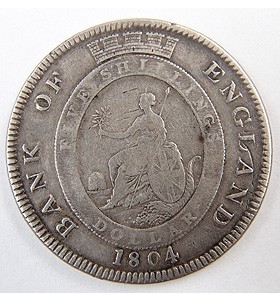
G'day ... again, Muckeye, I remember that right upto 1966, a dollar meant five shillings, which became confusing when, by law, ten shillings converted into one dollar. I thought that this was just a loose, colloquial usage. But I was wrong. The rate of exchange for "Spanish Dollars", a.k.a. eight reales; a.k.a. pieces of eight was fixed at five shillings for many years. The Spanish dollar, as I understand it, was the basis of the American dollar. In N.S.W. all government accounting upto about 1820 was in dollars. And, of course, in 1813, there was the "Holey Dollar". But, most interesting was a British overstriking of Spanish dollars in 1804: here is a pic of one in my collection - Image:  BoEdollar1804rev.jpg BoEdollar1804rev.jpg37.3 KB You can see for yourself that in 1804, a "dollar" equalled five shillings, in that one coin carried both denominations. Point of minor interest: of all my coins, this is the one that non-collectors express the most interest in. well Triggersmob: the "young people" I mix with are in the 4~5 y.o. bracket. I was fascinated by your references: my contemporary dictionary defines "fiddy" as an alternative to "fifty" generally, including $50, 50-cents, 50 per cent, etc, dating back to at least 2003. "Hunge" is defined as specifically $100, and is dated to 2006. I suddenly feel old. ... I'm over it. In my childhood, I spent a lot of time at racetracks: my Dad was an unreformed gambler. I recall him using phrases, which confused me at the time. I can't recall, if indeed I ever knew, their meanings. So I've looked them up in my dictionary (same as above). These are references to amounts of money, rather than to particular notes or coins: pony = 25 pounds monkey = 500 pounds gorilla = I quote "Australian Slang term for $1000" - but I suspect that it might have been 1000 pounds. I'll ask my older acquaintances [yes: there's a few of them] if they can clarify these terms, and add others. Peter in Darwin |
|
Pillar of the Community
 Australia
877 Posts |
I seem to recall a race caller saying "you can bet London to a brick that...." (maybe Ken Howard?). I wonder if the 'brick' was 10 quid? Jeff |
|
Valued Member
Australia
372 Posts |
|
|
Pillar of the Community
Australia
2830 Posts |
G'day, Jeff "London to a brick":
I understood that that was a comparison between -
something very large - the whole of London, with many buildings; and
something very small - one brick.
And, on reflection, I think it still makes better sense if the "brick" is a small piece of building material, as opposed to a quantity of money.
Peter in Darwin
|
|
Pillar of the Community
Australia
877 Posts |
"Try This link. May have been shown before." Yes, actually in my post starting this thread  Jeff |
|
Valued Member
Australia
372 Posts |
thought Id seen it posted somewhere previously,  |
| |
Replies: 11 / Views: 6,217 |
|









 Posted 01/30/2008 04:40 am


 BoEdollar1804rev.jpg


