| Author |
 Replies: 12 / Views: 2,065 Replies: 12 / Views: 2,065 |
|
|
Pillar of the Community
United States
519 Posts |
Hi, I have removed all my coins and currency from my safety dep box, and I see spots on some of the silver coins. Can anyone tell me what is the spot on this Walking Liberty half that is above the T in United (at the left upper)? All of the coins were in 2 x 2, some of which were from a box I bought about 13 - 15 years ago. Is it environmental damage from the 2X2 or from just being in the SD box? Will acetone remove the problem? 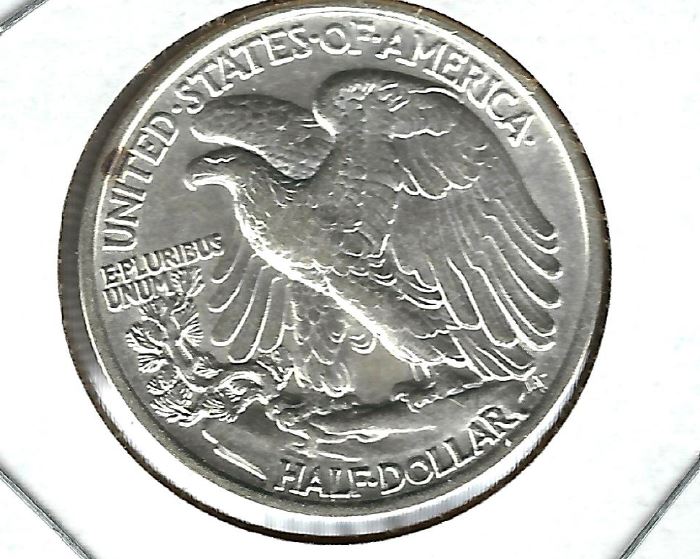 |
|
|
|
Pillar of the Community
United States
3546 Posts |
Quote:
...from a box I bought about 13 - 15 years ago Did you happen to recall if this coin had spots on it 15 years ago when you first dealt with it? If not, it looks like mold. In this potential scenario install a moisture suppressing desiccant: https://goccf.com/t/238280&SearchTerms=desiccantKeep in mind that the desiccant will not remove an existing moisture-instigated stain: only lesson the possibility that something like this will not occur again. Continuing with the troubleshooting steps, did you attempt to remove the spot with a toothpick or porcupine quill(does not damage sensitive patinas for high dollar coins)? Without knowing the exact chemical composition of this spot it wouldn't hurt it to initially try residue-free acetone and then xylene(or xylol) as a secondary non-polar agent. |
|
Bedrock of the Community
Australia
21789 Posts |
The spot that appears on this coin is not the fault of the steel safety deposit box, or it's inside lining of paint. The spot is probably silver sulfide, oxide, or chloride, or a variable combination of them. It has most probably been stored in close contact with acid paper security documents.
The spot can be removed, but there is a certain cost to be paid in doing so.
It can be dropped into a commercial mild silver cleaning solution, that has been diluted according to directions for the product, until the spot disappears. Do NOT rub or polish!
The coin is then rinsed twice in acetone then distilled water then dried.
If it is mold, it can be safely removed with acetone alone, but I don't think that is the case here. Molds need some sort of organic feed to survive. The base under this spot is inoganic silver.
The certain cost that has to be paid is that the patina will be be removed.
In my opinion, that cost is too high.
There is some risk that some detail may be lost as well, as some silver may also be removed.
Before putting back in the safety deposit box, at least rinse it in acetone, dry then seal in a polyethylene clip lock bag, isolated from the paper documents. It would be of benefit to the documents as well, if the whole lot was stored back in the safety deposit box, with a bag of silica gel included.
|
|
Pillar of the Community
United States
1758 Posts |
Acetone will not remove the problem. It's as SEI indicated its AgCL &/or AgS. Best to leave it alone.
John Lorenzo
Numismatist
United States
|
|
Pillar of the Community
 United States
519 Posts |
Thanks everyone I do appreciate the answers.
|
|
Valued Member
146 Posts |
Quote:
The spot can be removed, but there is a certain cost to be paid in doing so.
It can be dropped into a commercial mild silver cleaning solution, that has been diluted according to directions for the product, until the spot disappears. Do NOT rub or polish!
The coin is then rinsed twice in acetone then distilled water then dried. Sorry guys, have to laugh at this one. Hope you have not dipped your coin yet! I have been at the FUN show and just saw this. First, IMO the spot is 98% silver sulfide. Small spots like this can happen if there is some debris (like cardboard particles from flip) on the coin. However, they are usually cause when the clear plastic gets holed allowing contaminated air to reach that spot on the coin. Rather than dip the entire coin, a professional conservator would just treat the spot. Since many of you do not conserve coins for a living... The usual, "at home" method is to put a tiny amount of dip on a round toothpick and touch it to the spot. More may be required but that is enough for now. A place like NCS could remove something like this in less than a minute and you would not see ANY evidence or color change where they did their work. There is much more to add but not here. I've seen too many coins ruined by collectors. |
|
Valued Member
146 Posts |
PS PLEASE don't ever "drop" your coin in dip until the spot goes away. Good intentions yet very Bad information!
|
|
Pillar of the Community
United States
4499 Posts |
Dipper,
What compound would you use on the end of toothpick?
|
|
Valued Member
146 Posts |
Any of the commercial dips...jewel luster etc. You can start with a very dilute solution. Just put a few drops of dip (let's say 2) on a dish and add a little water (say 5 drops). when the spot is gone, neutralize coin in baking soda solution then blend the spot into the surrounding area w/acetone using the haze on the rest of the coin.
|
|
Pillar of the Community
United States
3284 Posts |
Of course I trust your diagnosis that this is most likely silver sulfide because I would not know.
I'm just wondering what sweat, or a coin coughed upon might look like after 10-15 years in a flip?
|
|
Bedrock of the Community
Australia
21789 Posts |
Although the mylar film used in 2x2's is very thin, I would believe that it would have very poor osmotic properties. A thin mylar film should provide a very good barrier to droplets released by sneezing, from affecting the metallic surface of the coin being protected the mylar film of the 2x2.
Generally speaking, most 2x2's are normally stored in album pages anyway, and thus afford a double layered protection for the coins.
I have only a small safe, that is not large enoughfor a 20 pocket per page coin album. I use a six pocket coin wallet instead, that has four pages. That fits in my safe quite nicely.
So sneeze away without fear of the coins being affected in any way. Just let common sense hygene apply, and wipe clean.
|
|
Pillar of the Community
United States
3284 Posts |
Oh, I meant a droplet on the coin (unseen), then it is placed in a flip, and left for an extended period of time.
My bad, I wasn't clear
|
|
Pillar of the Community
United States
7390 Posts |
Nice to see you dropping in ColonialJohn  |
| |
Replies: 12 / Views: 2,065 |
|










 Posted 01/09/2016 07:03 am


