| Author |
 Replies: 10 / Views: 1,986 Replies: 10 / Views: 1,986 |
|
|
New Member
United States
10 Posts |
Hello, I am new to the forum thanks to Swamperbob, and I have a question about the attached coin. I am new to collecting/trading 8 Reales, and was enlightened about how many Numismatic Forgeries that exist. Based on some feedback about a coin in my collection I think I understand that a wire rim on an 8R indicates that it may be a forgery. I located the following coin that has this characteristic, and I would like some additional info as to the authenticity of this coin. Again I am very new to the 8R series, and was just hoping someone could help me expand my understanding. Any thoughts on this coin? 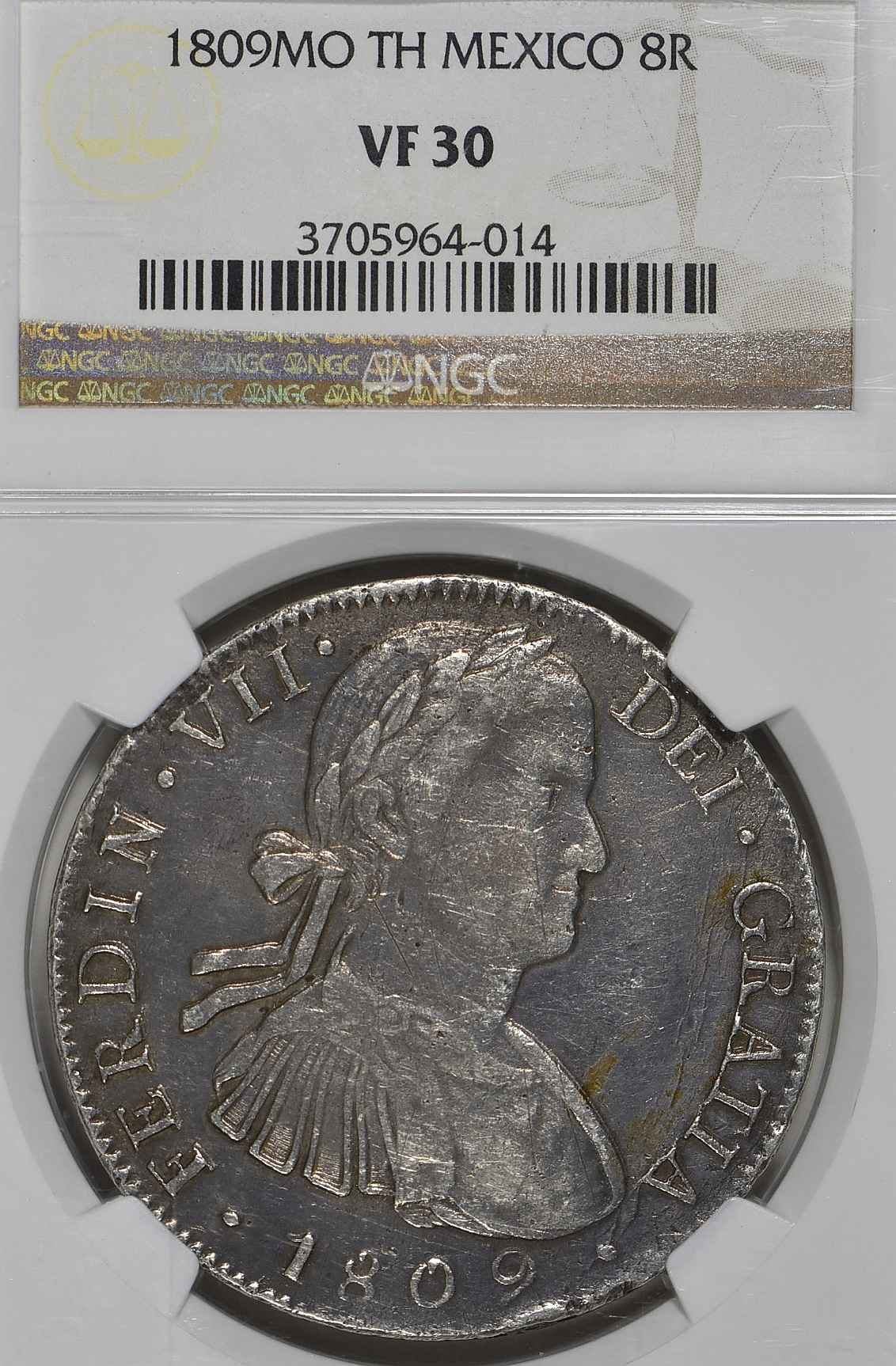 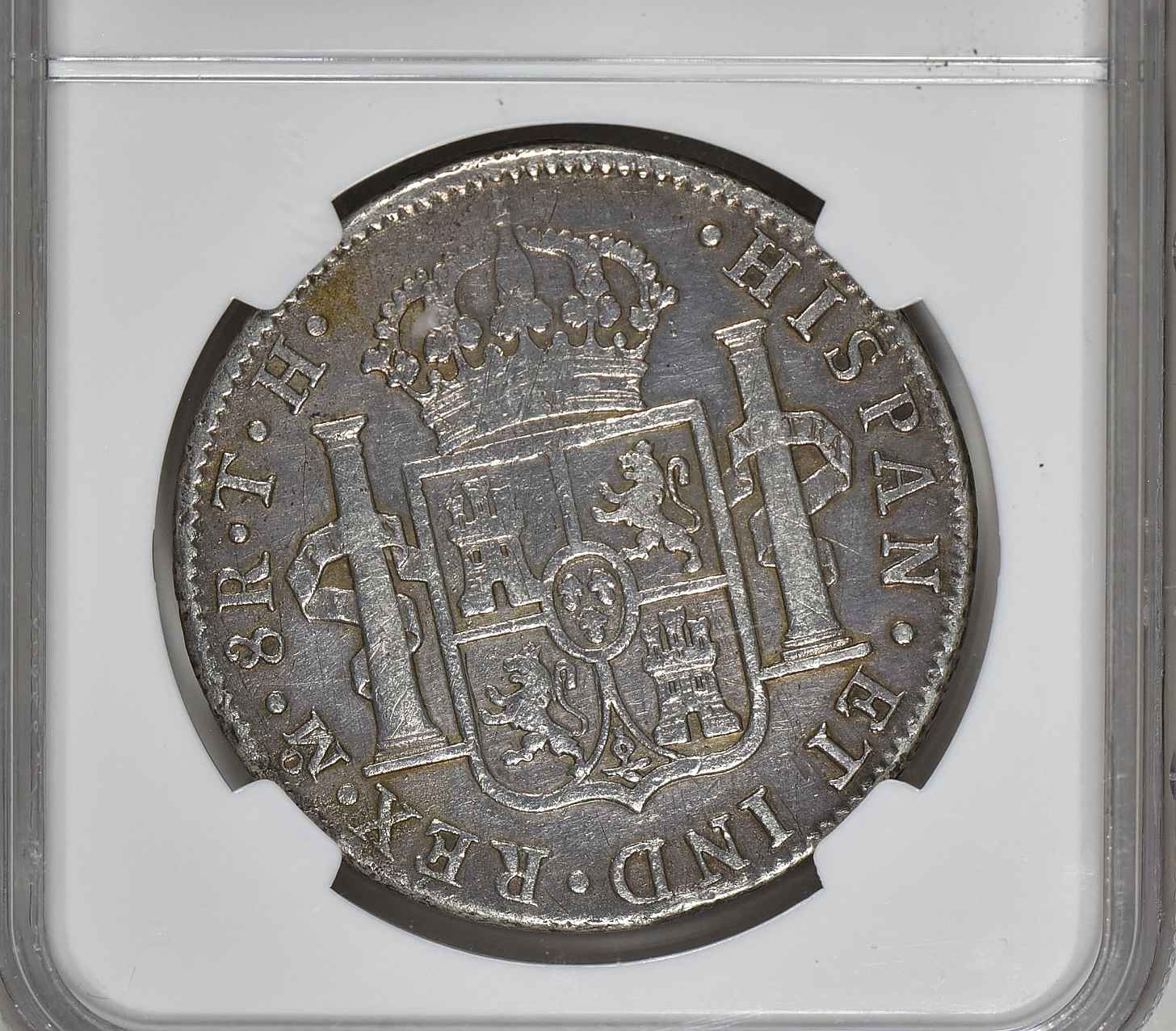 |
|
|
|
Pillar of the Community
Austria
566 Posts |
Seems authentic to me, also the slab seems to be genuine.
Edited by coinworldtv
01/27/2016 5:19 pm
|
|
New Member
 United States
10 Posts |
I have done some research, and the impression I am coming to is that the screw press wouldn't make a raised "wire rim." I kind of think I see this at the 7 o'clock position on the obverse. It also doesn't appear that the denticiles roll completely off of the edge of the coin on either side. I may be completely wrong, but just want to make sure I am looking for the right diagnostics.
|
|
Pillar of the Community
United States
5362 Posts |
Welcome to the forum. I believe the area at 7 o'clock may be an optical trick caused by the lighting. I would have to review the coin in person using a binocular scope to be sure but in a two dimensional photo it is sometimes difficult to see the difference between a true raised rim and wear that has made the "corner" rounded. A raised wire rim is created by pressure building up at the edge of the die where the collar encloses the dies to create a closed coining chamber. This happens when the die face of the forger's die is the size of a coin and not as wide as a real die. If the planchet is not placed perfectly a small section of the die face will stop before the collar leaving a raised rim. In other cases, the forger's die can itself have a raised section beyond the face of the coin that was copied. Wear can terminate dentils at a "false arc" short of the edge but in that case the surface falls away - it does not rise approaching the edge of the coin. The binocular scope will allow you to tell if the surface rises or falls away. A fourth possibility is edge damage creating a post strike raised rim. If the area between the stop and the 9 has raised metal - rising above the tops of the dentils - you need only check to see if the edge has been bumped (tapped or damaged) to cause the rise in the edge metal. If the edge is pristine - the coin is in fact a counterfeit which NGC would have failed to recognize. It would definitely NOT be the first such error made with a common coin. Looking at the coin as if it is raw I do see some points of concern - it may be a Class 2 Silver Circulating Counterfeit. Once encapsulated it is nearly impossible to be sure. Here is a sketch of what I mean - it may be a little clearer than my worded description. 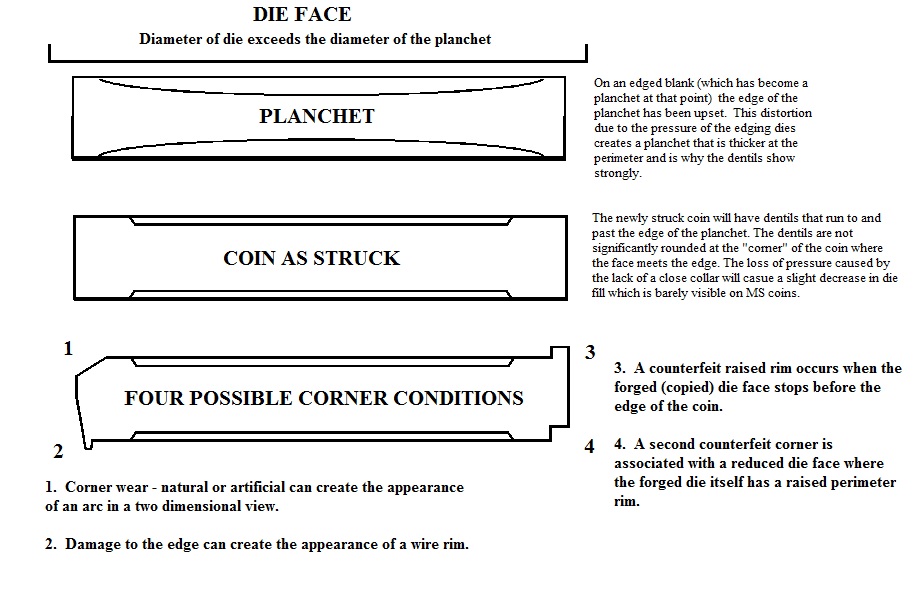 |
|
Pillar of the Community
Hong Kong
1270 Posts |
Hi Swamperbob, does the coin edged after surfaces strike would also produce such a "wire rim"?
|
|
New Member
United States
10 Posts |
Great. Thanks for sharing your knowledge. I will try to pick this coin up if the price stays reasonable. I can catalog a retail value for a legitimate piece, but don't know what this might be worth as a class 2. If I can purchase the coin I will get some better pics once it is in hand. What would the estimated value of a Contemporary Circulating Counterfeit be?
|
|
Pillar of the Community
United States
1962 Posts |
Some doubling and also what looks to be planchet peeling going on there. Certainly not any kind of modern numismatic forgery.
Understand that for the vast majority of the collecting world, even if they are able to grasp the concept of Bob's "Class 2" restrikes... a coin such as this is going to trade as a normal 1809 Mex. 8R.
That said, not the prettiest coin for the NGC assigned grade... unless cheap, don't bother. Plenty of nice grade military bust 8R out there (though strike is sometimes lacking).
Edited by realeswatcher
01/28/2016 1:01 pm
|
|
New Member
United States
10 Posts |
Thanks for the insight on value, so will see if I can score it at a good price....
|
|
Pillar of the Community
United States
5362 Posts |
wonghinghi An edge applied as a last step will cause distortion to the dentils and possibly upset the edge slightly but will not produce a uniform wire rim.
Sphil876 Regarding value - the silver counterfeits usually sell as if they are real. One of the old coin dealers I dealt with since the 1960s was aware that the silver counterfeits existed but he said to me on more than one occasion if the coin has the correct amount of silver in it who cares.
Personally I value some of the silver counterfeits differently. The examples made in the UK before 1850 are higher in value to me when the alloy has been tested by XRF and the proper ranges of metals are present (850-900 fine silver, with lead). I also like the late UK coins post 1850 that are sterling silver with no lead.
Final comment on value - if the area on the obverse is an actual raised rim (indicating a collared strike) it would be worth at minimum $100. That is the reward NGC pays for discovering counterfeits in their holders.
|
|
New Member
United States
10 Posts |
Bob, thanks for the update. I want to pick this one up more than ever now. I know you stated it it is near impossible to tell while in the holder, but without testing/ cracking this thing out will edge pictures through the holder indicate its origin? I believe I can get decent pictures "If I can procure the coin," of the edges with my macro lense since this is a edge display holder from NGC.
|
|
Pillar of the Community
United States
5362 Posts |
The value of a counterfeit in an NGC holder is dependent on the coin remaining in the holder. There are collectors who focus just on slabbed counterfeits.
The raised edge should be able to be diagnosed by looking at the edge through the holder while it remains intact.
|
| |
Replies: 10 / Views: 1,986 |
|










 Posted 01/27/2016 7:31 pm


