|
This page may contain links that result in small commissions to keep this free site up and running.

Welcome Guest! Registering and/or logging in will remove the anchor (bottom) ads. It's Free!
To participate in the forum you must log in or register. | Author |
 Replies: 7 / Views: 2,752 Replies: 7 / Views: 2,752 |
|
|
Pillar of the Community
United States
7067 Posts |
Mithradates II was one of the greatest of Parthia's kings. Prior to his rising to power around 123 BC, the empire had been losing territory to Characene and the Sakas (Scythians). Under his leadership, Parthia conquered lands from Armenia to well east of the Caspian and southward to India. In addition, Babylonia and Mesopotamia were reclaimed, and the Characene Kingdom was defeated. It was during Mithradates II's reign that China made contact with Parthia and that the Silk Road was opened in Central Asia. Reflecting the strength and commercial success of most of Mithradates' reign - which lasted until c. 88 BC, there was a robust output of drachms and tetradrachms, along with AE tetrachalkoi, dichalkoi, chalkoi and hemichalkoi. Drachms, which were the most important and common of Parthian denominations, were minted in numerous styles during Mithradates II's long reign. Earlier issues show the king with a short beard and diadem, progressing over time to a longer beard and diadem, then to a number of different tiara types later in his rule. (His coins were the first to depict the famous Parthian tiara) Mithradates' coins copied the Greek descriptor "Epiphanes" (interpreted as "God made into man" or "god manifest") from Seleucid issues. Later in his reign as, no doubt, he was beginning to feel his oats, Mithradates' coins began to incorporate the title "King of Kings" in legends. Some varied coinage of Mithradates II is pictured below. Thanks to Museumguy - who occasionally contributes to our threads here - for allowing the use of some of his coins. Medium length beard, diadem (drachms) Museumguy, Sellwood 24.9 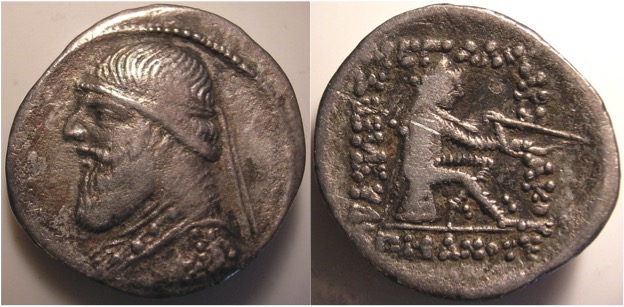 Bob, Sellwood 24.9 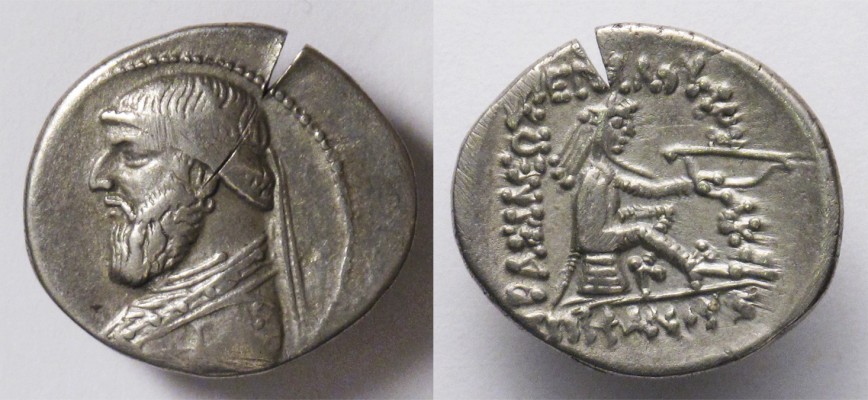 Medium length beard, diadem (tetradrachm) Bob, Sellwood 24.4v. 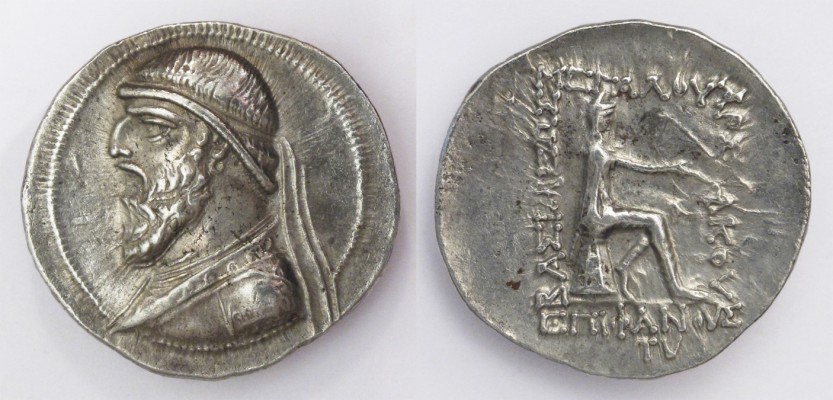 Long beard, diadem (drachms) Museumguy, Sellwood 27.1 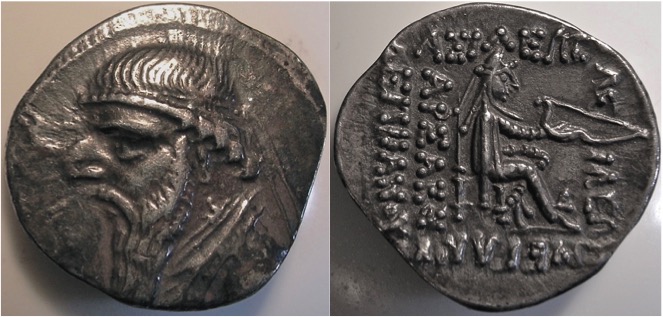 Bob, Sellwood 26.2 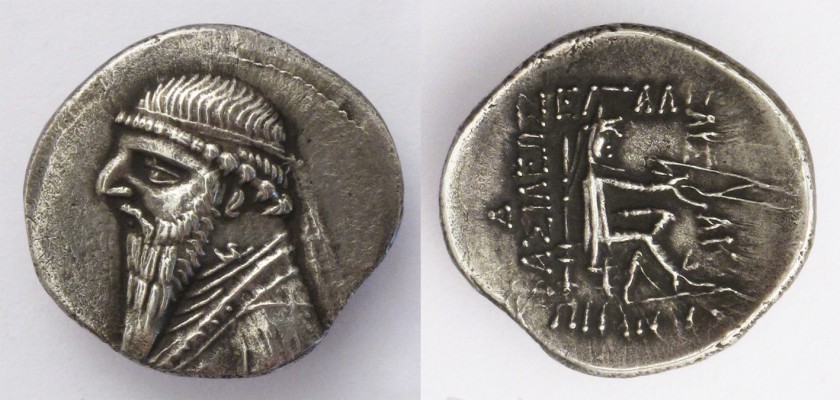 Museumguy, Sellwood 26.1 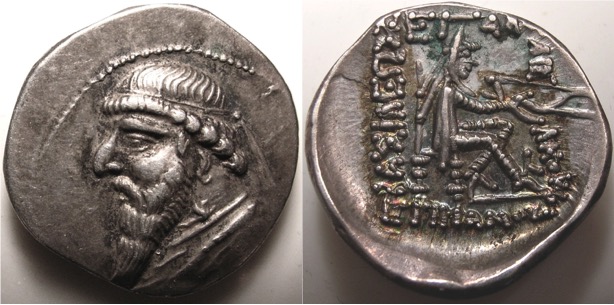 Various tiara types with long beard (drachms) Museumguy, Sellwood 28.3 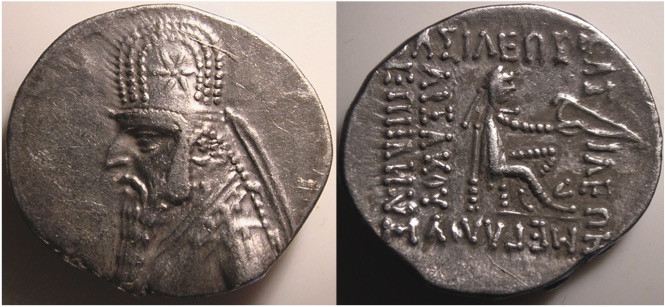 Bob, Sellwood 28.3 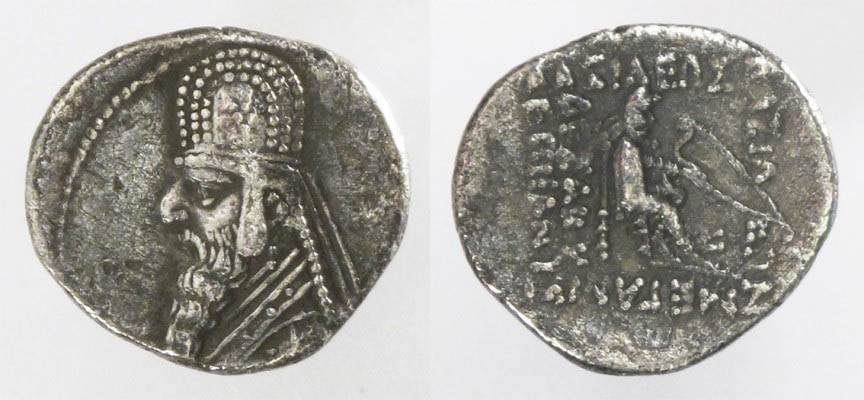 Museumguy, Sellwood 28.6v. 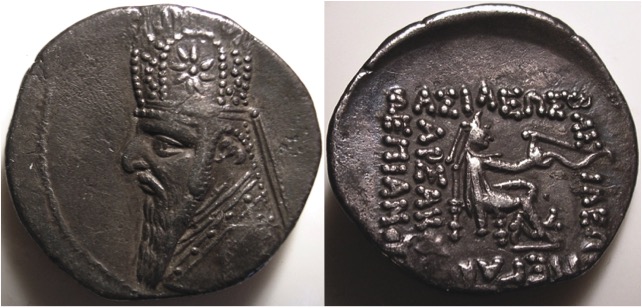 Bob, Sellwood 28.1 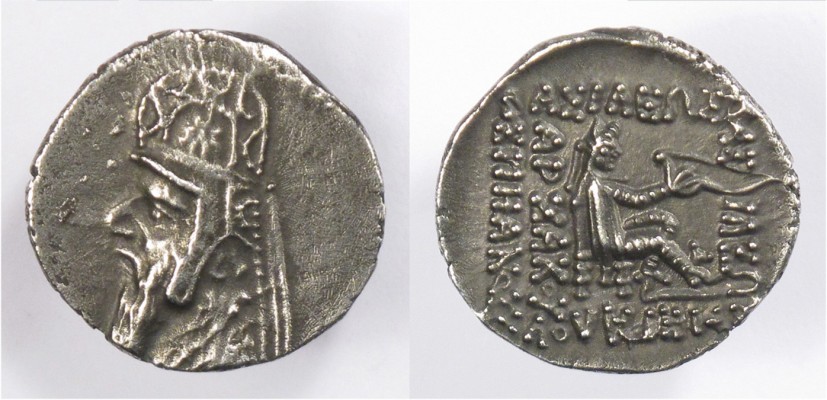 Edited by Kamnaskires
01/29/2016 5:49 pm
|
|
|
|
Moderator
 United States
23731 Posts |
Excellent thread, I love seeing some of your coins. He is on my list to get.
|
|
Moderator
United States
34542 Posts |
Thanks for sharing these pics. I bought one a few years back because of the cool circular text on the back.
"If you climb a good tree, you get a push."
-----Ghanaian proverb
"The danger we all now face is distinguishing between what is authentic and what is performed."
-----King Adz
|
|
Pillar of the Community
Belgium
1194 Posts |
very nice coins,how do you date his coins and how do you the name of the king ?Like on my two coins ,I don t see a date.On my coins , you have the same titles for the 2 kings Artananos II and Vologases I. How do you identify ?
|
|
Pillar of the Community
 United States
7067 Posts |
You're exactly right, Albert: the lack of kings' actual names on most of the coins in the series presents challenges for collectors and puts them totally at the mercy of the "big guns" (Sellwood, Shore, and Assar). Parthian attributions are fluid - with new chronologies and identifications of some coins being proposed in recent years, particularly by Assar, based on newer ethnographic studies, research on inscriptions on sculptures and cuneiform, contemporaneous written accounts, etc.). It's not uncommon to see one dealer selling a Parthian coin under one ruler's name and another seller listing it (the same type) differently based on more current research.
However, as far as I know, no recent research has suggested any changes to the chronology and attributions of the coinage of Mithradates II, as proposed by Sellwood decades ago. His research of this king's output seems solid.
Speaking to these issues, here's an excerpt from my article on Numiswiki:
"In (Parthian coin) legends the current ruler is usually referred to as Arsakes, rather than by his personal name. Exceptions include some drachms issued by Vonones I and Gotarzes II, and tetradrachms of Vologases II. "Arsakes" is thus essentially a title, like Caesar, and its usage as a reference to the current king obviously served to legitimize that king's rule by tying it to the dynasty's founder - just as the depiction of a "royal wart" on the obverse portrait was often used as a visual symbol denoting a legitimate familial tie to the Arsacid dynasty. As you might imagine, the lack of use of personal names has created headaches for numismatists trying to decisively attribute Parthian coins."
Edited by Kamnaskires
01/30/2016 10:20 am
|
|
Pillar of the Community
United States
5007 Posts |
great line up of parthians bob!
the obverse on the third coin is amazing, I love the flow lines (is that what I'm seeing?)...haven't seen any that look like that before. makes him look nimbate!
|
|
Pillar of the Community
United States
7067 Posts |
Yep, flow lines, Chris.
Thanks, all!
|
|
Valued Member
United States
90 Posts |
Great little piece Bob! I think one of the main attractions for me to the Mith. II coins are the variety of noses portrayed - from the Roman nose to the Jimmy Durante nose! All different but all great!
Steve S.
|
| |
Replies: 7 / Views: 2,752 |
|
To participate in the forum you must log in or register.
Disclaimer: While a tremendous amount of effort goes into ensuring the accuracy of the information contained in this site, Coin Community assumes no liability for errors. Copyright 2005 - 2026 Coin Community Family- all rights reserved worldwide. Use of any images or content on this website without prior written permission of Coin Community or the original lender is strictly prohibited.
Contact Us | Advertise Here | Privacy Policy / Terms of Use
|
| Coin Community Forum |
© 2005 - 2026 Coin Community Forums |
| It took 0.35 seconds to rattle this change. |
 |
|
| |
| |






 Posted 01/30/2016 12:18 am


