| Author |
 Replies: 14 / Views: 4,759 Replies: 14 / Views: 4,759 |
|
|
New Member
Australia
23 Posts |
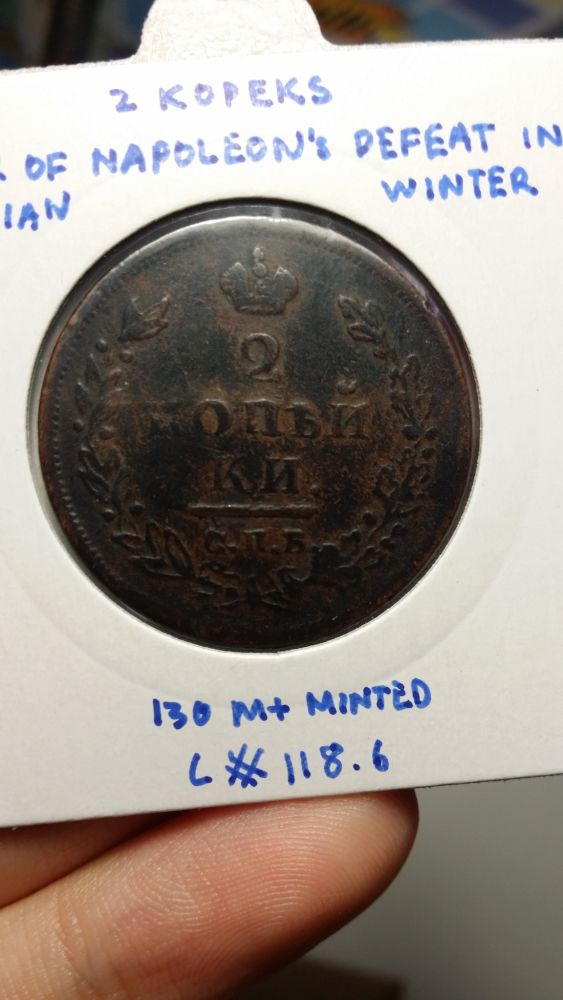
Got these at a local coin fair $20 for the pair. Feel a bit uneasy about them as the 'K' in kopek is a bit rubbed out and the letters seem a bit jumbled. Thanks! 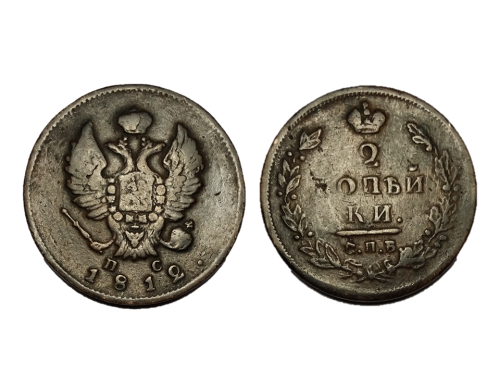 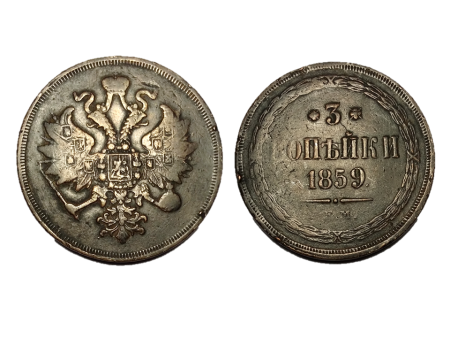 |
|
|
|
New Member
 Australia
23 Posts |
Would also like to add that the patina is very uneven and blotchy between black and brown.
|
|
Pillar of the Community
United States
5362 Posts |
I believe both coins are genuine. The price is full retail. I would just enjoy them if you like them.
|
|
New Member
Australia
23 Posts |
|
|
Pillar of the Community
Austria
566 Posts |
Agree, strongly worn, but probably genuine.
|
|
Pillar of the Community
United States
3357 Posts |
"Two minutes ago I would have sold my chances for a tired dime." Fred Astaire
|
|
New Member
Australia
23 Posts |
Thanks thq. I've looked at your images and in terms of the colour, my coin has an uneven black colour on top of an even brown colour. The brown matches your photos closely.
Perhaps it was cleaned recently and developed the uneven black colouring as it reoxidised?
Here's a clearer picture on the 1812.
The 1859's colour is more even throughout and resembles the darker centre of the reverse where the date is.
|
|
New Member
Australia
23 Posts |
|
|
Pillar of the Community
Russian Federation
5186 Posts |
I agree, the letters are jumbled. Could be a contemporary counterfeit, I suppose.
It's one of the most common dates, apparently, so I don't think it would've been worth the effort to fake; not in this condition, anyway.
Now that I compare it with the 1859, it becomes more likely that both are fake, perhaps from the same origin. Still no idea why.
|
|
Pillar of the Community
United States
3357 Posts |
The color on your second photo looks more reasonable, and the wreath looks better, compared to the first photos. It's hard to believe that these coins would be faked historically. I'm more familiar with French coins from this period. Most of the fakes are silver. It would be easy to pass these Russian copper coins but very little incentive to make them because of their low metal value. Here's a bad French fake from the same period, where the attempt is made to pass copper for 20% silver billon: http://www.cgb.fr/faux-de-10-cent-a...82843,a.html"Two minutes ago I would have sold my chances for a tired dime." Fred Astaire
|
|
Pillar of the Community
United States
5362 Posts |
Am I missing something here? I do not see the lettering as incorrect at all. Which letters are wrong? I am attaching a comparison with a standard 2 Kopeck from 1812 (different mint) but the lettering is generally correct. The coins being asked about are obviously damaged. 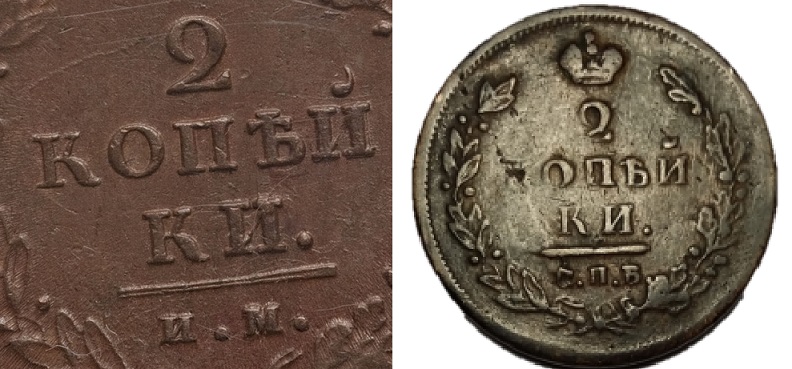 Edited by swamperbob
02/02/2016 4:27 pm
|
|
New Member
Australia
23 Posts |
Interesting.
The only faked Russian Imperial coppers I'm aware of are Chinese imitations sold in bulk on (Not Allowed).
Those all feature a lot of detail and a very even dark patina.
|
|
Pillar of the Community
Russian Federation
5186 Posts |
Quote:
Am I missing something here? I do not see the lettering as incorrect at all. Which letters are wrong? No, it's completely correct, as far as spelling goes. All the letters are right. What I (and, presumably, the OP) mean by "jumbled" is more the general letter shape/style; they're nice and regular on the comparison coin, but very uneven on the OP's coin (in particular, look at the different sides of the O, and the randomly protruding upper line of the next letter). |
|
Pillar of the Community
United States
5362 Posts |
january1may OK now I clearly understand what you were saying when you said jumbled. I presumed it was the alphabet itself. I had noticed the O but the balance of the irregularities I attributed to post strike wear and damage. To check out the O, I did check 7 different 1812 2 Kopecks including one from the St. Petersburg mint. My review of the 7 examples indicated to me that the punches used were not well standardized. The shapes varied. I did find what I thought was the same O shape on one coin. On the coin in question I also believe that the punch was improperly set (struck at an angle into the die) because of the weakness on the thin side lower quadrant. 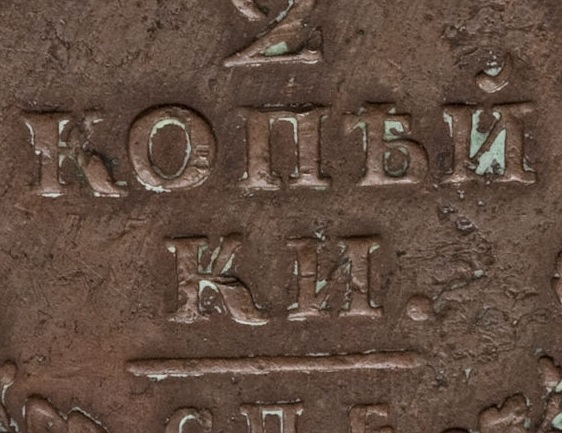 From my review, I presumed that the letter punches were not fully standardized, but that the O was correct. Have you ever developed a range of punches used at the mint for this issue? I would be hesitant to label the coins as counterfeit without understanding the range of shapes possible for the letters used at that mint. The coin does not appear to have any other clear indications of being forged and the large mintage seems to preclude a modern forgery. To eliminate the possibility of a contemporary forgery a simple weight should be enough.
|
|
Pillar of the Community
Australia
3839 Posts |
At this point of time, nothing rings alarm other than the unusual characters of "SPB". The side with the double headed eagle checks out ok. Quality control of St. Petersburg actually were not the best around 1810 when they were switching over to collar edging. As such, what used to be somewhat circular shape became circular coins by then. However there minor quality control issues. This is an example which I have not seen another example yet. The line has completely drooped on one side 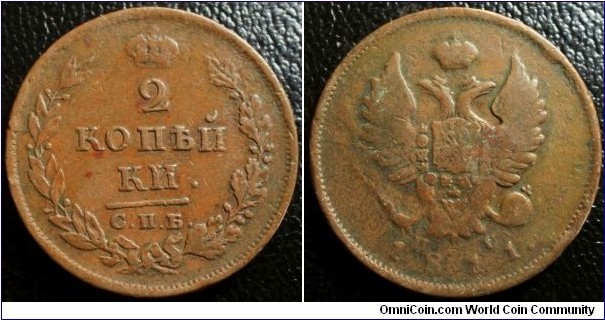 This is compared to a "normal" 2 kopek struck by SPB. Again this has lots of Die Cud  I certainly would like to see a close up photo to understand what happened there. My partial coin collection http://www.omnicoin.com/collection/gxseriesMy numismatics articles and collection: http://www.gxseries.com/numis/numis_index.htmRegularly updated at least once a month. |
| |
Replies: 14 / Views: 4,759 |
|







 Posted 02/01/2016 12:55 am