| Author |
 Replies: 17 / Views: 4,572 Replies: 17 / Views: 4,572 |
|
Pillar of the Community
United States
1915 Posts |
Does anyone agree? I think these lines on the coin are a result of being struck through a cleaning rag. It's all can think of. 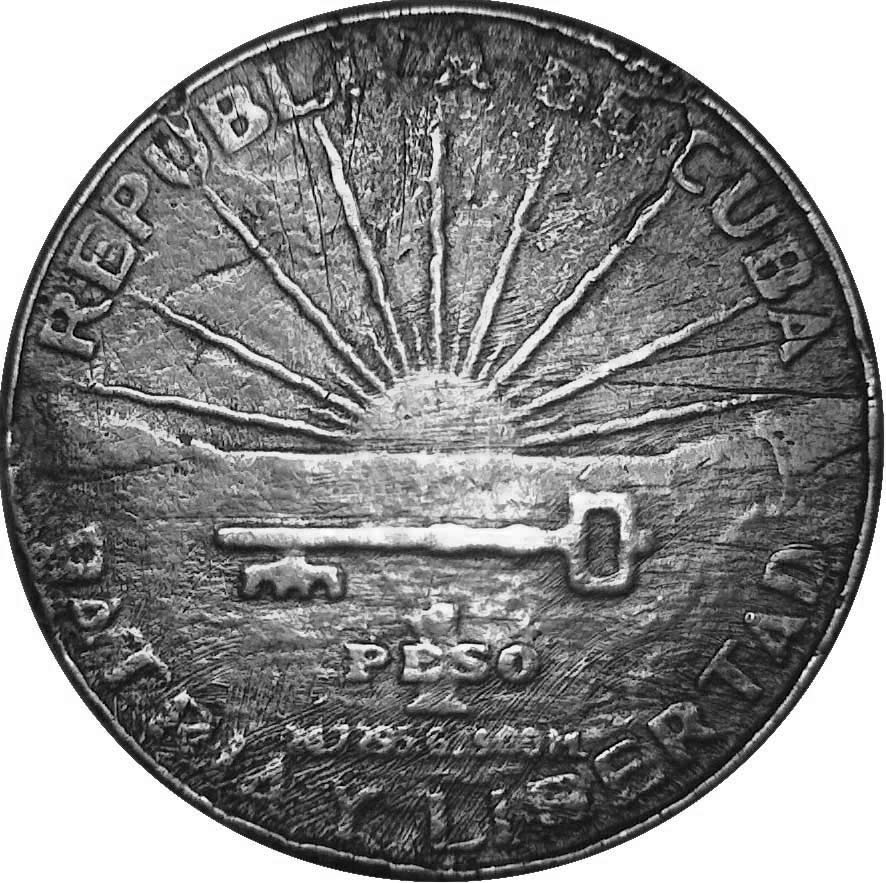 Edited by Albert
02/04/2016 11:05 pm
|
|
|
|
Pillar of the Community
United States
1192 Posts |
Are you sure it's not some sort of bad cast counterfeit of one?
|
|
Pillar of the Community
 United States
1915 Posts |
I'm sorry I neglected to say all that I have done so far.
It's a good coin in all ways except for the appearance of the reverse.
|
|
Moderator
 United States
34541 Posts |
Albert, if you post a picture of the edge then that might help with the determination of cast vs. struck.
"If you climb a good tree, you get a push."
-----Ghanaian proverb
"The danger we all now face is distinguishing between what is authentic and what is performed."
-----King Adz
|
|
Pillar of the Community
United States
1915 Posts |
Well you are right and I should have said good coin in most ways but two: reverse appearance and edges. Here they are. 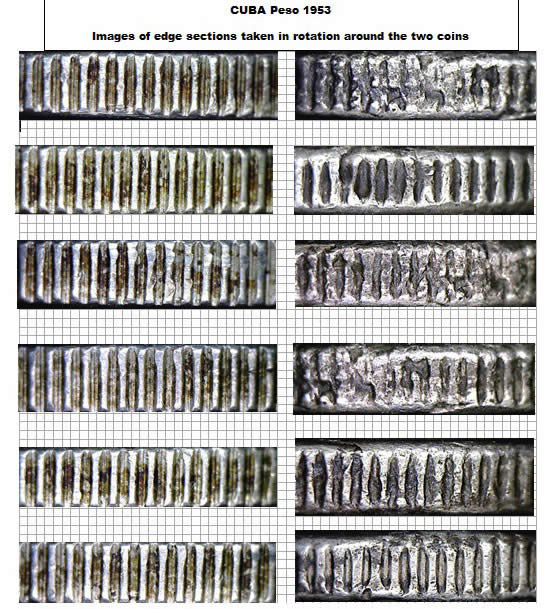 Edited by Albert
02/05/2016 1:53 pm
|
|
Pillar of the Community
United States
5362 Posts |
If your coin's edge is on the right - I would be of the opinion the coin is a numismatic forgery. The reeding is irregular. Perhaps the coin or mold was intentionally distressed to look like a strike through. In the case of a coin, it could be a cover over corrosion.
The appearance of the surface is clearly not a strike through cloth because there is a lack of regularity in the pattern. Cloth has a very regular pattern that can be seen even when folded. To me it looks like the mold surface was "brushed" while still pliable in multiple directions to provide a texture.
What tests were done to determine the coin was genuine?
|
|
Pillar of the Community
United States
1915 Posts |
Good question that prompts me to do more testing. Poor choice of words on my part when I said it was "good". Actually it's the very first coin I've come across that makes it hard to know if it's fake or not. All the others are obvious in one measurable way or another. So all I was really looking for is if it might be a "Struck-Through" coin be it cloth or paper towels or steel wool. The obverse is so good but the reverse is so bad. I am presently doing more tests and will follow up later when done. But to answer your question here is what I found so far based on an A-B comparison with a known genuine coin:
Diameter same
Thickness same
Diamagnetic properties same
Ping Test identical 10Kz recorded on spectrum analyzer
Weight is different and a bit light at 26.16g compared to 26.75g
Density is interesting, it is 10.28 which compares to coin silver and the genuine coin is 10.27
It passes for silver under the bleach spot test (turns black).
Edited by Albert
02/06/2016 2:10 pm
|
|
Pillar of the Community
United States
1915 Posts |
1953 Cuba Peso GENUINE SPECIMEN
Diameter-mm 38 38
Thickness-mm 2.7 2.7
Weight-grams 26.75 26.17
Composition .900 silver like .900 silver
Vinegar Test pass pass
Bleach Test pass pass
Ice Test pass pass
Slide Test pass pass
Ring Test 10Khz same 10Khz
Die Axis 6 6
Edge milled badly milled
Density-g/cm³ 10.27 10.28
Magnet Test diamagnetic same
|
|
New Member
Cuba
27 Posts |
Hello, Albert!
Yours is definitely the worst shaped 1953 Cuban peso I have ever seen!
It really breaks my heart!
It is as if someone had deliberately rubbed it against a rugged surface.
But it definitely looks like the real thing to me.
|
|
Pillar of the Community
United States
1915 Posts |
Yeah it also resembles someone whizzing the reverse die with one of those really stiff wire brushes used for de-scaling or cleaning up weld using the brush spinning in a hand drill doesn't it?
|
|
New Member
Cuba
27 Posts |
I know this sounds crazy, but I feel about your coin as if it were some kind of deadly-wounded animal, you know?
I would like just to put it out of its misery. Only in this case, a bullet wouldn't do it. Melting it down, maybe? :)
And then you could buy a pretty new 1953 Centenario de Jose Martí 1 peso coin.
You know the guy on the coin and the story behind the coin, right?
|
|
Pillar of the Community
United States
1915 Posts |
I'll retract my very first question asking if the reverse might be struck-through (something). A close exam of the obverse suggests to me that this coin is cast and not struck at all. But what troubles me is that this coin tests same as silver. So what is the motivation? It's the only coin I have so far where the metal seems to be correct instead of some other alloy that is obvious and easy to tell. So what I see at this point it's cast in silver and a half gram light. Thanks to Pillar of the Community swamperbob prompting me to take a much closer look under the microscope and polarized light. The two coin obverses look virtually identical in hand with the unaided eye. The difference reveals itself under high mag.
Edited by Albert
02/09/2016 11:43 am
|
|
Pillar of the Community
United States
1915 Posts |
Here is a picture of the ears on the genuine and presumed counterfeit. Anyone try to tell which is which? 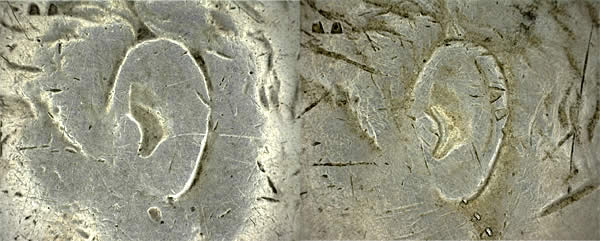 |
|
Pillar of the Community
United States
5362 Posts |
This is a genuine ear. 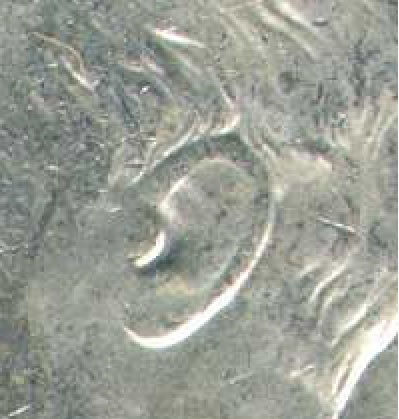 I do not see much of a difference except that caused by wear. |
|
Pillar of the Community
United States
1915 Posts |
Not being much different is fair to say mostly all over the obverse and especially unaided. The genuine is on the right and the counterfeit is on the left. But in this particular shot they sure don't appear much different. The real differences reveal themselves in other pictures taken under the microscope. In short, the genuine clearly shows evidence of being struck (metal flow),while the counterfeit has no such characteristics at all. I owe the final decision on this to swamperbob for prompting me to re-visit this coin and take a much closer look. That means my very first post about being struck-through was just off base.
|
|
Pillar of the Community
United States
5362 Posts |
The design outlines on most numismatic forgeries will be correct because the design is mechanically transferred from the original to the mold or die.
In this instance flow lines can not be seen in photos clearly.
|
| |
Replies: 17 / Views: 4,572 |







 Posted 02/05/2016 09:45 am





