| Author |
 Replies: 12 / Views: 5,377 Replies: 12 / Views: 5,377 |
|
|
New Member
United States
4 Posts |
I was hoping to get this forum's opinion on an item that is upcoming in Heritage's April 14-19 CICF World Coins & Ancient Coins Signature Auction. The item in question is an 1808 Charles IV 8 Reales (Mexico) that has both Chinese chopmarks and a British George III Honduras Colony countermark. It is in an NGC Holder. (See link: http://coins.ha.com/itm/british-hon...s-12202013#) Given the uniqueness of the combination of these countermarks and chopmarks, the fact that this coin is unpublished and relatively unknown, and the strength and clarity applied to the chopmarks, this seems almost too good to be true. What is your opinion on the validity of this piece (both the host coin and the applied marks)? 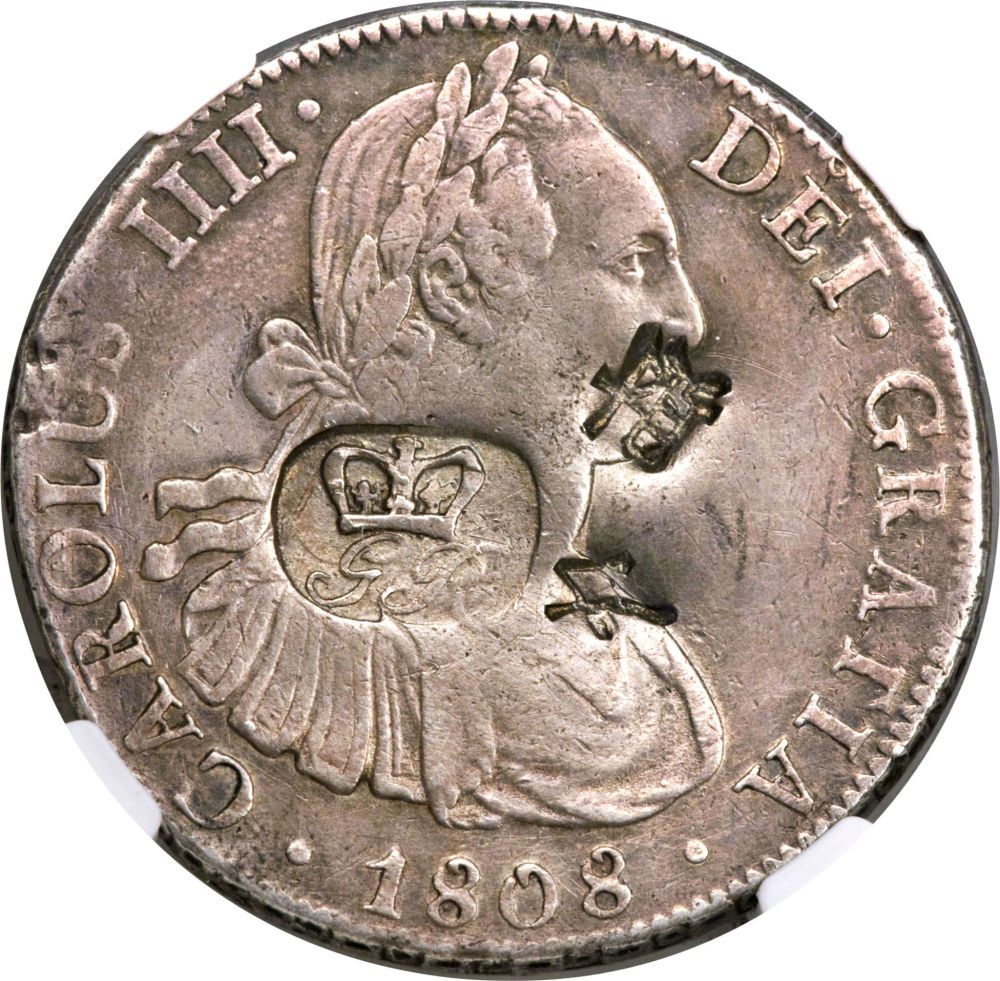 |
|
|
|
Pillar of the Community
United States
1758 Posts |
Personally, I never heard of a chop-mark INTERFERING with a counter-mark. One is to test the integrity of a coin the other to impose a new value. Host coin looks legit.
JPL
|
|
Pillar of the Community
United States
5362 Posts |
This coin screams forgery at least to me. The cataloger at Heritage did a poor job with his write-up since he calls this the "rectangular" version of the counterstamp when it is clearly the "oval" version. Quote:
British Colony - George III Countermarked - Chinese Chopmarked - 6 Shilling 1 Penny ND (1810-18) VF Details (Chopmarked, Scratches) NGC, KM1.1. Struck upon a Mexico 1808 Mo-Th 8 Reales of Charles IV. Type with crowned script "GR" in rectangular indent, with two bold Chinese merchant chop marks on the obverse. An extreme rarity with Chinese marks, having made its way to Asia only to be later re-validated for circulation in British Honduras. Unpublished and reportedly unknown in this combination to several experts in the field. Perhaps unique as such, and as a result, a coin that will certainly appeal highly to specialists. Estimate: $800 - $1,000
I have several problems with is coin beginning with the overall authenticity. The die type is one I would classify as Class 2 a late made post 1830 silver restrike made for the China trade. It can not be tested with XRF now to confirm or deny that supposition. The chops are large and heavily applied which, at least to me, has always been a general indication that they were applied in the latter part of the 19th century not in the period before 1820. The heritage author is clear in his belief that the British Honduran stamp was applied AFTER the chops. Why you might ask? I presume he realizes that once the coin was stamped by British Honduras the value in Honduras was increased to 6 Shilling one pence. That was done precisely to keep the silver coins in Honduras. The Bank of England countermarks pegged the value of an 8R at 4 shilling 9 pence in 1797 (oval stamp) and 5 shillings in 1804 so that means no one would export a coin valued at 6/-1d for 5/-. That would be stupid - hence the need to believe the coin went from Mexico to China and back to Honduras before 1818. I see that as far fetched especially since silver coins in the 1810-1850 period were trapped in China. They were not exported back to the west until after the opium trade had developed. Do the dates add up? Based on the dates of coins marked by the British 1808-1818 seems to be the period when the coins were marked. The host coin has wear on it which predates the stamp and chops. There is essentially the same level of wear (very minimal) AFTER the stamps were applied - see reverse. The texture of the anvil was rough in all three cases and the high points created by the stamping were never worn down. I think that accepting the story fabricated by the Heritage Cataloger would require a very gullible collector. What happened to the Heritage and NGC expertise? This sounds more like a story concocted by a used car salesman to hype up prices that an honest expert statement of facts. Sounds similar to the description of the 1840 ADo OMC pattern Mexican coin. Poorly researched and over reaching in scope to drive up the price. Not making any direct aspersions yet but check out the players. When too many unique coins start to come to market from one and the same source, I get very suspicious of the motivations in play. |
|
Pillar of the Community
United States
5362 Posts |
Here is the reverse of the coin showing the lack of wear on the damage to the reverse of the coin: Revision: I just noticed on very close examination that there is some wear associated with the chops. Less wear is associated with the oval counterstamp. See below. 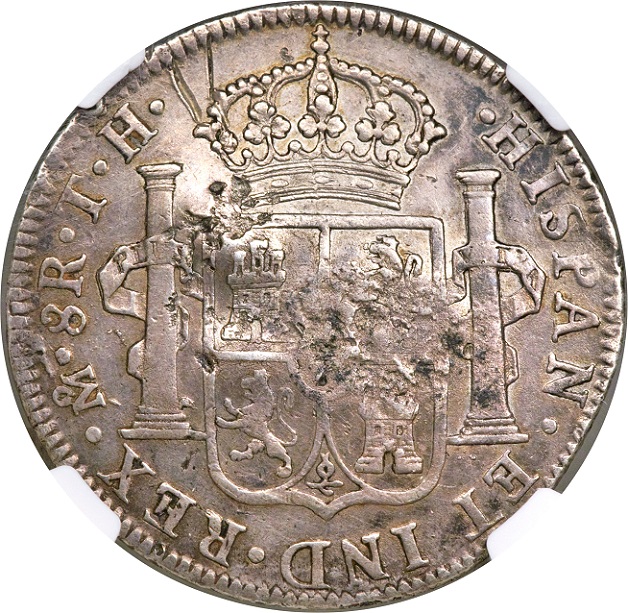 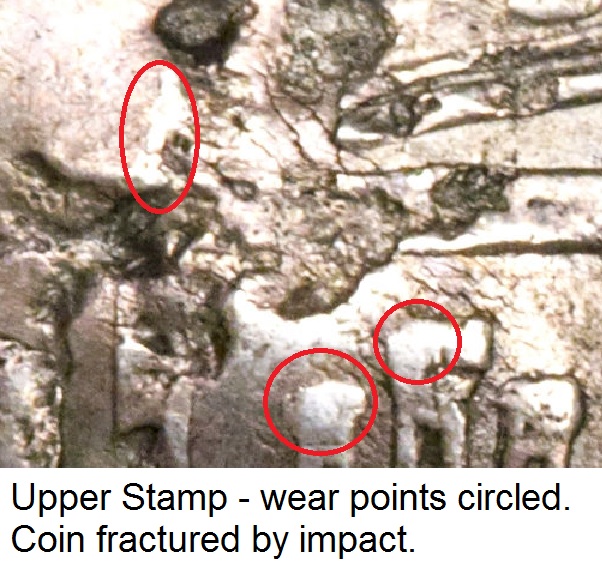 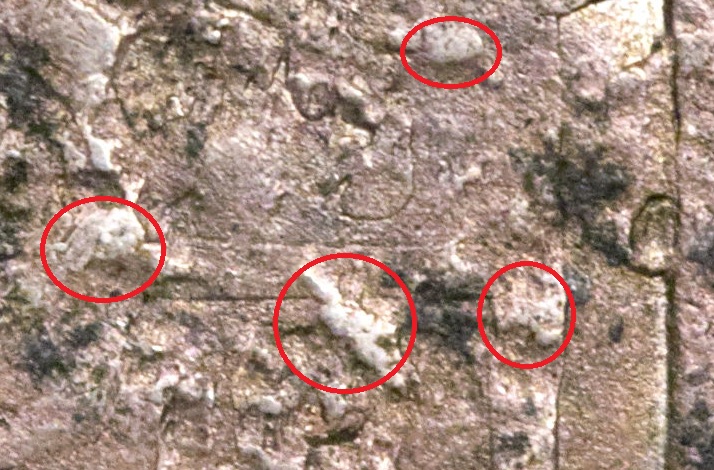 I see this as adding up to a cull 8R with scratches and heavy chops having a forged stamp added to increase value. Edited by swamperbob
03/21/2016 4:39 pm
|
|
Pillar of the Community
United States
1758 Posts |
Interesting & unusual - just a consideration - silver in its most oxidized state is black ... normally when I see black oxidation in a punch or chop marks and in the fields or devices it suggest to me the coin is not debased with that much copper and its probably regal before XRF testing. I assume they looked in Pridmore to confirm the authenticity of the Honduras stamp as a plate match. This route of Mexico/China/Honduras is interesting and probably unique? ... I assume Bob it does not match any Class 2 1808 Mo TH in your photo library?
I do understand the limitations of NGC and normally after its slabbed Heritage more often than not just recites the label. Unfortunately I sold my West Indies Collection and library ...
I would think in this passage of Mexico/China/Honduras if counterfeited Honduras the likely culprit. What does the Pridmore plate comparisons REVEAL?
JPL
Edited by colonialjohn
03/21/2016 7:16 pm
|
|
Pillar of the Community
United States
5362 Posts |
John The counterstamp is a very close copy of one version of the original stamp. It is however a very crude stamp and anyone with half way decent engraving skills would have no problem duplicating it. I am still working on a study to confirm the dimensions and compare them to known originals.
However, the existence of this coin makes no sense at all given the number of unlikely or previously unknown factors that combine in this ONE coin.
I am a great believer in occam's razor. The simplist solution to a complex problem is usually the correct solution. Stated in a way more applicable to this case, I would paraphrase it as, "Too many rare or unique possibilities linked together usually amounts to an impossibility."
That is exactly the case I see operating here.
I have looked at perhaps a dozen examples of that same stamp and every one shows the percussive surface on the reverse as smooth or nearly smooth. The roughest surface that I could locate looks like it was rusty - smooth but rusty. So you need to postulate that Honduras switched to a VERY rough anvil to strike this one example. That is rather unlikely at best.
Second the route Mexico - China - Honduras is exceptionally unlikely. Before 1818 there was a prohibition on the export of silver from China. Deficits of payment, if there were any, were paid in gold NOT silver. So there is almost no situation short of a single individual (best case a sailor) bringing the coin back from China for the coin to move from China to Honduras.
Third, the Honduras punch itself is weakest at the point closest to the chop. This for me establishes that the chops were definitely present first.
Fourth, the host coin has a significant number of surface anomalies that point, in my opinion, to the coin being a silver restrike made after 1830 at the very earliest. It could be English in which case there is no known way of proving the contention beyond doubt since pre-1850 silver contains gold. Without access to the edge design itself or to the coin, I believe my opinion in this regard is as good as anyone at NGC.
Fifth, small chops are found on earlier Portrait 8 reales - these large ones are typical of chops applied to Cap and Ray 8Rs and Portrait restrikes that went to China after 1870. They were however, very common on the 8 reales that came out of China in large lots in the 1970s and 1980s. Many of these were darkly stained culls.
Sixth, the majority of re-stamped 8Rs that circulated in Honduras did so for an extended period of time. There were no coin collectors taking them out of circulation in 1818, yet this coin shows minimal post stamp wear.
Seventh, all or nearly all of the wear seen on the coin occurred BEFORE the coin went to China. There is a small amount of wear visible on the side opposite the chops. The coin returned to Honduras to be re-stamped BEFORE 1818 which is the end date for the re-stamping of this issue. Very little wear took place after 1818. Taken together this is a situation that would have been very rare.
Finally eighth, the fact that black silver tarnish takes a while to develop would indicate burial for a considerable period of time at some point. There is a very thick deposit associated with one of the chops where it remains intact. It was not compressed by the application of the chop. Yet the dark tarnish associated with the Honduran stamp has clearly been compressed (crushed) by the stamp application. This means that the burial and tarnish development occurred in the very restricted time frame AFTER the general wear to the coin had occurred and AFTER the chops were applied to the coin and BEFORE the Honduran stamp was applied.
The simple conclusion is rather obvious. This 8 reales was buried for decades before returning to the west. It was a cull with two large deforming chops and two scratches (which also contain black deposits). The Honduran stamp is a forgery applied to make a $50 coin worth ten times as much.
|
|
Pillar of the Community
United States
5362 Posts |
I have completed my stamp comparison and conclude the stamp is a forgery beyond any doubt. The particular stamp seen on this coin has an odd break in the bottom perimeter that approaches the tail of the R. This defect appears on BOTH stamps. That is a key diagnostic for this particular stamp and I suspect the inspection by the authenticator went no further. When I learned authentication stamps were of particular interest. At the time I learned many fake stamps were appearing. So my teacher explained that there are two parts of any stamp, the perimeter and the features engraved into the stamp. Both elements need to be authenticated. Many of the forged stamps that appeared on the market about 40 years ago were well made as far as the engraving went. Where they were often in error was a failure to match the outside perimeter with the engraving. Since these punches were engraved one at a time, there is a precise correlation between the shape of the perimeter and the engraved shape. On the picture below I marked the break in the bottom perimeter with a black arrow - that is a close correlation. I also noted on first glance that the elements of both punches were very close in appearance. When you look at the red arrows you will see two points where the correlation breaks down. The loop on the G is a different shape on both punches. Second the outside perimeter of the stamp is not identical at the upper right. The forged stamp has a sharper curve which is further away from the R. The genuine stamp has a smoother longer radius curve. The stamp on the left CAN NOT BE GENUINE IT IS A GOOD FAKE. If you believe differently. Please let me know where my analysis fails. 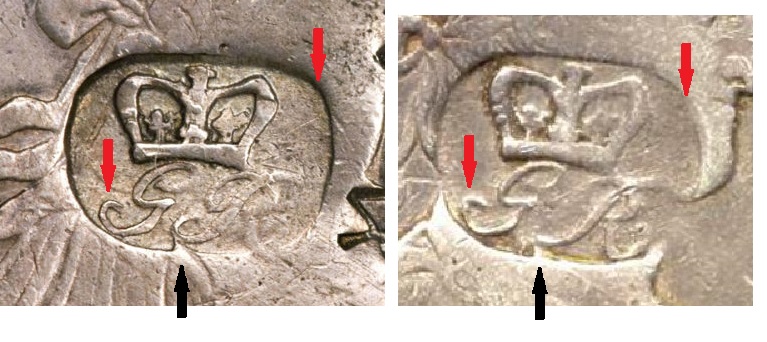 |
|
Pillar of the Community
United States
1758 Posts |
Excellent. When I did purchase West Indies counter stamps I followed two rules - good pedigrees and exact Pridmore plate matches or past MAJOR AUCTION specimen verification's. Sometimes a cataloger would indicate a new discovery type counter mark - but then you just have to decide based on your instincts. I think being in a Heritage Sale and certified this could take some political pull to take this out of the auction.
I spent a year assembling a top notch library on West Indies BEFORE my first purchase including all the big BALDWIN's sales who I consider the best firm to purchase these pieces from at auction. Its a DANGEROUS field FLOODED with forgeries and contemporary circulating counterfeits. To me this has some collector value ... as a novelty piece. Perhaps even several hundred ... that is just me ... although too many of these can POISON your collection ... CCCs and regals do not MIX very well in this series. <VVBG>.
JPL
Edited by colonialjohn
03/22/2016 08:10 am
|
|
Valued Member
United States
426 Posts |
Very, very informative. It looks like having knowledge on the historical context of when these coins were minted and how silver circulated across the world is very useful in discovering the fake stamp.
|
|
New Member
 United States
4 Posts |
swamperbob,
I asked a forum question regarding a potentially counterfeit George III Honduras Colony countermark on an 1808 Charles IV 8 Reales restrike with Chinese chopmarks about a year ago, to which you posted a very thorough response confirming my suspicions. The coin was just featured on the cover of 'Chopmark News', and I sent the editor a link to your findings. I just wanted to confirm with you if it was alright to reprint selections from your forum comments in a subsequent edition of the magazine updating the status of the coin?
|
|
Bedrock of the Community
United States
10284 Posts |
I reported this to HA.
I will update with their response.
|
|
Pillar of the Community
United States
7729 Posts |
That particular coin sold for $1762.50 in that auction.
I guess somebody thought it was real or didn't care.
|
|
Pillar of the Community
United States
5362 Posts |
A pedigree to a Heritage auction is about as good as an NGC authentication. But neither is actually any good. They both make errors. Heritage is a great source for high end counterfeits.
RE - using quotes taken from things I have written - I have no objection as long as they are properly attributed and that newer posts have not corrected older theories. In that vein it might be advisable to get my current take on the topic based on precisely what the quote would be. Many quotes have a definite context that needs to be properly understood.
For example - the necessity of the Gold trace in pre-1850 eight reales is correct provided the coin was made in Mexico and Not Peru. Also most XRF readings need to be properly interpreted to be of any value. Handheld XRF readings need more than a cursory review because the depth of the return signature is far more accurate for gold than it is for silver.
So you can use the data but please check first. This is especially true of older posts.
|
| |
Replies: 12 / Views: 5,377 |
|










 Posted 03/21/2016 4:10 pm


