| Author |
 Replies: 13 / Views: 4,566 Replies: 13 / Views: 4,566 |
|
|
Valued Member
Australia
248 Posts |
One of the things that has continually frustrated me over the years is the lack of reliable information regarding the relative frequency (or scarcity) of various 5c coin varieties.  Ever since I learnt that there were two different reverse dies used for the 1991-1994 release, I've noticed that the "large SD" version was extremely common in circulation coins dated 1991 and 1992, but much rarer in those dated 1993 and 1994. Nevertheless, the latest version of Macca's still lists the "large SD" version as being "rare" in both 1991 and 1992, which is odd considering that the "large SD" version clearly dominates the 1991 circulation release, and makes up a substantial portion of the 1992 one. As a result, I've compiled some statistics based on a random sample of 3347 circulating coins, which I'm hoping will shed some light on this issue once and for all. Although I'm going to keep adding to the sample as I keep noodling, now is a good time to publish some preliminary results. Here goes: Overlap between the Type 2 (high SD) and Type 3 (low SD) reverses: 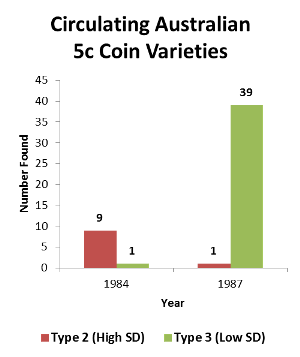 Overlap between the Type 3 (small SD) and Type 4 (large SD) reverses: 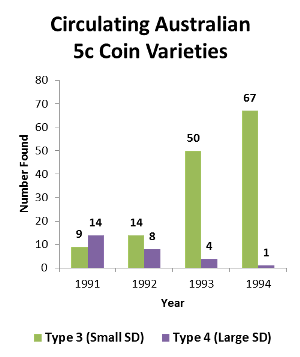 Overlap between the Type 3/5 (small echidna) and Type 6 (large echidna) reverses: 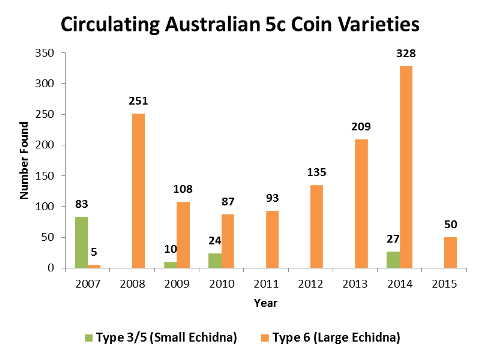 Distribution of the remaining coins, by year: 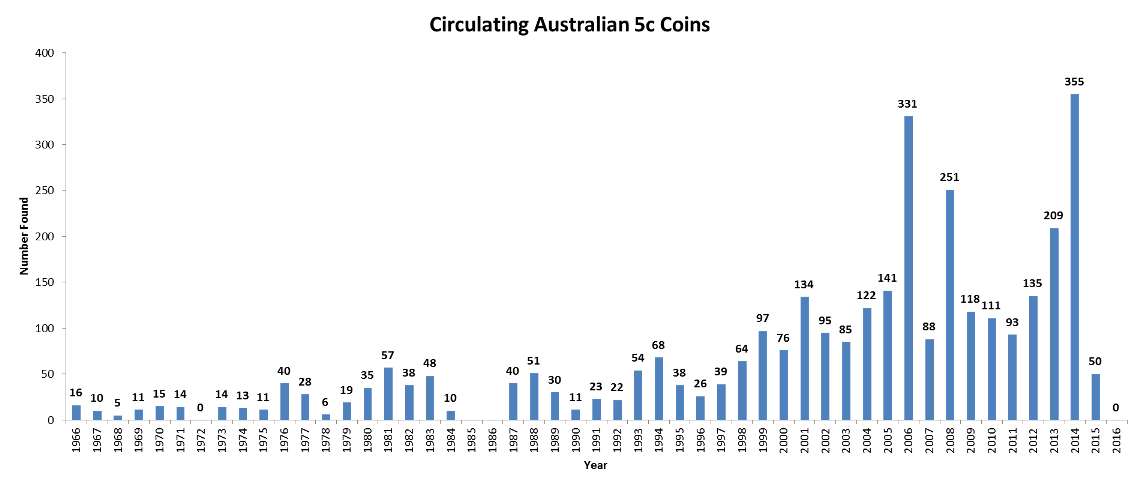 Overall, I've found this to be a truly fascinating and rewarding exercise, not least because I've discovered a whole bunch of errors and omissions in Macca's.  Has anyone else obtained similar results to mine? |
|
|
|
Pillar of the Community
United States
4212 Posts |
No, but I've now completed my full-run set. I find your work encouraging, as I now have unchartered searches
to look forward to.
|
|
Pillar of the Community
Australia
7096 Posts |
Quote:
but I've now completed my full-run set Well done Mate  |
|
Valued Member
Australia
102 Posts |
Thanks Hercules for clearing up some of these matters for us. I have been a member here for sometime but this is my first post, mostly because you all seem so knowledgeable here that there isn't much that I could add.
I am in the process of collecting all the variations described above. Can you / someone please tell what low and high SD is? Any pics of these would help. I assume it is different to small and large echidna, which is really low and high echidna isn't it? Aren't they actually the same size?
Thanks everyone. Great forum.
Hans
|
|
Valued Member
Australia
75 Posts |
There will be results of a larger survey in the October 2016 Coin and Banknote magazine
|
|
Valued Member
 Australia
248 Posts |
Quote:
Can you / someone please tell what low and high SD is? Any pics of these would help. I assume it is different to small and large echidna, which is really low and high echidna isn't it? Aren't they actually the same size?  Hans It's all in this thread: https://goccf.com/t/57054. Unfortunately, this thread hasn't been updated since 2010, so the information it provides from 2008 onwards isn't very accurate. For example, it implies that the Type 6 reverse was used exclusively for circulating coins dated 2008 onwards, but I've noodled plenty of 5c coins dated 2009, 2010 and 2014 that use the Type 3 reverse instead. I even use them as a consolation prize whenever I don't find a 1972. Quote:
There will be results of a larger survey in the October 2016 Coin and Banknote magazine That's very interesting. I got sick of waiting for other people to do a survey, so I decided to run my own and publish the results. It would be nice to know what other people have found, though.  |
|
Valued Member
Australia
102 Posts |
Thanks Hercules. From that link I gather that high and low sd is the same as high and low echidna.
Brissyboy's analysis is fantastic, but it is silent on 1997,1998 and 2000 variations. Does anyone have any pics of the different sized sd on these? I have noodled quite a few and cannot really see any difference. I am only magnifying 10x. Maybe it's not enough.
|
|
Valued Member
Australia
75 Posts |
I believe there is just one variety for each of 1997, 1998 and 2000.
|
|
Valued Member
Australia
248 Posts |
Quote:
Brissyboy's analysis is fantastic, but it is silent on 1997,1998 and 2000 variations. Does anyone have any pics of the different sized sd on these? These variations are listed in Maccas, but I've never been able to detect them with either the naked eye or a microscope. I'm sure these variations do exist, but they are so minute that they're not worth worrying about. I'd rather spend my time looking for a wavy or a mule.  |
|
Formerly nancyc
Australia
5385 Posts |
I have this in my images. 5c 2000, Med & Small SD, imaged on 10 Nov 2014. 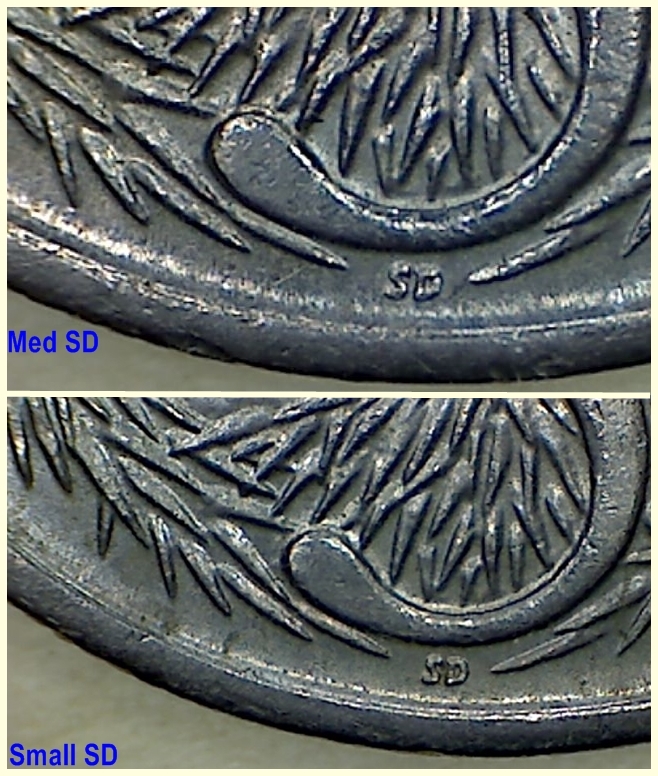 life is a mystery to be lived not a problem to be solved
|
|
Valued Member
Australia
102 Posts |
Thanks very much for your help everyone. Great pictures Nancy. Even with that magnification the difference is quite small. I think I can just make out the difference with my 10x magnifier, but mainly because the small SD is also finer, with a larger void inside the D. Trying to find all the variations in one hit is too much for me so I have put them aside to do some fun noodling on larger coins. It's the 2010 50 cent bubble that is eluding me!
|
|
Valued Member
Australia
248 Posts |
Quote:
I have this in my images. 5c 2000, Med & Small SD, imaged on 10 Nov 2014. Thanks, Nevol. The only problem is that you've used a different magnification for each coin, so you're really comparing apples with oranges. Do you have an image of both coins taken with the same magnification? Quote:
It's the 2010 50 cent bubble that is eluding me! There is no bubble on the 2010 50c. The bubbles are on the 2010 20c, the 2012 50c and the 2014 50c. However, the 2010 CoA 50c can be rotated. Edited by Hercules
09/09/2016 02:54 am
|
|
Formerly nancyc
Australia
5385 Posts |
Quote:
Thanks, Nevol. The only problem is that you've used a different magnification for each coin, so you're really comparing apples with oranges. Do you have an image of both coins taken with the same magnification? Not at present, I might be able to dig them out to take the images again, but it will be down the track a while. I'm currently in the middle of a massive reorganization of my coins. life is a mystery to be lived not a problem to be solved
|
|
Valued Member
Australia
248 Posts |
Quote:
I'm currently in the middle of a massive reorganization of my coins. Do you have any tips on how to do that? I got so carried away with noodling that I didn't think very much about how I was going to store them, and now my current system has become completely unmanageable. I've even started to lose interest in noodling, because I don't know how to manage the coins I've already got. |
| |
Replies: 13 / Views: 4,566 |
|





 Posted 04/17/2016 1:41 pm





