|
This page may contain links that result in small commissions to keep this free site up and running.

Welcome Guest! Registering and/or logging in will remove the anchor (bottom) ads and the security checks. It's Free!
To participate in the forum you must log in or register. | Author |
 Replies: 9 / Views: 3,037 Replies: 9 / Views: 3,037 |
|
|
Pillar of the Community
United States
6370 Posts |
You all are probably familiar with the round-coin-with-square-hole style of Chinese cash coins. The square hole was adopted to ease the process of filing off the casting sprues as the coins would not rotate when slid onto a square peg. However, there is a type of round coin that predates these that has a round hole in the middle. I have read that this design was created to emulate jade rings that symbolize eternal life, in the same way spade coins and knife coins emulated spade and knife tools, respectively. The round hole served no real purpose other than to facilitate stringing the coins together. The inscription on the obverse says "Yuan," which was a city in the ancient state of Liang, not the monetary donomination. This variety is by far the most common, and all other types are incredibly hard to obtain. While I have no written provenance, I presume that it was one of 1180 "Yuan" coins unearthed from a 1981 hoard in the Henan province of Modern-Day China. Its patina matches several I have seen for sale, and you can see the imprint of another coin on the reverse, which shows that it was buried between other coins. (Usually the imprint of another coin on a coin in question is a sign of authenticity, but I have seen counterfeits that display this feature, though it looks more like a vise job than a transfer of patina.) The round-hole coins are a product exclusively from the states that produces spade coins during the Warring States period. During this era, there were two monetary systems in China, one based on spades and one based on knives. The two types circulated contemporarily, and there was little overlap, with the only exception coming to mind being the city of Lin. The coins with the square holes came from the states that used knives exclusively. However, as the kingdom of Qin grew in power (a spade state), they started casting coins with square holes known as Ban Liangs. These were produced in such industrial quantities that a square hole was needed to make an efficient filing process. But more on that later. Round Coin Round Hole ca. 400-220 BC, though likely 350-250 BC Obverse: Yuan (a city in the state of Liang) Reverse: Blank (note the impression of another yuan coin in the reverse. This usually means that the coin is authentic hoard material) H-6.3  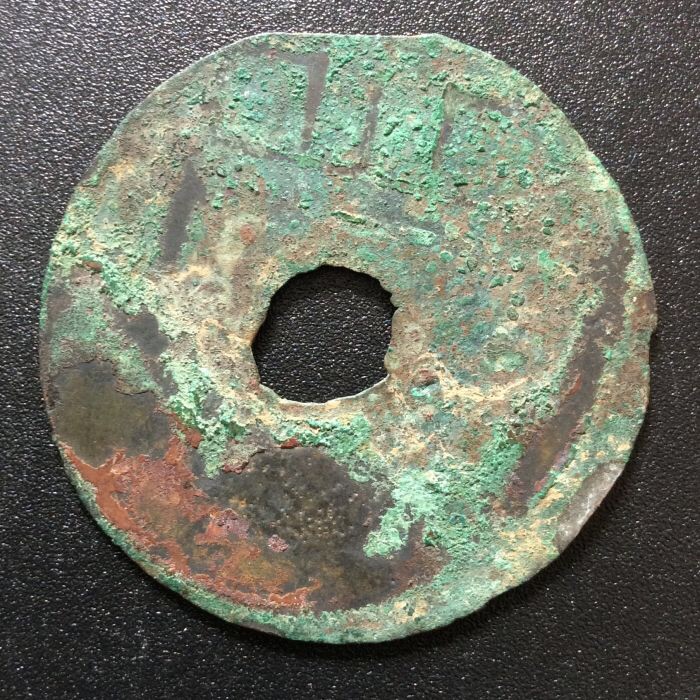 Edited by TypeCoin971793
04/22/2016 11:54 pm
|
|
|
|
Pillar of the Community
United States
7067 Posts |
Excellent write-up as usual, TC971793.
|
|
Moderator
 United States
23731 Posts |
Nice coin and interesting write up. Refresh my memory what is the approximate date of this coin?
|
|
Pillar of the Community
 United States
6370 Posts |
I knew I forgot something. Attribution (with date range) added.
|
|
Pillar of the Community
United Kingdom
2624 Posts |
Thanks for the education. I only have half a dozen ancient Chinese and no round holes for me.
You remind me of an expression "square peg in a round hole" which means someone who doesn't fit in... I just checked the derivation and it was nothing to do with this (it came from a lecture in the early 1800's)
|
|
Moderator
United States
34567 Posts |
Thanks @typecoin for the write-up on this early cast coin.
"If you climb a good tree, you get a push."
-----Ghanaian proverb
"The danger we all now face is distinguishing between what is authentic and what is performed."
-----King Adz
|
|
Valued Member
Netherlands
91 Posts |
As promised, my newly acquired "Yuan" inscribed round coin: (thought I would show it here in this topic, seems like a good home for it ;) ) 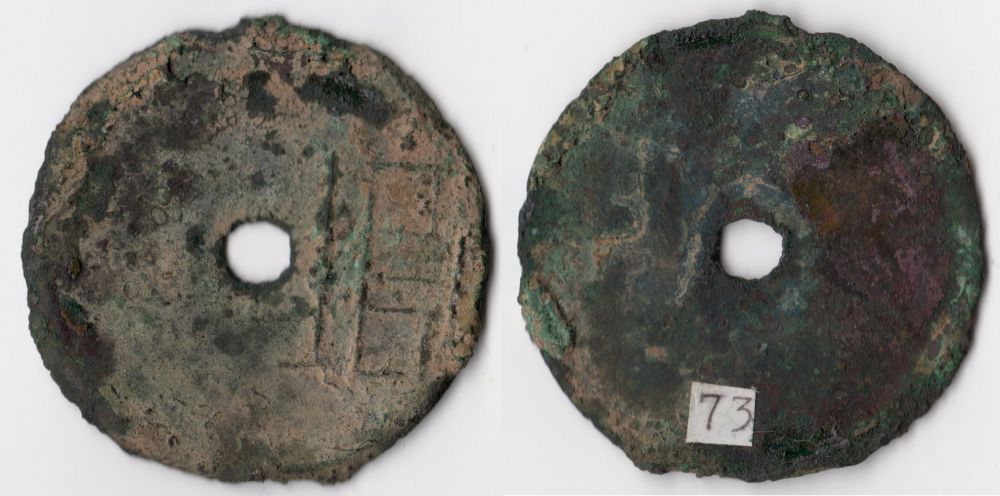 Obviously, the condition of this coin is slightly worse than the one shown by Thomas in the beginning of this topic. Nevertheless, I am quite happy with it. It probably was also part of a hoard, seeing as both on the obverse and reverse part of the rim of the adjacent coin is visible in the patination. Quite a bit of corrosion on the edges and an uneven patina, which is probably why it was a little on the cheap side. It comes from an old German collection, formed during the seventies and eighties, which is always a good sign (the older the collection, the less chance it has of containing fakes, although it is definitely not impossible! Even the famous Ramsden and Schjöth collections, formed during the early 20th century, contained fakes!). The auction house had (and has) quite a few coins from this collection available, all having a such a Schjöth number glued to the reverse. I am again assuming it is genuine, the folks over at Zeno seem to agree with me, but feel free to give your opinion. I originally was quite impressed by the size, usually between 40 and 42 mm. Mine measures 42 mm and 10.57 gram. Also note the rather small hole, especially compared to the larger one on Thomas's coin. Please do comment! Oh, and just one slight addition to your excellent write-up: Quite a few of the metal contents of these coins have been analysed, nearly all coming to the same conclusion; these coins contain a relatively high percentage of copper (often upwards of 90%), especially compared to the other round coins from this period. But how come? As mentioned, these coins were from the Liang (Wei) state, one of the central states that emerged after the partition of Jin at the beginning of the Warring States period. To be more specific, the city of Yuan, literally meaning "a (city) wall", was probably located in what we would now call Yuanqu county, in the south of Shanxi province. Shanxi literally translates into "West of the Mountains", referring to the Taihang mountain range in central China, slightly east of the province, although some of the foothills (hope I am using this term correctly) are still located within the province itself. It is in one of these foothills, that the city of Yuan was located. As it turns out, the area was quite rich in copper ore, and the mining of it dates back to at least the Shang period. It is highly likely that these coins were minted from the copper dug up only a couple of miles away. Mika Ps. You mention Qin was a spade state. I am assuming you are referencing to the round footed (holed) bu's here? |
|
Pillar of the Community
United States
6370 Posts |
Quote:
Obviously, the condition of this coin is slightly worse than the one shown by Thomas in the beginning of this topic. Nevertheless, I am quite happy with it. It probably was also part of a hoard, seeing as both on the obverse and reverse part of the rim of the adjacent coin is visible in the patination. Quite a bit of corrosion on the edges and an uneven patina, which is probably why it was a little on the cheap side. It comes from an old German collection, formed during the seventies and eighties, which is always a good sign (the older the collection, the less chance it has of containing fakes, although it is definitely not impossible! Even the famous Ramsden and Schjöth collections, formed during the early 20th century, contained fakes!). The auction house had (and has) quite a few coins from this collection available, all having a such a Schjöth number glued to the reverse. I am again assuming it is genuine, the folks over at Zeno seem to agree with me, but feel free to give your opinion. I originally was quite impressed by the size, usually between 40 and 42 mm. Mine measures 42 mm and 10.57 gram. Also note the rather small hole, especially compared to the larger one on Thomas's coin. My first thought when I saw your coin was that the patina was incredibly similar to that on some counterfeits I own. 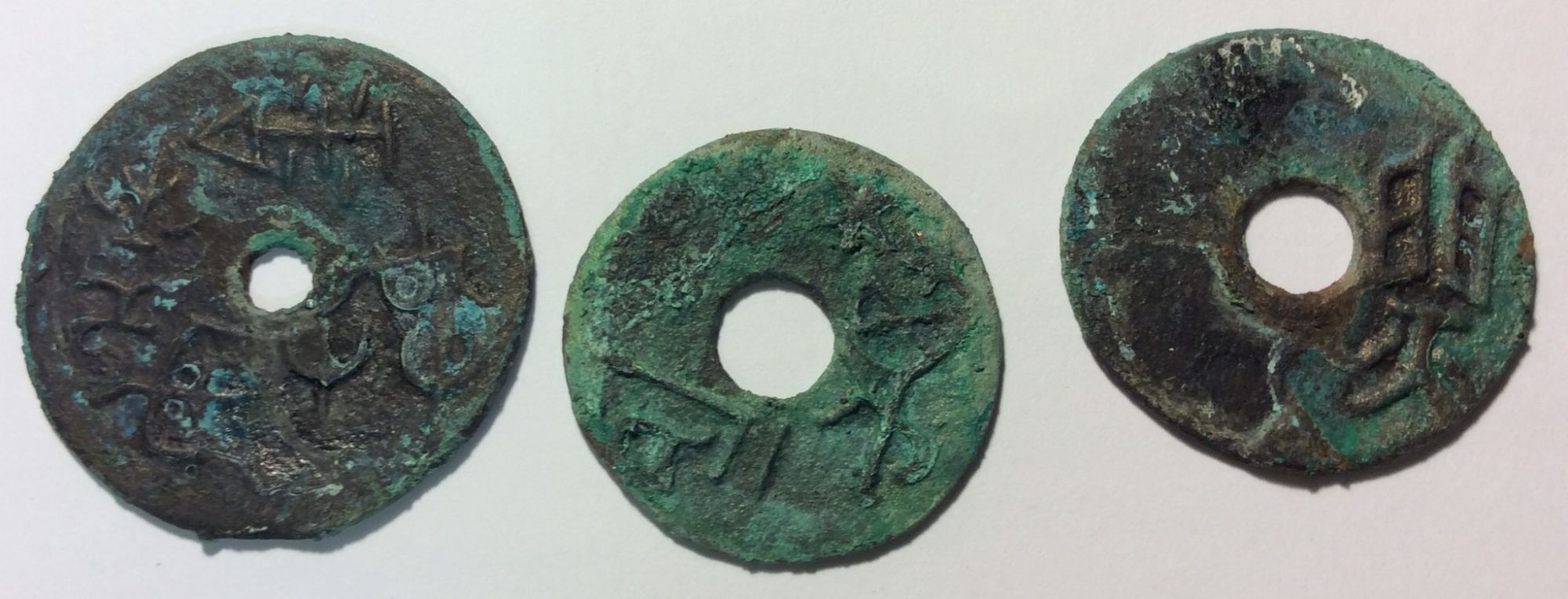 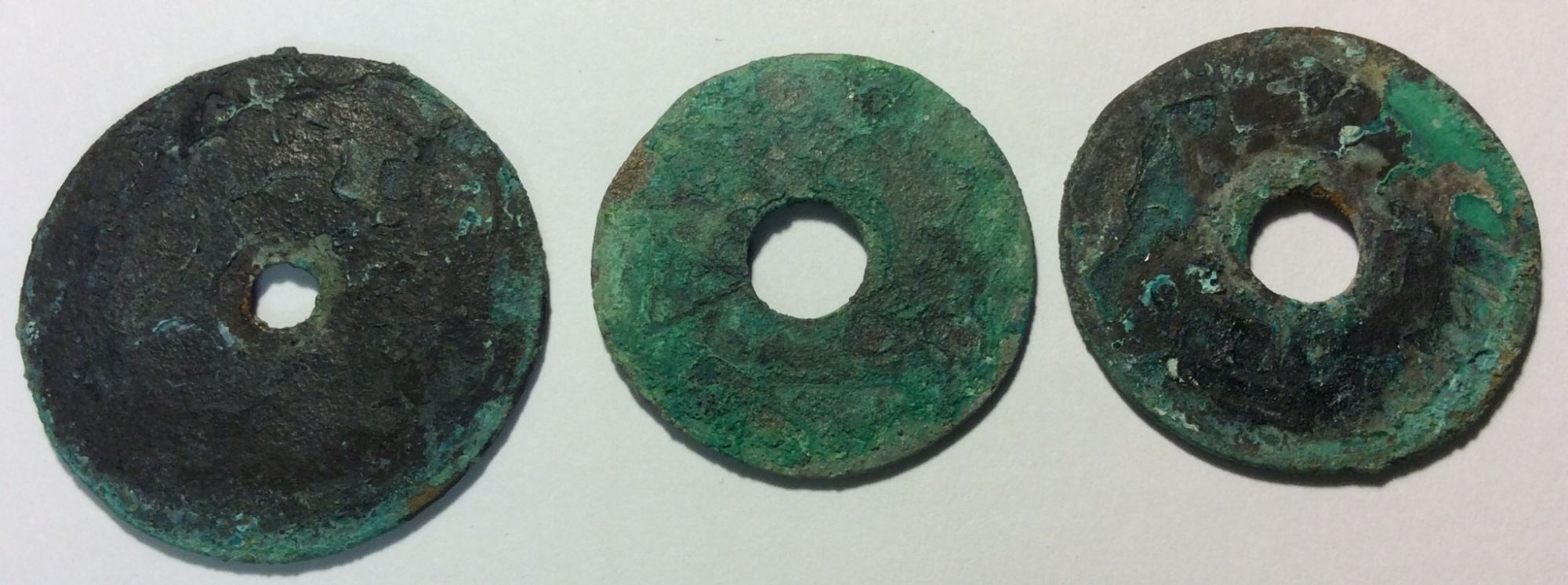 But upon closer inspection, I feel the patina on your coin is actually old. It has more character and looks more natural than that on my counterfeits. Also, the corrosion, correct weight, and the evidence of being stuck to other coins help in saying your coin is genuine. Also, the style of the coin is correct, while the strokes are all fat on my countefeits. In addition, the auction house you are buying from has offered fakes in the past (and currently has a couple listed), so I am fairly leery of the scarcer stuff they offer. However, the inventory sticker is old, and the coins were not as valuable back then, so counterfeiters would not have been focusing on this issue to make their most money. A word of caution: evidence of being buried with other coins is no longer a surefire method of authentication. The counterfeiters are burying their coins for extended periods of time to get a somewhat natural-looking patina. They even sometimes put impressions of other coins into their coins (though they are literally pressed into the coin, not simply patina stripping/sticking in the shape of characters). What I see on your coin is a transfer of patina when hoard coins are pried apart, which is a good sign. Quote:
Quite a few of the metal contents of these coins have been analysed, nearly all coming to the same conclusion; these coins contain a relatively high percentage of copper (often upwards of 90%), especially compared to the other round coins from this period. But how come? As mentioned, these coins were from the Liang (Wei) state, one of the central states that emerged after the partition of Jin at the beginning of the Warring States period. To be more specific, the city of Yuan, literally meaning "a (city) wall", was probably located in what we would now call Yuanqu county, in the south of Shanxi province. Shanxi literally translates into "West of the Mountains", referring to the Taihang mountain range in central China, slightly east of the province, although some of the foothills (hope I am using this term correctly) are still located within the province itself. It is in one of these foothills, that the city of Yuan was located. As it turns out, the area was quite rich in copper ore, and the mining of it dates back to at least the Shang period. It is highly likely that these coins were minted from the copper dug up only a couple of miles away. I very much appreciate your historical anecdotes; you have been doing more research than I! They are quite interesting and I always look forward to whatever insight you bring. Quote:
Ps. You mention Qin was a spade state. I am assuming you are referencing to the round footed (holed) bu's here? I know they have been credited with those spades, and I thought there some others that were made in Qin (please stand by on verification). What I was getting at was that they certainly didn't cast any knife coins, even if they only dabbled a little bit in spades. |
|
Moderator
United States
34567 Posts |
@mika, what a great addition to this thread. I'm learning a lot from both of you.
"If you climb a good tree, you get a push."
-----Ghanaian proverb
"The danger we all now face is distinguishing between what is authentic and what is performed."
-----King Adz
|
|
Valued Member
Netherlands
91 Posts |
Thanks Thomas and Spence! One of the main reason I collect is because of the (monetary) history preserved in these coins, and what better than to share this with people who genuinely enjoy this!
Indeed, the fakes have gotten so good that even the best of the best have trouble separating the counterfeits from the originals. Forgers even go so far as to break some of their "coins" and gluing them back together, then saying such a break is evidence of it being real. Many genuine Qi Knives for example have also been broken in similar fashion (I believe Thomas's specimen as well), so telling them apart keeps getting harder and harder. I think that it is partly due to this fact that a lot of people are deterred from collecting ancient Chinese cash. Such a shame, because it really is an interesting topic!
As for the Qin-spades, I believe Wang Yü-Ch'üan attributed some of the flat handled square and pointed foot spades to places within the Qin domain. However, more recently all these seem to have been attributed to the other states, known to certainly have issued spade type coins. But you're right, they for sure didn't issue any knives! They did however issue perhaps the most famous round coin, but more on that later.....
Edited by AnYangMan
10/18/2016 10:06 am
|
| |
Replies: 9 / Views: 3,037 |
|
To participate in the forum you must log in or register.
Disclaimer: While a tremendous amount of effort goes into ensuring the accuracy of the information contained in this site, Coin Community assumes no liability for errors. Copyright 2005 - 2026 Coin Community Family- all rights reserved worldwide. Use of any images or content on this website without prior written permission of Coin Community or the original lender is strictly prohibited.
Contact Us | Advertise Here | Privacy Policy / Terms of Use
|
| Coin Community Forum |
© 2005 - 2026 Coin Community Forums |
| It took 0.44 seconds to rattle this change. |
 |
|
| |
| |




 Posted 04/22/2016 11:25 pm


