| Author |
 Replies: 28 / Views: 10,313 Replies: 28 / Views: 10,313 |
|
Moderator
 United States
23731 Posts |
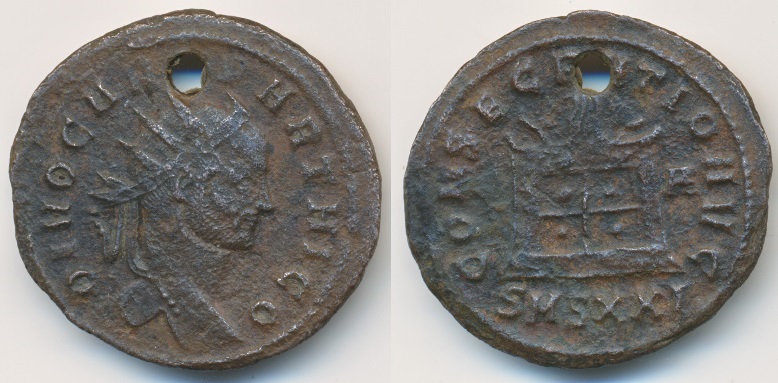
Those of us that collect ancient coins are going to come across coins with holes either punched or drilled through them. I've wondered why this was done. Some of my questions were answered on this link http://www.forumancientcoins.com/mo...d_coins.html, but this some questions go unanswered. Most of the holed coins we come across are crudely punched leaving the coin malformed. There are some however that are very skillfully done. One of those is a coin that I've had for many years of Constantine I. There are two holes skillfully drill from the reverse side and countersunk. IMO this was not done in modern times with a modern drill, but done shortly after the coin was struck. If you have any holed coins post them here. 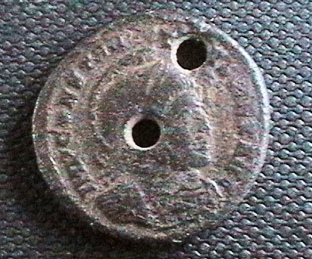 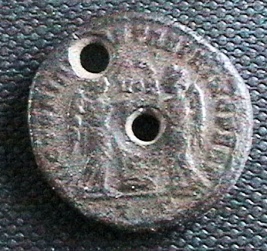 |
|
|
|
Pillar of the Community
United States
7067 Posts |
My holies: 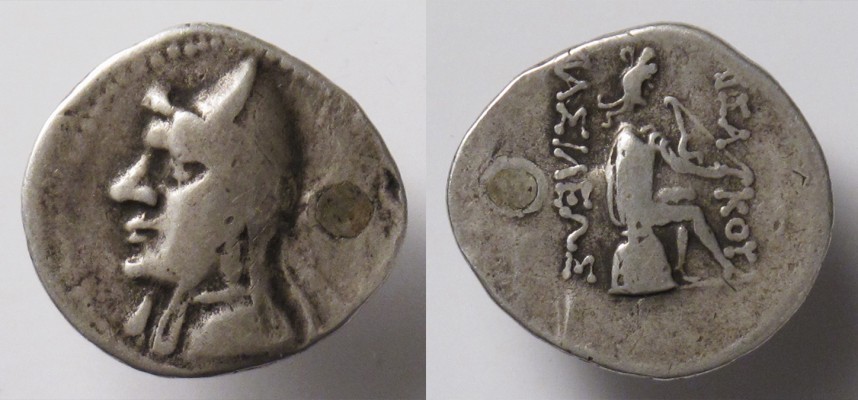 Mithradates I drachm, 171 - 138 BC Sellwood 9.1 (hole filled) 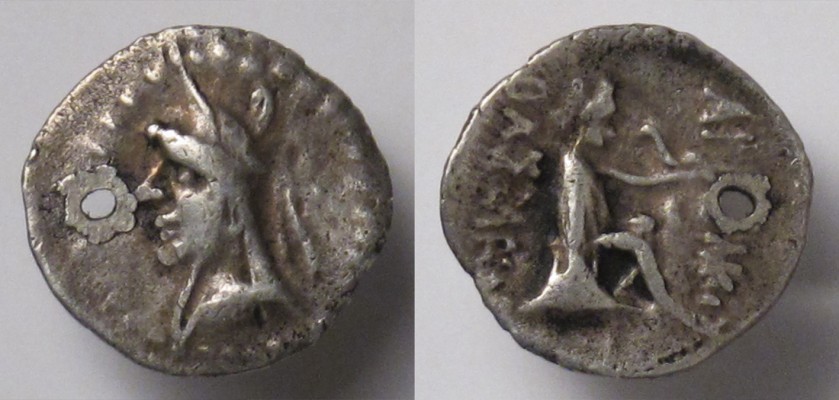 Mithradates I obol, 171 - 138 BC Sellwood 9.7 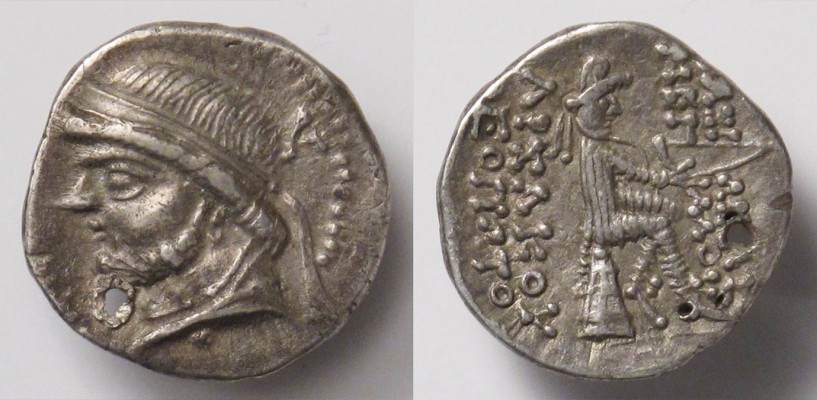 Phraates II drachm, 138 - 127 BC Sellwood 16.3 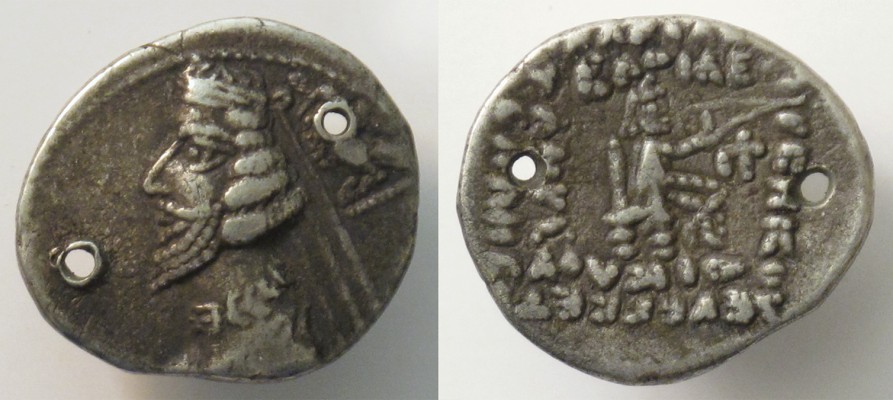 Phraates IV drachm, 38 - 2 BC Sellwood 52.12 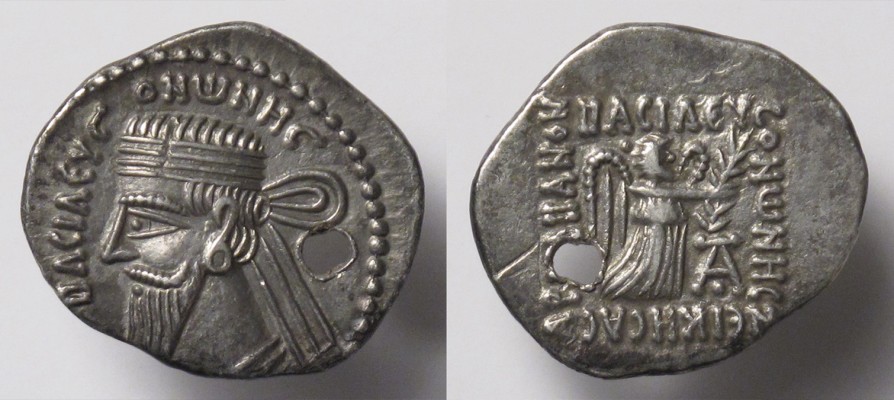 Vonones I drachm, 8 - 12 AD Sellwood 60.5 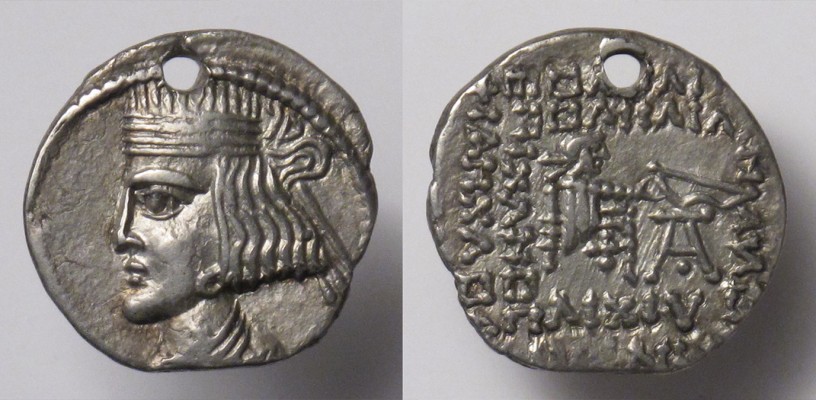 Pakoros II drachm, 78 - 105 AD Sellwood 73.13 (pretty rare type) |
|
Moderator
 United States
23731 Posts |
Nice ones Bob, thanks for posting them.
|
|
Moderator
United States
34560 Posts |
Interesting thread echizento. Have you considered that your two-holer Roman might have been a whirligig?
"If you climb a good tree, you get a push."
-----Ghanaian proverb
"The danger we all now face is distinguishing between what is authentic and what is performed."
-----King Adz
|
|
New Member
United States
10 Posts |
I'm not certain where I came up with this shred of knowledge. Perhaps College in 1972. It's been part of my thoughts since, that Women of the Middle East sewed coins into their clothing. Thus carrying their wealth on their person. A coin hole would have been required. As needles and thread from the time might be far more coarse, the hole would have been larger.
I'm not strongly attached to this idea, but I recalled it when reading this thread.
Gary
|
|
Valued Member
United States
119 Posts |
I've often wondered
The same. I have a collection of indo Chinas with holes. I always thought it was to wear?
|
|
Pillar of the Community
United States
513 Posts |
My one holed coin is Parthian. It seems really common in eastern coins (or at least more common than in Roman/Green coins.)  A Parthian silver drachm of Artabanos II, minted in Ekbatana between 10-38 AD. 20.7mm, 2.7g - See more at: http://s807.photobucket.com/user/ar...pml2TRT.dpuf |
|
Moderator
United States
23731 Posts |
Coinmaker  to the community It's well know that coins were sewn into clothes which could explain the holes. But if that was the case, why would the holes be countersunk? spence, could have be a whirligig  |
|
Valued Member
Netherlands
409 Posts |
|
|
Pillar of the Community
United States
1315 Posts |
L.Thorius Balbus, fouree. 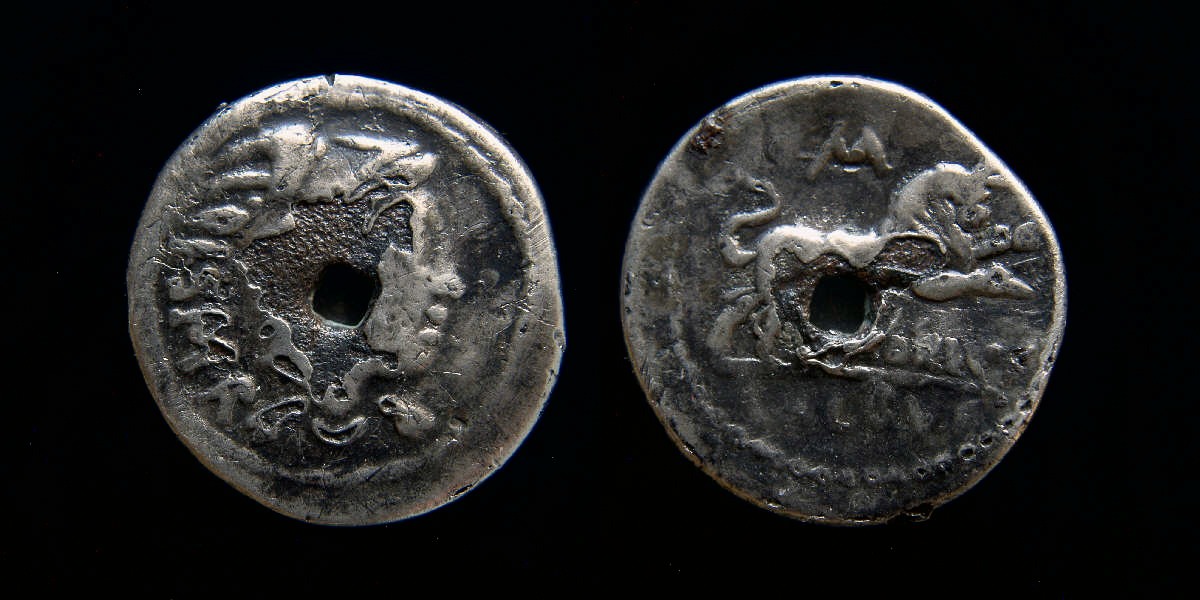 |
|
Pillar of the Community
United States
6370 Posts |
I like how this last coin has a square hole from a square nail.
|
|
Pillar of the Community
United States
7067 Posts |
The neat thing about a hole, even if we can't be certain about its purpose, is that it tells us about one specific event in the life of the coin. Most ancients collectors have at one time or another handled a coin and wondered about the individuals who held that same coin two millennia or so ago - and perhaps been frustrated by their inability to do more than speculate (i.e. dream) about the coin's individual history.
Of course a reconstruction of the coin's history in antiquity is impossible - where it traveled, what transactions it was used for, how many exchanges it was used for, and when and how (and if) it was lost to history only to be rediscovered centuries later.
In most cases only the event of minting serves as a tangible, visible record of a specific day in a coin's life. But holes, along with bankers' marks, test cuts, graffiti, and such, are the residue of singular ancient events "experienced" by a coin. While a coin may serve as a medium connecting a collector to a culture and time, holes and such may connect the collector with the unique individual whose actions affected the fabric of the coin centuries ago. So, while some folks devalue ancient coins with cuts and holes and graffiti based on aesthetics, for me these things add value - even if not in the monetary sense.
Great topic, Ron. Thanks for starting the thread.
|
|
Moderator
Australia
17005 Posts |
The holed silver pieces are, no doubt, a legacy of the tradition of women holing and wearing their wealth, as Coinmaker said. And the fouree was clearly nailed to invalidate it and/or hang it on the wall as a warning and reminder.
Echizento's late Roman bronze holed piece is more of a mystery, as it was not holed as a symbol of wealth - late Roman bronzes were practically worthless back in their day - nor as a counterfeit. Nor even for decoration, as the design has been badly abused; yet it is not so badly abused that we might imagine it to be some simple form of damnatio memoriae. The "random" and "ugly" placement of the holes lead me to believe this is purely a utilitarian object: someone needed a round metal object with two holes in it just so, and a coin was a convenient piece of metal to use to start with. Perhaps a makeshift button, or a repair to a piece of horse's kit or armour.
Don't say "infinitely" when you mean "very"; otherwise, you'll have no word left when you want to talk about something really infinite. - C. S. Lewis
|
|
Pillar of the Community
United States
1315 Posts |
Sap's explanation of Echizento's two holed coin makes sense to me, it would also account for the beveling on both sides.
A tie (perhaps leather) would be less likely to be cut by the edges of the holes when beveled.
|
|
Moderator
United States
23731 Posts |
Interesting comment on the subject, thanks for all the input. Here is another interesting one. 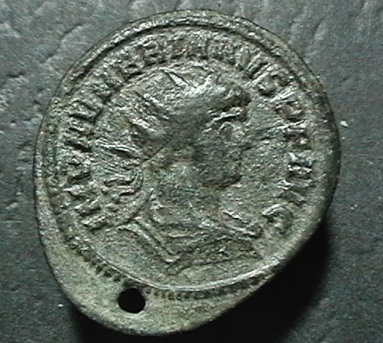 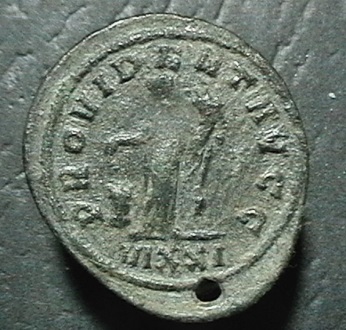 |
|
Pillar of the Community
United States
949 Posts |
Why assume the holing is contemporaneous with a time when the coin was in circulation?
As jewelry (earrings, bracelets, belts, pendants, etc) or ornamental decoration (medallions, bangle insets, noisemakers, etc) they could have been holed and put to use any time. We have nearly 2000 years to play with. Hoards have been stumbled upon as "buried treasure" for centuries. Excavated coins still had a decorative function even if they no longer had fiscal value, and some had value as melt 1000 years ago even as they might today.
|
| |
Replies: 28 / Views: 10,313 |







 Posted 04/27/2016 9:17 pm