Doug Winter Numismatics -
Many collectors of 19th century rare date gold (finally) appreciate coins with natural color and choice surfaces. I'm not sure that there is an actual consensus among these collectors about what "natural" color actually is but I, for one, am glad to see dirty gold more appreciated than its bright, shiny counterparts.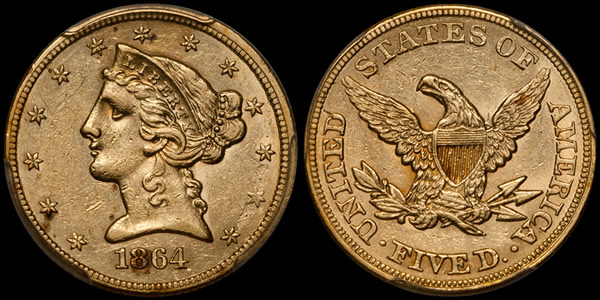
As collectors become more insistent on originality, they are quickly discovering that many 19th century issues are extremely hard to locate with a nice, natural appearance. Why is this?
I believe that the answer(s) to this question is actually more complex than generally assumed, and it encompasses a century old timeline.
The first reason—and maybe the most obvious—has to do with low original mintage figures and even lower survival rates. Many No Motto issues (and the equivalent era for gold dollars, quarter eagles, and three dollars) have low mintage figures. In the case of the branch mint issues, these figures were often under 10,000 coins and nearly always below 25,000-50,000. Given that the typical survival rate falls within the 0.5 to 2.5% range, this means that were are invariably talking about coins which number between 50 and 250 known.
The second reason has to do with heavy circulation patterns, especially for No Motto New Orleans and San Francisco issues, and all pre-1885 Carson City issues. The quarter eagles, half eagles and, to some extent, eagles from these mints/this era saw active use in circulation. As an example, look at the San Francisco half eagles and eagles dated 1858 through 1876. With very few exceptions, these dates are all rare from an absolute standpoint (the total number known) and nearly all are very rare from a condition rarity standpoint. If a coin has seen enough time in circulation to grade Very Good to Very Fine, the chances of it having been mishandled at one time are likely close to 90-95%.
Read the Entire Article 









 Posted 06/07/2016 11:24 am


