| Author |
 Replies: 11 / Views: 1,094 Replies: 11 / Views: 1,094 |
|
|
Pillar of the Community
United States
1499 Posts |
Here is odd coin, that you often don't see, a Masschusetts three pence. I saw my first example of this coin at the Peabody Museum in Massachusetts. I really liked the coin and wanted to add one to my collection, but they are hard to find and pricey. I'll say more later when the grading estimates are done. This piece is about the size of a dime. 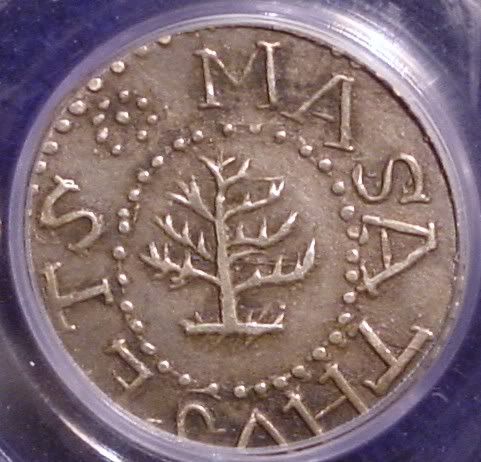 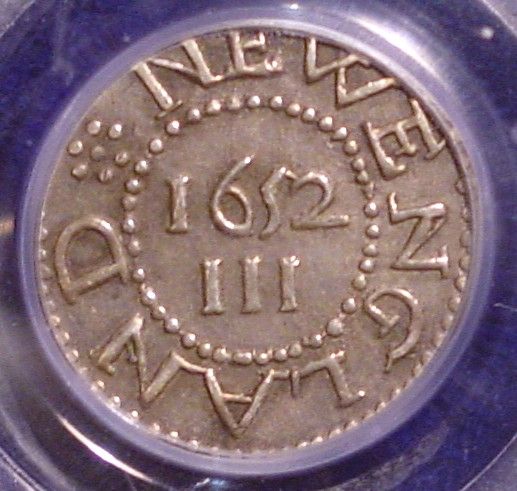 |
|
|
|
Pillar of the Community
United States
2189 Posts |
I will take a stab at it, AU-55
|
|
Moderator
 United States
16697 Posts |
I'm at AU53 on this one. Great coin!
swcoin.ecrater.com
|
|
Pillar of the Community
United States
3210 Posts |
I have no clue au55 as well
|
|
Rest in Peace
United States
4078 Posts |
|
|
Pillar of the Community
United States
4409 Posts |
Out of my league I'll go with the AU-55 crowd
|
|
Pillar of the Community
United States
5904 Posts |
No idea!
But it would be one center of attention piece if it were mine.
|
|
Pillar of the Community
 United States
5720 Posts |
Never seen one before, but I'll guess AU-50.
|
|
Bedrock of the Community
United States
94367 Posts |
Hardly any experience here, actually none, but I'll say AU-55. Beauty.
|
|
Pillar of the Community
 United States
1499 Posts |
Congratulations! Many of you got the grade on the nose and the others were very close. The grade is AU-55. These coins are hard to grade because there is no microscopic detail in the design. What I mean by that is unlike an Indian cent, for example, there is no "LIBERTY," hair detail, feathers and diamonds to use for grading. Everything is just "there" in one two dimensional design. Therefore one has to grade by surfaces, which can get technical and sometimes controversial. To the untrained eye one of these coins in VF can look as good as one in AU. Another factor is that these coins were struck on a rocker press and are usually bent. This especially true for the six pence and shilling. As anyone who has even really looked at a bent coin knows, those pieces wear unevenly. Therefore with a lot of Massachusetts silver from the Willow Tree coinage to the Large Pine Tree shilling era, these coins usually grade from Unc. and EF-AU to really ugly VG or lower coins. There is seldom anything in VF to EF-40. Since the three pence is small, the bending effect is not as pronounced. Therefore decent VF-30 or 35 graded pieces show up now and then. Finally these little three pence pieces are really scarce, but the sell for about the same price as the more common shillings. The reason, as usually, is the "bigger is better" attitude that many collectors have. Most collectors just don't care about these little coins. If they did, the prices would go into orbit, but you very rarely see these coins offered for sale. Edited by billjones
06/12/2016 09:59 am
|
|
Bedrock of the Community
United States
18935 Posts |
This is such a cool piece of history. I remember getting my first RedBook in 1968 and was just mesmorized looking at the picture of a willow tree pence thinking how neat it would be to own one.this one is a beauty |
|
Pillar of the Community
United States
1499 Posts |
Quote:This is such a cool piece of history. I remember getting my first RedBook in 1968 and was just mesmorized looking at the picture of a willow tree pence thinking how neat it would be to own one.this one is a beauty The Willow Tree Massachusetts silver coins are lot tougher than the Oak Tree, Pine Tree and even the NE shillings. They were all poorly struck to one to degree or another because in most cases the dies seemed to be moving when the coins were struck. The designs and lettering are almost always poorly defined, even on higher grade pieces. A lot of them were worn smooth while in circulation, and probably sent back to John Hull's mint for re-coinage. I've looked at the Oak Tree three and six pence coins, but have been outbid every time. Oddly enough the Oak Tree Two pence coins are fairly common, for a Massachusetts silver coin, because they were made in quantity. |
| |
Replies: 11 / Views: 1,094 |
|







 Posted 06/10/2016 5:59 pm





