| Author |
 Replies: 25 / Views: 3,656 Replies: 25 / Views: 3,656 |
|
Pillar of the Community
United States
6370 Posts |
This is a brand new purchase for me, and an exciting one at that. With this purchase, my type collection of knife coins is complete. This type of knife has not been seen at auction since 2008 (definitely, but there might have been an appearance in 2011), so I snatched it up while I had the chance. The price was very fair, so I have no regrets. It is called a Boshan knife because this type of knife coin was discovered in the early 1800's in the city of Boshan. They are characterized by having a large, angular "Ming" character on the obverse, and multiple characters on the reverse. Boshan knives are intriguing in that they are a fusion of two other types of knives: the Qi knives cast by the state of Qi and the Ming knives cast by the state of Yan. The obverse and the overall shape of the Boshan knives resemble that of the Ming knives with the single obverse character "Ming." The reverse resembles the obverses of the Qi knives. This mixture of types makes for an easy attripution to 284-279 BC. The city of Boshan is in an area that was under Qi control during the Warring States Period. However, the state of Yan was in control of this area during that narrow time window, so these coins were probably made then. 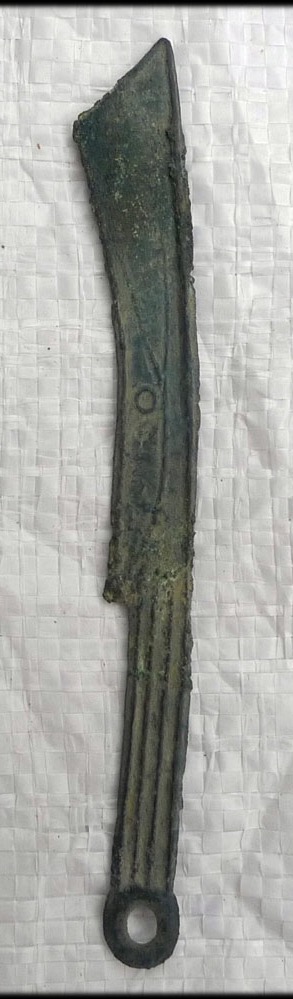 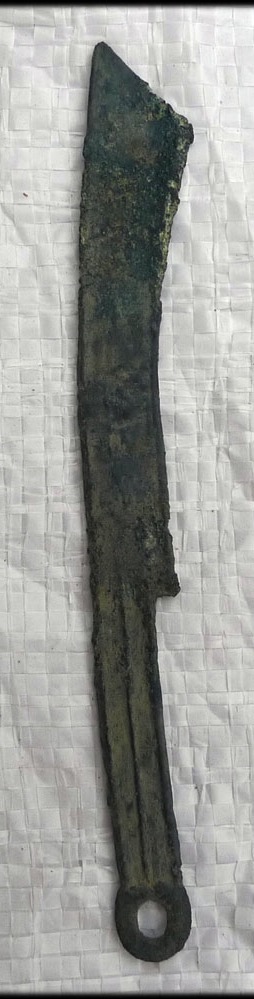 |
|
|
|
Moderator
 United States
23731 Posts |
Congratulations on completing the series. Very nice coin.
|
|
Pillar of the Community
United States
7067 Posts |
Always a good feeling to fill in a collection gap with a rarity. Congratulations, Thomas...your patience paid off. Interesting type.
|
|
Moderator
United States
34562 Posts |
Very nice addition. Can you show us the characters on the rev? I can't see any on thei pic you posted. Thx.
"If you climb a good tree, you get a push."
-----Ghanaian proverb
"The danger we all now face is distinguishing between what is authentic and what is performed."
-----King Adz
|
|
Pillar of the Community
 United States
1950 Posts |
|
|
Pillar of the Community
 United States
6370 Posts |
Quote:
Can you show us the characters on the rev? I can't see any on thei pic you posted. Thx. To be honest, I can't see them either. I will update this thread when I get it in-hand. This is a fairly low-grade piece, which is why I could afford it. Better-grade specimens sell in the order of $2000-3000. I got this one for $175 from a very tusted dealer I have bought from several times before. |
|
Moderator
United States
34562 Posts |
Sounds great! Just to be clear, I wasn't suggesting that there was anything wrong with your acquisition, but rather just interested in learning more about these.  "If you climb a good tree, you get a push."
-----Ghanaian proverb
"The danger we all now face is distinguishing between what is authentic and what is performed."
-----King Adz
|
|
Pillar of the Community
Russian Federation
5186 Posts |
I wonder if any (non-Chinese) collector ever managed to assemble the full set before... if they're really that rare, that couldn't have been anywhere near easy.
How far along are you on the other (non-knife) types of ancient Chinese money?
|
|
Valued Member
200 Posts |
Wow! I really like your coins!
|
|
Pillar of the Community
United States
6370 Posts |
Quote:
Just to be clear, I wasn't suggesting that there was anything wrong with your acquisition, but rather just interested in learning more about these. That's how I interpreted your original post. I was just saying that they are normally quite obvious, but they aren't very visible on this coin due to its low grade. I will try to point them out when I get it in hand. No hard feelings. |
|
Pillar of the Community
United States
6370 Posts |
Quote:
How far along are you on the other (non-knife) types of ancient Chinese money? All numbers are Percentage I have of the total types extant. About 2/3 with the spades (1/3 if you count the Wang Mang spades). 10% with cowrie imitations. 10% with misc proto-money. I can't give you an accurate estimate of the round coins, but I have about 300 pre-618 AD coins, and a couple hundred coins from after that date. Most are different to some degree or another, but the differences can be quite minor. I still have a long way to go, and some of the remaining types and varie Edited by TypeCoin971793
06/19/2016 10:50 pm
|
|
Pillar of the Community
United States
6370 Posts |
Thank you all for the positive input!
|
|
Pillar of the Community
United States
3552 Posts |
Quote:
...to 284-279 BC How far back do ancient Chinese coin knives go? Plus, on a personal note I was initially hesitant to select my Lydian coin as an avatar since there seems to be a debate on whether or not these Chinese knives should be classified as coins based upon their non-round shape. What seems to be the general consensus on this issue insofar as the oldest Chinese round coin/knife coin etc. |
|
Pillar of the Community
United States
6370 Posts |
Quote:
How far back do ancient Chinese coin knives go?
Plus, on a personal note I was initially hesitant to select my Lydian coin as an avatar since there seems to be a debate on whether or not these Chinese knives should be classified as coins based upon their non-round shape.
What seems to be the general consensus on this issue insofar as the oldest Chinese round coin/knife coin etc. The estimated start date is 600 BC, but there is no evidence to confirm that. The advantage your Lydian coin has is that is can be proven to be as old as 600 BC. There's no way to do that for Chinese coins. The Chinese knives and spades were used as money because they were too dull and structurally weak to be used as anything else. However, from what I've read, for a coin to be a coin, it needs to have some mark of an issuing authority. Otherwise, the object is just proto-money. My earliest spade and knife coin both have inscriptions, so, technically, they are both coins. Spade coins, however, have some stronger evidence for an early start date. There are poems and songs that mention spades that date to 500 BC. For spades to be regarded as a form of money by 500 BC, they must have had an earlier start date for the concept to be readily accepted and diffused into Chinese society. Various scholars (Schjoth for example) believe(d) that the Qi knives were from ca 900 BC, but that has been debunked on many levels, so your avatar is safe in that respect. |
|
Pillar of the Community
United States
1316 Posts |
Congratulations on the milestone! What a cool set! (and thanks again for the lead on my 1182 Chines coins!)
|
|
Pillar of the Community
Russian Federation
5186 Posts |
There are other contenders for pre-600 BC coins (the Ionian striated staters and the Phanes series of Ephesus come to mind), and I think some Indian punchmarked pieces are known from 6th century BC, but not 7th (though the dating for them is about as confusing as that for Chinese coins).
And don't even ask me about Olbian dolphins (the dating for these is all over the place, I've seen everything from 7th to 2nd century BC).
TL/DR: as far as anyone can tell, coins (or something that vaguely resembled coins) were invented independently in Asia Minor, India and China, apparently within a century of each other. Asia Minor was probably slightly earlier, but the specific issuer that made the first coins there is still somewhat uncertain (it might well not be Lydia).
|
| |
Replies: 25 / Views: 3,656 |







 Posted 06/17/2016 10:45 pm





