I was thinking that it might be an interesting study to see the whole variety of stylistic representations of a particular letter. I chose the letter "A" not because it is the start of the alphabet, but rather because it is quite commonly used and therefore the sample size from my collection was pretty decent. Also this letter in particular seems to have multiple interesting forms. Coins that are this old are typically found pretty beat up, but I have specifically chosen coins that best illustrate the shape of this letter.
The organization of this essay is from most the simple representation to the most complex as defined by the number of strokes (and is commonly done in some character-based languages, such as Mandarin Chinese) as opposed to chronologically or geographically. I should point out this essay is not meant to be an exhaustive study of early medieval numismatic typography and I would welcome everyone's corrections, additions, and input. If it ends up being fun, I may try the same for other letters down the road.
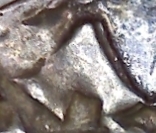
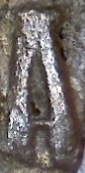
1 strokeIn its most simple form, the letter A is represented by a single up-down stroke, as can be seen on this Denar from the Austrian city of Bohemia dated 1061-1085 (Figure 1). In other cases, there seems to be a bit of thickening at the apex (Figure 2). This is from a Denier of Charles the Bald (840-870 AD) of France.
Fig 1:
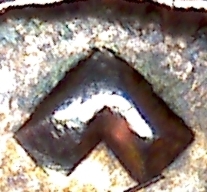
Fig 2:
 2 strokes
However, there are examples of this general "upside-down V" shape with two separate vertical strokes being connected at the apex, such as on this Denier of Richard I from Normandy France (943-996 AD) (Figure 3). The pennies of Aedelred in Great Britain (978-1016 AD) have the same shape, but comprise two separate vertical strokes of different lengths that do not touch (Figure 4). Sometimes the two separate strokes were mirror images of each other, as can be seen in this Denaro from Susa Italy (1103-1148 AD) (Figure 5). The lower parts of the vertical strokes flare out to nearly touch each other, thus giving the general impression of a triangular shape.
Fig 3:
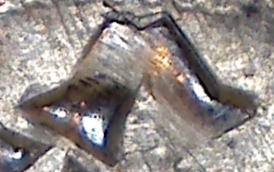
Fig 4:
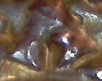
Fig 5:
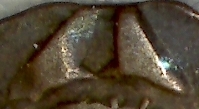 3 strokes
Perhaps unsurprisingly, the letter A was also portrayed very similarly to the letter H. In this case, the angle of the two vertical strokes was non-parallel and would just barely touch to form the apex. The vertical strokes are now connected primarily by a single horizontal stroke. One such example is a Denaro Scodatello from Milan (1039-1125 AD) (Figure 6). A slightly different take on this comes from a Denier of France dated 1060-1108 AD, where the two separate triangular strokes are topped by a third, inverted triangle (Figure 7--sorry about the poor quality of the letter on this one). Examples of a very modern shape to the letter A were also present in this timeframe. For example, the Denars of Friesland (Germany) under Herman I (1020-1051 AD) utilized a letter A that looks like it could be on a coin nearly one thousand years later (Figure 8). Similarly, the A on this Follis from Hungary (1172-1196 AD) is quite modern (Figure 9). In some cases, the letter A was really not pointy at the apex at all, but rather had a serif at the very top to cause the apex to be flat (Figure 10). This is from a Denar of the city of Cologne in Germany (936-962 AD).
Fig 6:
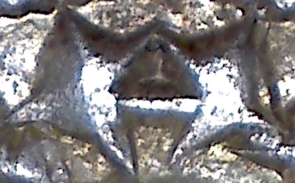
Fig 7:
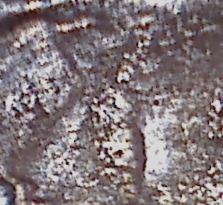
Fig 8:
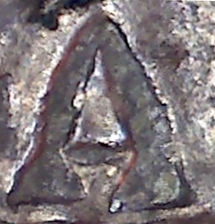
Fig 9:
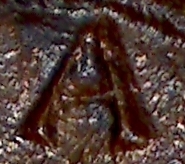
Fig 10:
 4 strokes
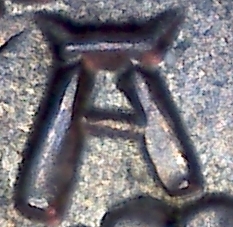
The flattened serif at the apex also manifested itself as a separate horizontal stroke. Here is a Denaro from the Italian commune of Brescia (1186-1254 AD) (Figure 11) which shows that clearly, although the lower horizontal stroke is almost hidden at the very bottom of the letter. This can be contrasted with the Denaro of the Italian republic of Genoa (1139-1252 AD), where the lower horizontal stroke is located mid-letter (Figure 12). Another example of letter A having a separate, upper horizontal stroke comes from Hungary (1020-1038 AD) (Figure 13). The fact that the lower horizontal stroke extends beyond the vertical stroke may be a minor variation as other examples of the letter A on Hungarian coins from the same timeframe do not have this feature (Figure 14). This is a Pfennig from Hungary (1046-1060 AD). You may notice that the horizontal stroke at the apex itself now has serifs.
Fig 11:
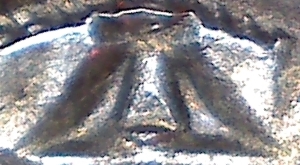
Fig 12:
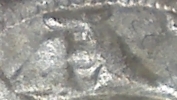
Fig 13:
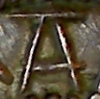
Fig 14:
 6 strokes
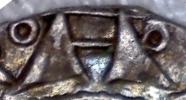
The most complex form of the letter A from this time period that I have in my collection comes from Antioch, where two annulets (i.e. tiny circles) were added to the outside of the letter, in between the upper and lower horizontal strokes. Here is a Denier from 1163-1188 AD (Figure 15). Perhaps someone more knowledgeable than I am within CCF can weigh in why this decoration was added? Was it Ottoman influence stemming from the crusades?
Fig 15:






 Posted 07/10/2016 1:53 pm





