| Author |
 Replies: 12 / Views: 2,432 Replies: 12 / Views: 2,432 |
|
|
Valued Member
United Arab Emirates
79 Posts |
|
|
|
|
Valued Member
United States
234 Posts |
The coins do not look authentic to me. The reverses seem to have soft details and looks like casting bubbles
|
|
Pillar of the Community
United States
7067 Posts |
The Vespasian seems to match a documented fake: 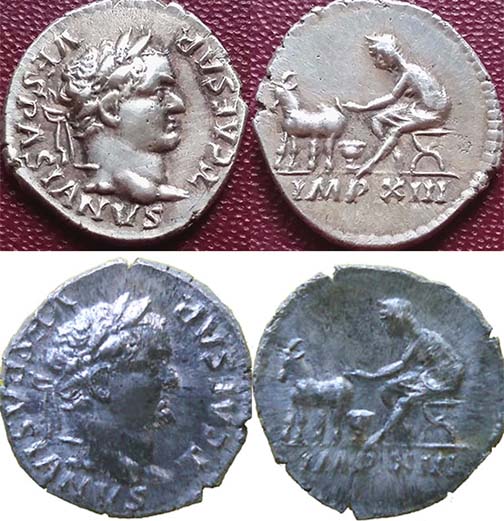 |
|
Pillar of the Community
United States
3495 Posts |
Well I don't think they were actually cast. I get the impression though that the dies were made from castings polished up a bit and then used to mint up some nice shiney new ancient coins !
Undoubtably fakes but of very good quality. It is coins like these that worry me the most.
Someone will acquire these and do some distressing on them to make them look ancient rather than the fresh off the press look they currently have.
With some adequate wear and tear and some authentic looking grime applied they look like they could fool many collectors.
|
|
Pillar of the Community
United States
3495 Posts |
Oh that is a match !
The owner rather than distressing it looks to have baked it in an attempt to give it a patina.
I have said before
I will say again
Silver ancients scare me !
There are some expert smiths out there doing better than average work.
Edited by FVRIVS RVFVS
07/16/2016 5:35 pm
|
|
Moderator
 United States
23731 Posts |
 to the community Someone went through a lot of trouble to produce these fakes. They are well made and while some do look cast the others appear to be struck. I wouldn't reveal which. I can see where these might fool a novice collector, but would not get past a more experienced one. |
|
Pillar of the Community
United States
3495 Posts |
I also see elements of both casting and striking which leads me to the conclusion that the dies were cast (bronze ?) then used to strike pure silver blanks, which when properly annealed is slightly harder than dried bubblegum.
|
|
Pillar of the Community
Spain
629 Posts |
I think that some of that coins are struck from fake dies
|
|
Valued Member
 United Arab Emirates
79 Posts |
Many thanks all! The owner is currently selling them on ebay, which is truly unfortunate since I've seen a number of bids already. I appreciate all the help! I had my doubts since I saw them, especially the Maximinus piece, looked weird. |
|
Pillar of the Community
Spain
629 Posts |
You never must buy a coin if you have a minimum doubt...
You have been very clever assuming that you need more experience with roman and greek coins instead of buying such bargains whithout thinking for a while (Nobody can be a master in every matter).
|
|
Pillar of the Community
Australia
1006 Posts |
I agree most definetely fake however the method of creating them would be a hybrid between striking and casting as stated by those above my post
|
|
Moderator
United States
54297 Posts |
Quote:
...a hybrid between striking and casting Is there even such a thing? Show your financial support of the Coin Community Family (click here)See my topic on Mexican Numismatic Medals (click here) |
|
Pillar of the Community
United States
7067 Posts |
Based on the flatness of the fields, I strongly suspect that at least some of these are stamped (machine pressed). The casting referred to above, nss-52, is for the dies (not the coins themselves), meaning that they (the dies) may have been taken from original, legit coins, as opposed to being engraved from scratch. Another method for using original coins as a starting point for new dies is a "spark and chemical erosion" process. Wayne Sayles describes a new tech called "trans-electrotype 3D die sinking" to create dies that sounds pretty scary since it creates "remarkable accuracy and fidelity" to the source material.
Edited by Kamnaskires
07/17/2016 09:27 am
|
| |
Replies: 12 / Views: 2,432 |
|







 Posted 07/16/2016 5:22 pm





