| Author |
 Replies: 11 / Views: 2,120 Replies: 11 / Views: 2,120 |
|
|
Pillar of the Community
Poland
3201 Posts |
|
|
|
|
Pillar of the Community
United States
4212 Posts |
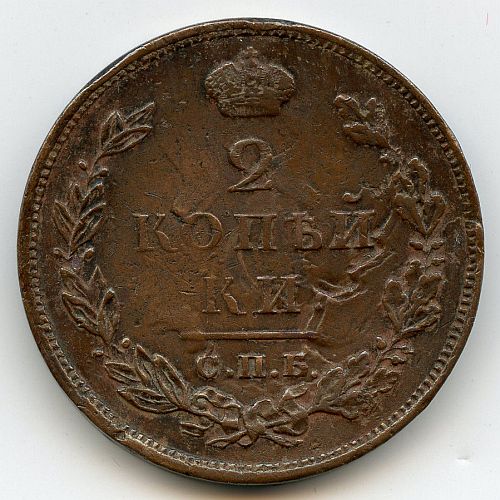
I dont believe it's ghosting, perhaps a clash?
|
|
Pillar of the Community
 Poland
3201 Posts |
The problem might be that this shape doesn't look like any device on the obverse of this coin  If someone placed another coin on it and took a hammer to them, I'd guess the rim of the other coin would make an impression as well, wouldn't it? And there is no sign of that. |
|
Pillar of the Community
United States
3516 Posts |
Or it could e a clash with another denomination like we see on the Flying Eagle cents of the US |
|
New Member
Belarus
30 Posts |
In Russia been the practice recoinage coins. The new coins were made of old coins. Perhaps it is the traces of the old coin.  |
|
Pillar of the Community
Australia
3841 Posts |
It's definitely a clash. You can see the outline of the double head eagle. This is just very pronounced.
|
|
Valued Member
Belgium
464 Posts |
very nice clashed specimen  |
|
New Member
Belarus
30 Posts |
gxseries, absolutely right. I did overlap. The result is identical. 
|
|
Pillar of the Community
Australia
3841 Posts |
The practice of overstriking over older coins stopped at the end of 1700s. I am not aware of any official Russian coins overstruck over older coins after 1800s
My partial coin collection http://www.omnicoin.com/collection/gxseriesMy numismatics articles and collection: http://www.gxseries.com/numis/numis_index.htmRegularly updated at least once a month. |
|
New Member
Belarus
30 Posts |
Yes you are right. The last official recoinage in Tsarist Russia - the end of XVIII - the beginning XIX century.
P.S. there is information about recoinage in Soviet Russia in the XX century.
Edited by _w_
09/15/2016 2:04 pm
|
|
Pillar of the Community
Australia
3841 Posts |
I think you are mixing up some terminology here. I believe you were talking about overstriking, which ended at the start of Paul I era (1797 - 1801). Overstrike is the use of older coins as planchets to be struck as fresh coins. This normally results in newer design with traces of the older design in the background.
The Soviet era "recoinage" is different. While similar planchets were used (with different metal composition), the value of the ruble was devalued from 10 to 1. So what was worth one ruble is now worth only 10 kopek.
My partial coin collection http://www.omnicoin.com/collection/gxseriesMy numismatics articles and collection: http://www.gxseries.com/numis/numis_index.htmRegularly updated at least once a month. |
|
New Member
Belarus
30 Posts |
Maybe I can not really be expressed. Unfortunately, I do not speak english and I use Google translator. A sense replaced and not always translated correctly. Excuse me!))).
|
| |
Replies: 11 / Views: 2,120 |
|












 Posted 08/02/2016 06:00 am


