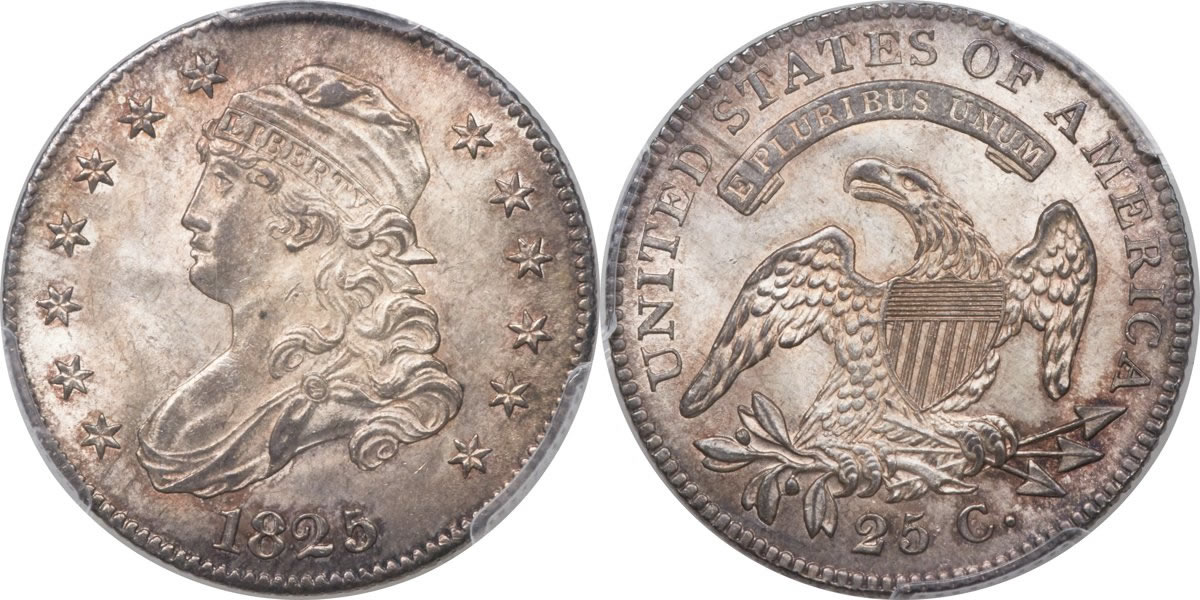
Heritage Auctions - In the past, the overdate varieties of the 1825 quarter have been the subject of much debate in regards to exactly what the underlying numerals were; B-1 was generally labeled an 1825/2, while B-2 and B-3 have been viewed as 1825/3, 1825/4, and more recently 1825/4/(2). A recent study of die states and emissions sequences, however, outlined in-depth by Steve Tompkins in his Early United States Quarters 1796 - 1838 (2008), suggests rather convincingly that all three 1825 varieties were struck with just two different obverses, both of which are in fact 1825/4/2 overdates.
The first was used only for the B-1 marriage, while the second was used for B-2, then lapped, and reemployed for B-3. The story of how this remarkable scenario came to be is not set in stone, but a careful study of the available data suggests that both dies were prepared in 1822, but were unneeded for production, so they were shelved. In 1824, they were among three dies that were overdated for new coinage (likely by the hand of Christian Gobrecht), but were again not employed for production. Then, in 1825, they were overdated once more (this time by William Kneass) and finally used for coinage. This likely chain of events is substantiated by noticeable recutting on the 8 in the date of both obverses, a characteristic shared by the 1824/2 obverse that was used in that year and overdated by Christian Gobrecht.
Of the three 1825 overdate varieties, B-2 is the most frequently seen, but its availability in Mint State is nearly nil. PCGS has certified and attributed only 26 examples in all levels of Uncirculated, with just two pieces in MS66 and none numerically finer.
In our current October 31-November 2 Signature Auction, we are offering one of the aforementioned MS66 examples. This coin is lightly toned lavender-gray, with glowing underlying luster and notable preservation. The stars show complete centers and the central devices are sharply impressed. This is an early die state piece (Tompkins 1/1), with the upper curve of the underlying 2 clearly evident to the right and left of the primary 5, and the horizontal crossbar of the 4 faintly visible within the lower loop of the same. This is an important condition rarity and an intriguing variety for the Capped Bust quarter specialist.
Disclaimer: While a tremendous amount of effort goes into ensuring the accuracy of the information contained in this site, Coin Community assumes no liability for errors. Copyright 2005 - 2026 Coin Community Family- all rights reserved worldwide. Use of any images or content on this website without prior written permission of Coin Community or the original lender is strictly prohibited. Contact Us | Advertise Here | Privacy Policy / Terms of Use










 Posted 10/19/2016 10:22 am