Early mint issues with coins (1794-1799 Dollars)
Before the Revolutionary War, coins from many European nations circulated freely in the American colonies along with decimal coinage issued by the various colonies. Chief among these was the Spanish silver dollar coins (also called pieces of eight or eight reales) minted in Mexico and other colonies with silver mined from Central and South American mines. These coins, along with others of similar size and value, were in use throughout the colonies. They remained legal tender in the United States until 1857. The
dollar was intended to replace the Spanish, English, Dutch and French coins that dominated the commerce of the Confederation era. It was authorized on April 2, 1792 in an act that also created the United States Mint and our nation's coinage. Because it was the Unit,
the silver dollar was the most important coin created and the basis of the nation's monetary system. All other coins struck, and all paper money as well, are either
fractional parts or multiples of the dollar.In 1794 the Engraver,
Robert Scot made dies for the
cent, half dollar, and the dollar coins. Since there was no standardized hubbing, individual punches were used for numbers, letters, the stars, and leaf punches. The edge was lettered with decorative designs in between the words.
On the first dollar, the Flowing Hair (1794-1795),


Liberty is facing right with her hair untied. A small, unrealistic eagle in a wreath adorns the reverse.
The next design, the Draped Bust, Small Eagle (1795-1798) shows a new portrait of Liberty with her hair tied with a ribbon and drapery around her bosom.
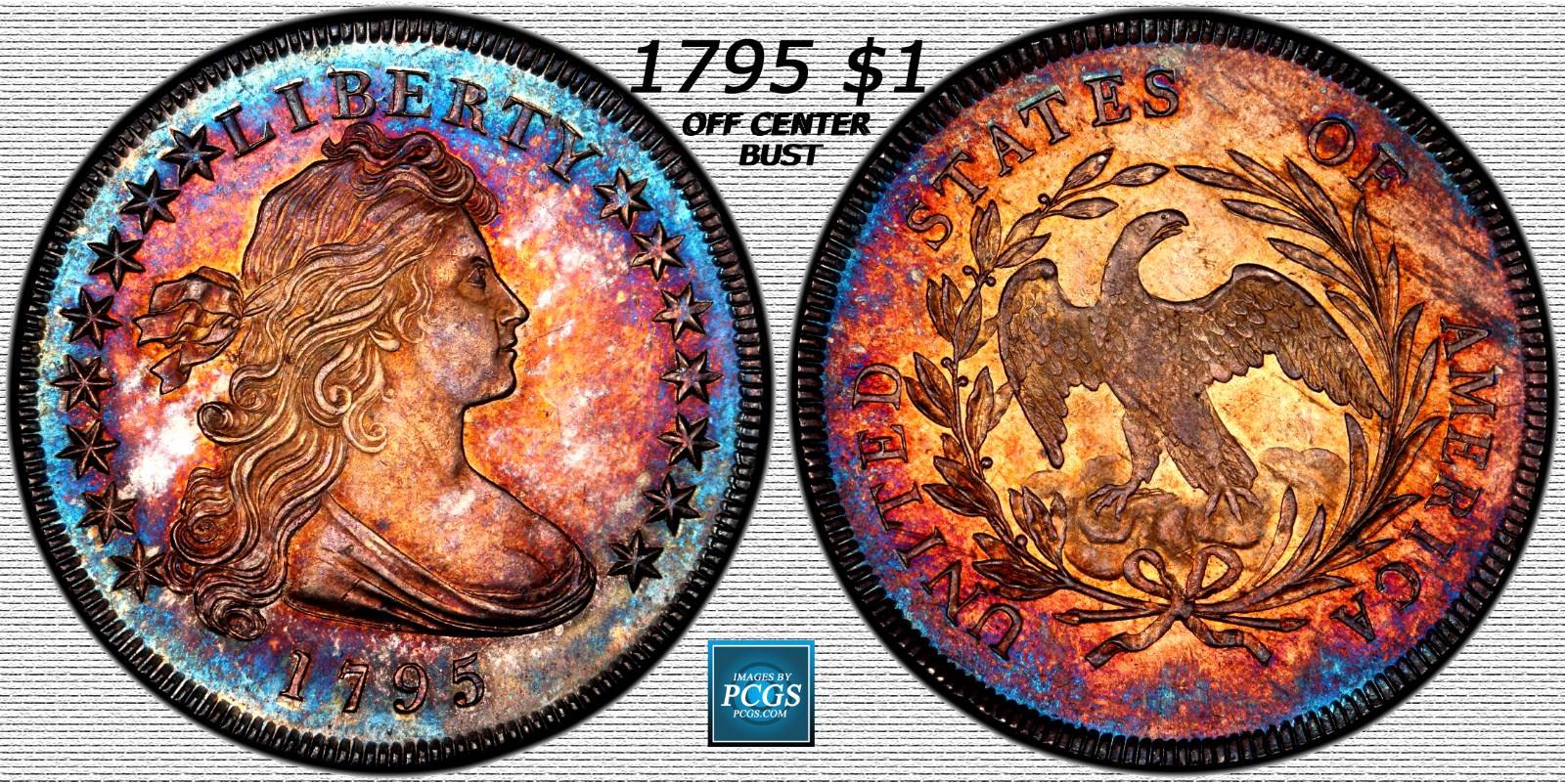
The reverse was similar to the previous issue except that the wreath changed from laurel to laurel on the left and palm on the right.
The third motif, the Draped Bust, Heraldic Eagle Reverse (1798-1804) was the most enduring design of the series.

The 1799 silver dollar is the second Draped Bust type. It was made from 1798 to 1804. The design shows a draped bust of Liberty facing right. Above is LIBERTY, and below is the date.
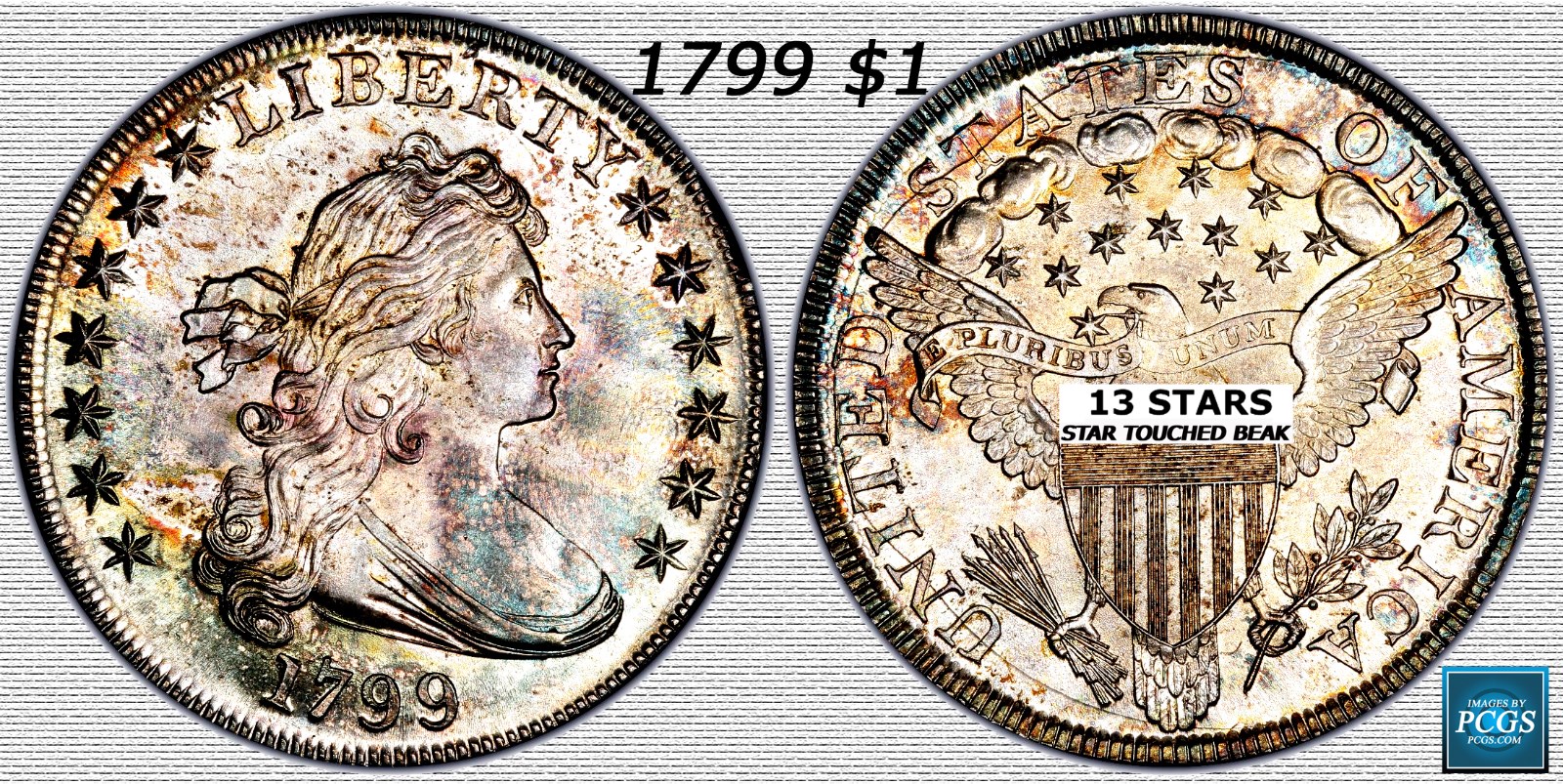
Seven six-pointed stars are to the left and six are to the right. The portrait, taken from a drawing by the famous artist Gilbert Stuart, is of Ann Bingham. John Eckstein translated this drawing to models for Engraver
Robert Scot. Evidently Eckstein made the models poorly, which might explain why Stuart's family refused to acknowledge his role in the coinage design. The heraldic eagle reverse shows the eagle with up stretched wings and a Union shield on its breast. A banner inscribed E PLURIBUS UNUM curls across the left wing and under the right. Except for the wing tips that interrupt it, the inscription UNITED STATES OF AMERICA is in an arc near the periphery. Thirteen stars are above the eagle's head under the clouds in an arc pattern. Dentils are near the edge on both sides of the coin, and the edge is lettered.
In what some have called colossal design blunder,
Robert Scot placed the arrows in the wrong talon. On the left side, the eagle's right talon, arrows symbolize aggressive militarism. They should have been placed in the left talon with the olive branch in the right. If this rearrangement was unintentional, it shows a new, inexperienced country that can't even get its symbolism correct. If this was a deliberate rearrangement, it shows a young country taking an aggressive stance during a time of conflict. In 1799 the country was engaged with France in an undeclared naval war. Perhaps this symbolism was being used to make a statement to France and others about the sovereignty of the United States. Except for its edge lettering, the coin has no denomination-- something that might appear as a sign of ineptitude on the part of early Mint employees to someone familiar with
United States coinage of the 21st century. The omission was intentional, however, since
United States coinage was new to the world market of the 18th century and the term "dollar" would have been unfamiliar to merchants of the day. Like European coinage of the time, silver and gold pieces were valued by their weight and fineness so the denomination was largely irrelevant.
Thomas Jefferson chose
Robert Scot to be the first Chief Engraver of the United States Mint on November 23, 1793. Scot was born in 1744 in Edinburgh, Scotland or England. (Documentary evidence is lacking as to where he was born.) He was trained as a watchmaker in England and learned engraving afterwards. He moved to the United States in 1777, where he worked as an engraver of plates, bills of exchange, and office scales. During the Revolution, he was an engraver of paper money. In 1780 he was made the State Engraver of Virginia. He moved to Philadelphia the next year. He was appointed Chief Engraver of the United States Mint on November 23, 1793 by David Rittenhouse, Mint Director. His salary in 1795 was $1,200 per year. The Mint Director received only $800 dollars per year more. Scot's ability to make dies was limited, and he was advanced in years with failing eyesight. His work was somewhat less than that done in Europe at the time, and Scot was criticized for its poor quality. He was responsible for designs of most of America's first coins. These include the Flowing Hair and the Draped Bust motifs used on the early silver coins, and the gold quarter eagle, half eagle and eagle Capped Busts. Scot also designed the 1794-1797
Half Cent, the 1800-1808 draped bust
Half Cent, and the Thomas Jefferson Indian Peace Medal. Scot died on November 1, 1823 and was succeeded by
William Kneass as Chief Engraver.
The early mint had several problems. At the end of the eighteenth century Philadelphia had recovered from the British occupation and the Revolutionary War. It was the second largest city in the English-speaking world, but it could do nothing to protect its citizens from the mosquito-borne epidemic of yellow fever. Its wealthy citizens went to the countryside to escape, and the poor grimly waited their fate. Of course these annual epidemics caused havoc with all manufacturing that required continuity, such as a coinage sequence. A second problem was that the Chief Coiner and Assayer were not wealthy men. Only copper coins were made until 1794 because neither
Henry Voigt nor Albion Cox had the funds to post the $10,000 bond necessary to use precious metals. Congress also considered not allowing them to make copper coinage for the same reason. In addition other problems caused chaos at the Mint. There were chronic bullion shortages, coin dies that would wear out and had to be re-engraved because they were not taken out of production until they failed completely, difficulty rolling sheets for planchets, and a
Chief Engraver, Robert Scot, who was in his seventies and had failing eyesight.
The Draped Bust, Heraldic Eagle series had several varieties. The
BB-142 is identified by the last 9 punched over the previous 8.

It is the only over date die for the year.

The last 9 is almost touching the bust, and the stars are close together. The letters of LIBERTY are widely spaced, and there are die flaws under ERTY. This obverse was combined with three reverse dies. The reverse of the BB-142 has 13 stars above the eagle.

A leaf points to the center of the I in AMERICA. Star 12 touches the eagle's lower beak. The ray of that star points to the left outside of the you in PLURIBUS. The you is usually weakly struck. The far right of the A in STATES is above the junction between Clouds 3 and 4. The first A in AMERICA touches Feathers 3 and 4. The die is cracked and scaled between the R and I in AMERICA and above the right of the T in STATES. There is also a
prominent die crack from the S in STATES to the top of the O in OF. This reverse die was only used for the BB-142 variety. There were several dies that had the lower beak touching the 12th. star, but the other markers are a match for this die for the reverse and the 1799/8 on the obverse.
There were many different varieties of dies during this time. The dies were put together as mentioned above with various punches making each die a little bit different. There were the flowing hair design with the small eagle reverses and the draped bust with ribbon in the hair. But here are a few things to look for on the 1795 dollars to identify which one you have:

The easiest way to tell these apart is to look at the highest curl on the top of the head. Note on the centered one, the curl is below the 'E' on LIBERTY.

The off center curl is
below the 'B' on LIBERTY.

The second variety for the
1795 dollars is on the flowing hair reverses:

There are a
two leaves and
three leaves variety.


On the
1796 dollars there are to different things to identify on your coins are the small and large dates.


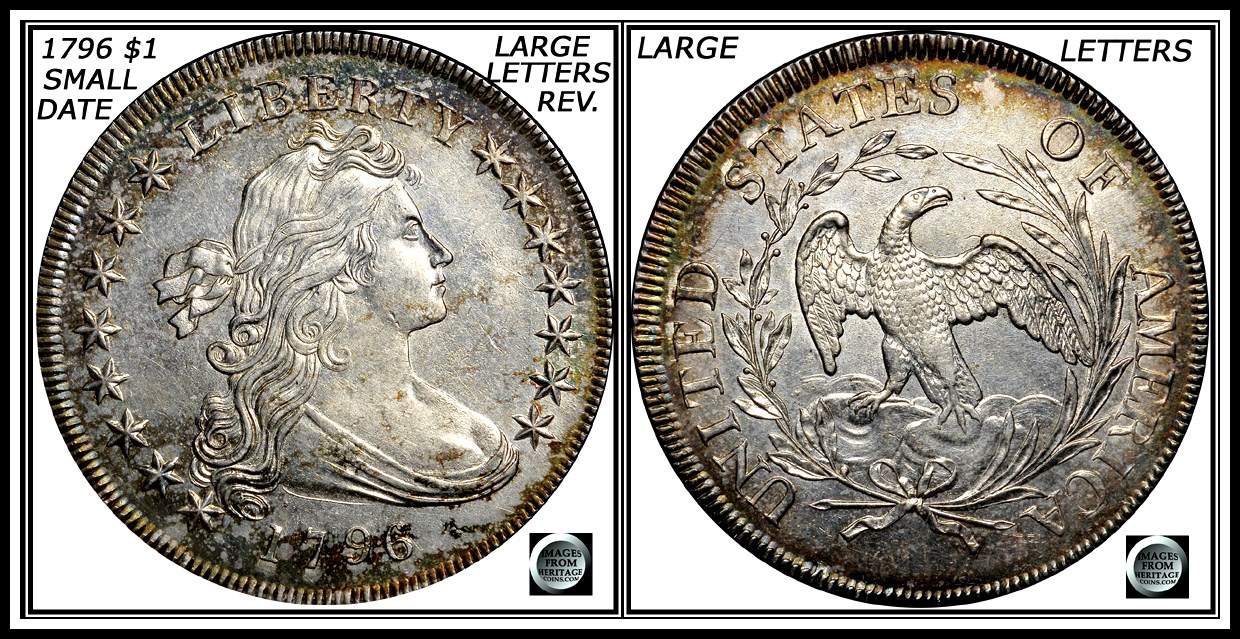

Also the reverses could have the large or small letters on them. (but I only found the small date with the large and small reverse letters on HeritageCoins)


On the obverse there were two different patterns of 16 stars on the Dollars. The 9X7 star pattern and the 10X6 star pattern.
On the
1797 reverses the same issue with the large and small letters on the reverses.


1798 had
6 different variety types that could be found that year.
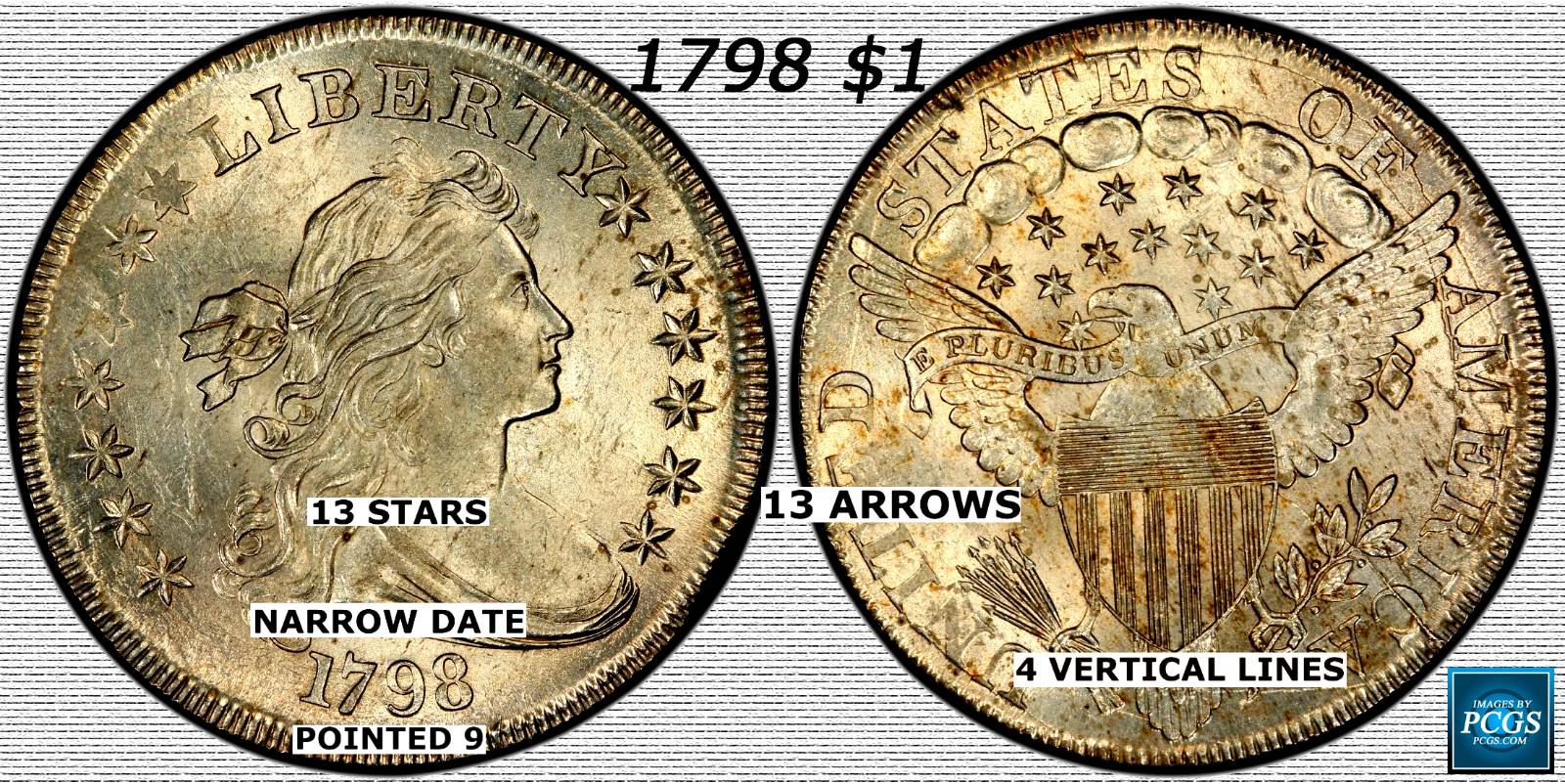
On the obverses there were some with 15 stars and others with 13 stars.

On the date there were two different 9 styles used that year. The pointed and the knob style 9's.
[img

Another variety was the narrow and wide placements of the date digits. One die had a wider set of digits with the last 8 almost touching the bust making the date wider in that area.

On there reverses there were some with 10 arrows and some with 13 arrows.

Another variety was on the shields. Some had 4 lines and others had 5 lines on the shield. (
two different punches used)
Also factor in the large and small eagle reverses were used that year.

So with these combinations, it was an interesting year:



 1799
1799 was less interesting than 1798 though. Just the over date of 1799 over 8 and the 15 and 13 stars on the reverse. There was also one die called an irregular date as the last two digits were not correctly aligned like the other ones that year.


 Irregular date:
 (note the last two digit locations)

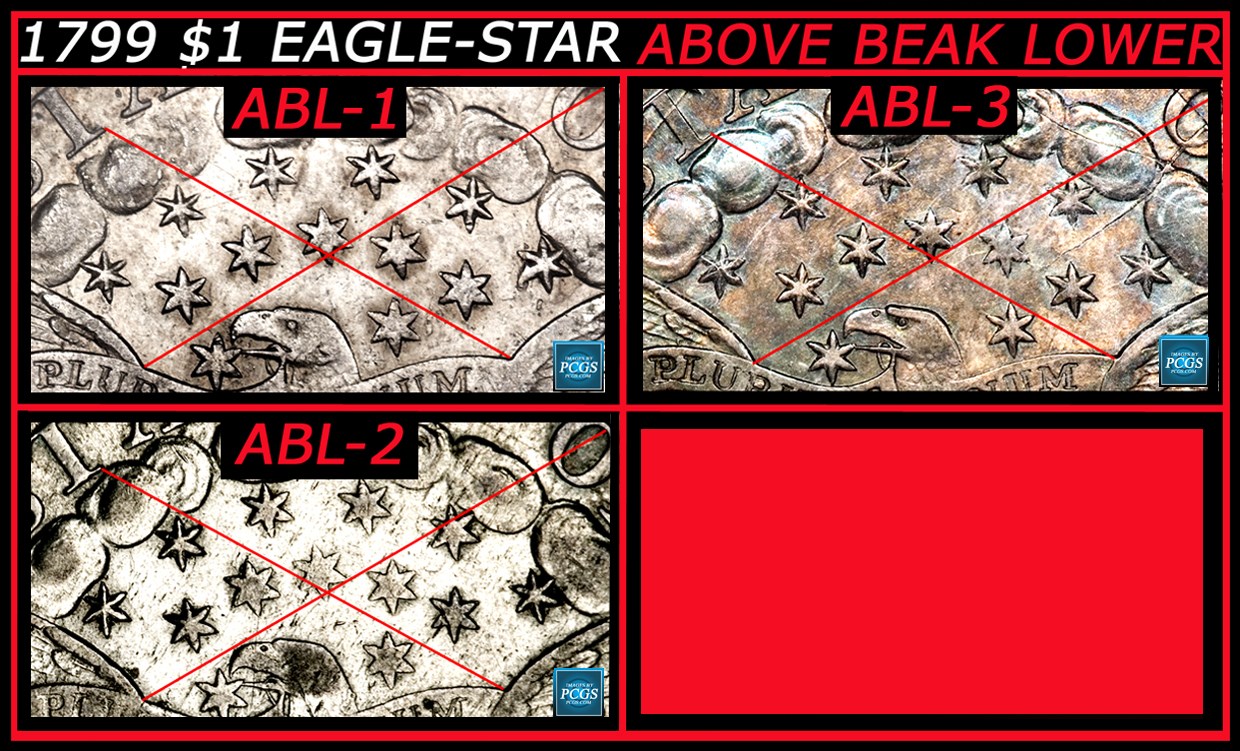
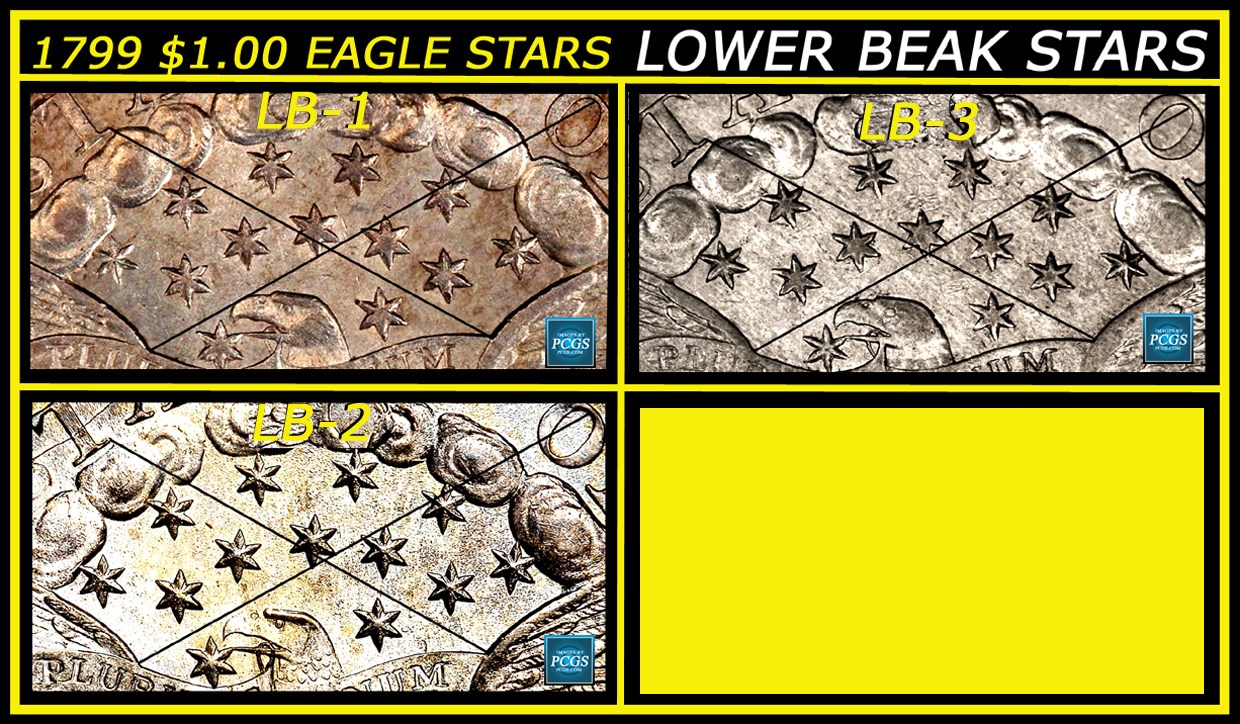
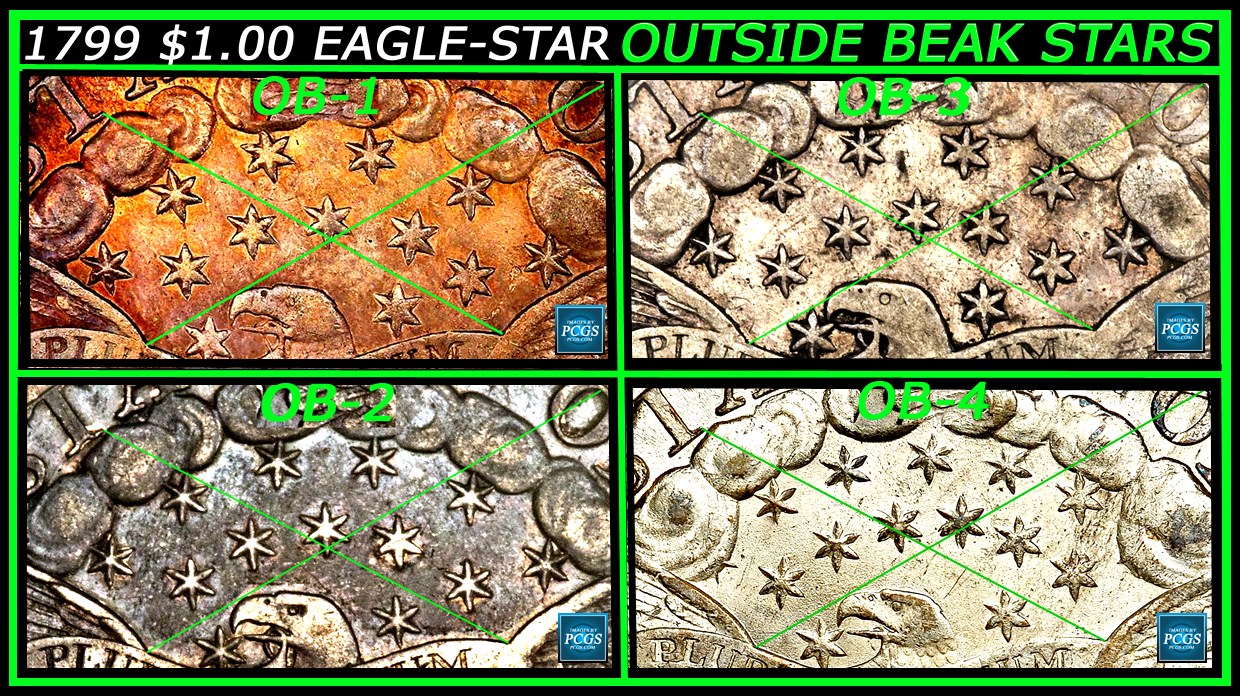
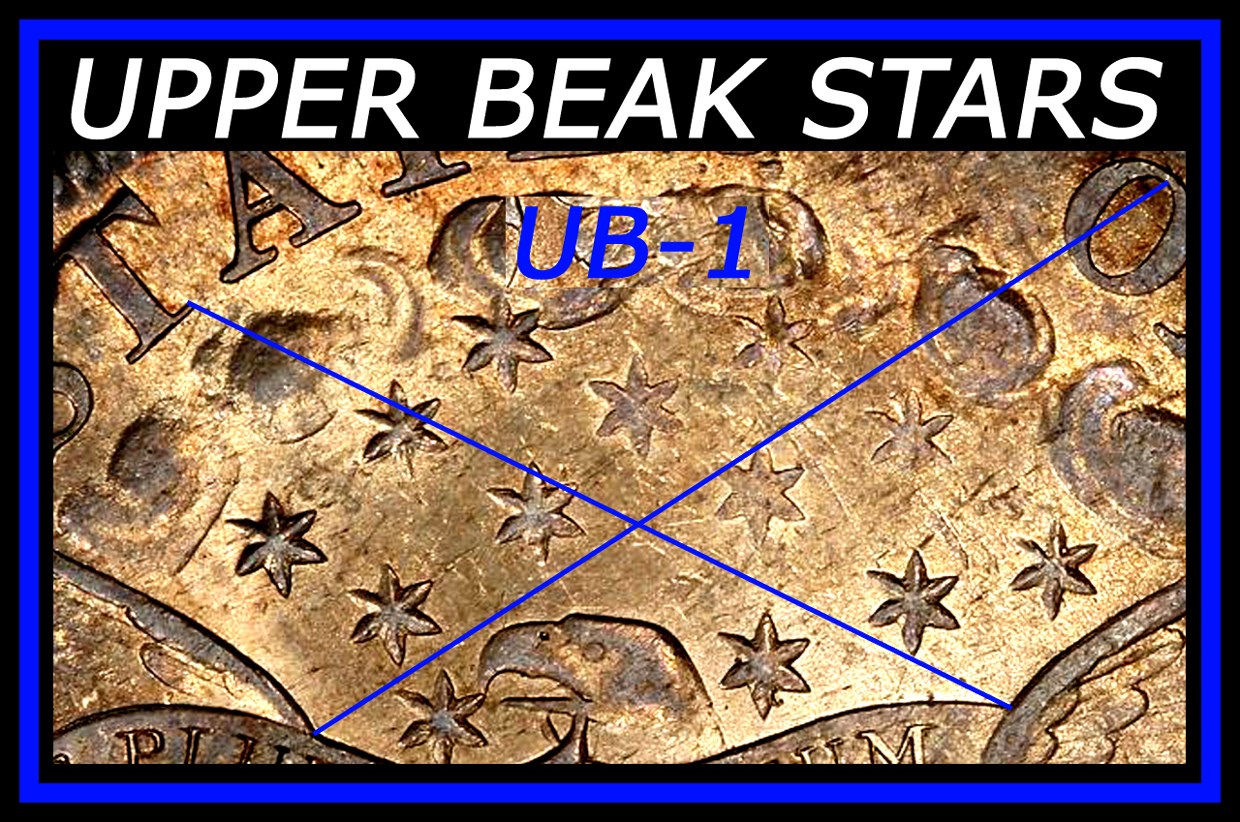
I did notice there was a location of the eagle and two different types of eagles used. The locations varied to touching star #12 with lower beak, upper beak, between the two beaks and outside the beak area. There was a total of 11 different locations I found. (
ask if you are interested in seeing this or not. I can prepare it for you)
Interesting information? But when you consider all the different denominations created this way with each die that can be listed with an Overton number,
we have just scratched the surface. Most of this information was from: usrarecoininvestments









 Posted 08/28/2016 5:31 pm