| Author |
 Replies: 14 / Views: 5,135 Replies: 14 / Views: 5,135 |
|
|
New Member
Czech Republic
4 Posts |
We inherited a lot of coins, some we believe are silver and few might be worth something. We're thinking of selling them on ebay. However, some of the coins which we believe are silver have blue spots on them. Is this possible? *** Moved by Staff to a more appropriate forum. *** |
|
|
|
Pillar of the Community
 United States
2843 Posts |
That may be toning, try posting some pictures and the forum will weigh in on if they think it is.
Toning can be in a range of different colors and can appear on all or part of a coin.
It can increase a coins value if it is nice and decrease the value if it is hideous.
|
|
Pillar of the Community
United States
2843 Posts |
Oh and....  to the forum |
|
New Member
 Czech Republic
4 Posts |
Here is one, the worse one so far.  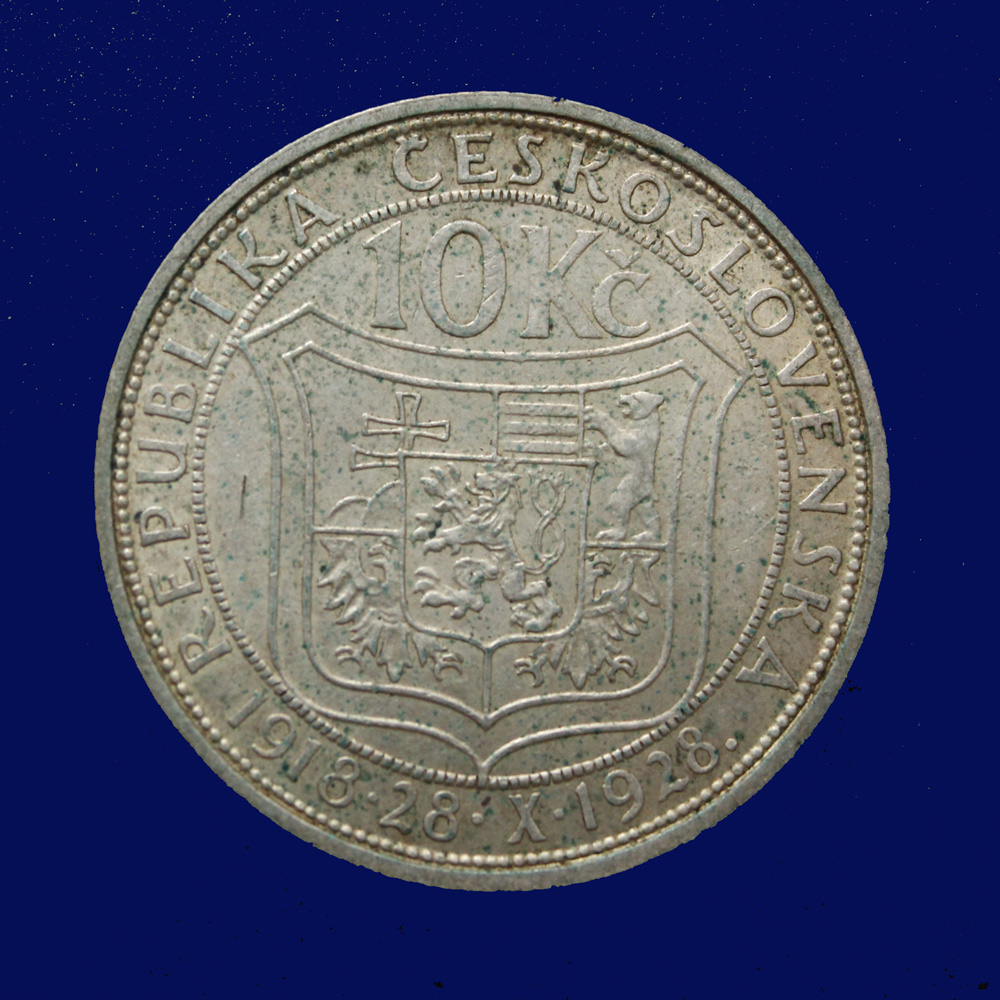 TYhak you for your help. And for the warm welcome. |
|
Pillar of the Community
Canada
5287 Posts |
That is not toning. It is corrosion, unfortunately. Specifically, corrosion of the copper portion of the alloy. Those Czech coins were, I think, 72% silver.
|
|
Pillar of the Community
United States
2843 Posts |
 those spots do not look like toning. Corrosion is definitely more likely. and .700 silver according to Numista.com |
|
New Member
Czech Republic
4 Posts |
Thank you for the answers. We have some of the same coins without spotting, all silver or just not spotted?
Cheeky question, how do we find out the approximate value?
|
|
Bedrock of the Community
United States
12437 Posts |
That looks more like green rather than blue. Green is definitely consistent with corrosion.
|
|
Bedrock of the Community
United States
94367 Posts |
to the CCF! |
|
Moderator
 United States
34541 Posts |
Quote:
how do we find out the approximate value? There are books that you could purchase or perhaps check out of the local library. For example, this coin would be in the Krause 20th Century catalog. There are similar, but separate books for each century going back to the 1600s (1500s for Germany coins only). If you prefer to digest your information digitally, you could also look for comparable coins sold on ebay or other websites like Heritage. "If you climb a good tree, you get a push."
-----Ghanaian proverb
"The danger we all now face is distinguishing between what is authentic and what is performed."
-----King Adz
|
|
Bedrock of the Community
United States
20038 Posts |
That is verdigris (corrosion) due to copper alloyed with the silver. Is was either induced by PVC (holder) or by the environment. The good news, it looks very light and should be fairly easy to remove.
Can you show us a picture of what kind of holder they are stored in?
Lincoln Cent Lover!VERDI-CARE™ INVENTOR https://verdi.care/
|
|
New Member
Czech Republic
4 Posts |
They were stored in PVC sheets. will change that as we progress. How do we clean it off?
|
|
Pillar of the Community
United States
2843 Posts |
Quote:
How do we clean it off? BadThad can respond, but I have a hunch that he will say Verdi-care. I have used it, and it does work. |
|
Pillar of the Community
United States
968 Posts |
Verdi-care may help (BadThad is the creator so he'll know more) but you need to be VERY careful about any treatment you do. You can very easily diminish the value of even the corroded coins if you are too harsh with your treatment and it is extremely easy to overdo it. In fact, just mentioning the world cleaning will probably result in replies of DON'T DO IT! Which is pretty much correct outside of very specific treatments done carefully.
Edited by Saruma
08/31/2016 11:34 am
|
|
Bedrock of the Community
United States
20038 Posts |
PVC residue is best addressed with ACETONE. VC is expensive compared to acetone. I'd only use VC if the acetone failed for some reason.
Lincoln Cent Lover!VERDI-CARE™ INVENTOR https://verdi.care/
Edited by BadThad
08/31/2016 3:18 pm
|
| |
Replies: 14 / Views: 5,135 |
|










 Posted 08/30/2016 10:38 am


