









 completecoin.jpg


 Posted 03/07/2008 10:33 pm


It's certainly in the style of early Sri Lankan coinage, but I have a couple of problems with it.
Coins of this design were issued by the Chola Kingdom in southern India, and issued in Sri Lanka after the Cholas conquered much of the island in 993 AD, and continued to be used by the native rulers on the island after the Cholas were overthrown.
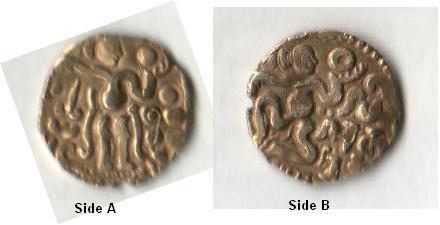
In the West, these coins are commonly called the "octopus series", because the picture of the king (or Queen) seated on the throne (your "Side A") looks like the guy's got lots of legs - the outer "legs" are really just the sides of the chair they're sitting on.
To identify which ruler this coin belongs to, we need to translate the ruler's name. On the other side ("Side B"), the king is shown again, this time "dancing", and his/her name appears in Devanagari script to the right. This page shows what the inscriptions on these coins normally look like, with links to sample pictures of the coins.
Now, to the problems. Not many Chola/Sri Lankan rulers issued coins of this design in gold. They're far more commonly encountered in [i]copper[i].
I did find a couple of rulers with this style of gold coin. First, Rajaraja of Chola, the conquerer of Sri Lanka. Here's one of his coins on Zeno.ru. Second, VijayaBahu I, the king that liberated Sri Lanka from the Chola.
But if your coin is an example of either of these two kings, I have two problems with this. First, the name doesn't quite seem to match.
Second (and more importantly), the heads of the ruler on both sides of the coin... they look too "good", they're clearly and distinctly heads with faces, and the hair is attached to the back of the head. The heads on normal coins of this time look much cruder, kind of resembling the letter "E" with an eye, and the hair is a couple of lines floating disconnected behind the head. I haven't found any examples online of Chola or Lankan coins where the head is so "clasically" done.
I'd be happy to be proved wrong by someone who is actually an expert in this series, by I suspect this may well be a reproduction made much later, done by someone who believed the old coins looked a bit crude and "improved" them by giving the monarch a proper head.
Coins of this design were issued by the Chola Kingdom in southern India, and issued in Sri Lanka after the Cholas conquered much of the island in 993 AD, and continued to be used by the native rulers on the island after the Cholas were overthrown.
In the West, these coins are commonly called the "octopus series", because the picture of the king (or Queen) seated on the throne (your "Side A") looks like the guy's got lots of legs - the outer "legs" are really just the sides of the chair they're sitting on.
To identify which ruler this coin belongs to, we need to translate the ruler's name. On the other side ("Side B"), the king is shown again, this time "dancing", and his/her name appears in Devanagari script to the right. This page shows what the inscriptions on these coins normally look like, with links to sample pictures of the coins.
Now, to the problems. Not many Chola/Sri Lankan rulers issued coins of this design in gold. They're far more commonly encountered in [i]copper[i].
I did find a couple of rulers with this style of gold coin. First, Rajaraja of Chola, the conquerer of Sri Lanka. Here's one of his coins on Zeno.ru. Second, VijayaBahu I, the king that liberated Sri Lanka from the Chola.
But if your coin is an example of either of these two kings, I have two problems with this. First, the name doesn't quite seem to match.
Second (and more importantly), the heads of the ruler on both sides of the coin... they look too "good", they're clearly and distinctly heads with faces, and the hair is attached to the back of the head. The heads on normal coins of this time look much cruder, kind of resembling the letter "E" with an eye, and the hair is a couple of lines floating disconnected behind the head. I haven't found any examples online of Chola or Lankan coins where the head is so "clasically" done.
I'd be happy to be proved wrong by someone who is actually an expert in this series, by I suspect this may well be a reproduction made much later, done by someone who believed the old coins looked a bit crude and "improved" them by giving the monarch a proper head.
Don't say "infinitely" when you mean "very"; otherwise, you'll have no word left when you want to talk about something really infinite. - C. S. Lewis


