| Author |
 Replies: 26 / Views: 5,359 Replies: 26 / Views: 5,359 |
|
Valued Member
United States
202 Posts |
Hi everyone, hope someone can explain what a Clad coin is. I have read some information on this but to look at my Kennedy coins I still don't understand. I hope that by you experts you might be able to tell me how I can look at my coins to let me know. Hope this makes sense just started several months ago, I would appreciate any information. Thank you 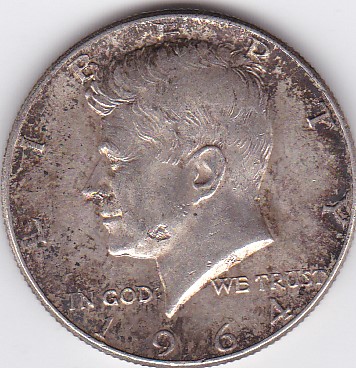 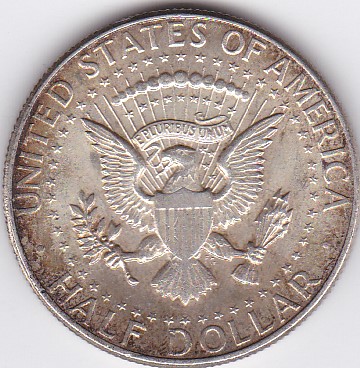 |
|
|
|
Valued Member
United States
354 Posts |
A clad coin is a coin not containing silver; most of the times clad coins are made out of copper and nickel, sometimes zinc or magnesium. That 1964 half is not a clad because it is 90% silver.
|
|
Formerly coinlover1899
 United States
3058 Posts |
I found this picture on google: The third coin down is silver, note the 100% silver colored rim. 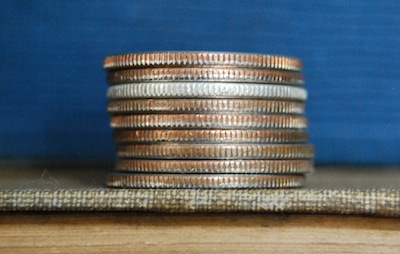 www.InGodWeTrustCoins.com
|
|
Pillar of the Community
United States
1007 Posts |
Clad coins have 3 layers, an inner layer and the two outer layers. If you look at the edges you can tell the difference. Silver alloy coins have a uniform appearance on the edge, clad coins display the layers. 1964 dated Kennedy halves had a non-clad silver-copper composition (90% silver and 10% copper alloy). Kennedy halves dated 1965 through 1970 had percentages of silver in all three layers for a total silver percentage of 40%. 1965 to present dimes and quarters, SBA and Ike dollars as well as 1971 to present halves are a copper-nickel clad. The outer layers are an alloy of nickel and copper and the center portion is pure copper. Golden Dollars are also clad but with different metals, none of which are silver. Your 1964 half dollar is a 90% silver alloy, not clad. There are some special issue coins of various values with different compositions from Proof and Mint sets but all of the circulation coins followed the above specs. Edited by n9jig
09/09/2016 9:40 pm
|
|
Valued Member
 United States
202 Posts |
Thank you everyone for your information especially the pictures which help a great deal. I will go on your youtube site and watch.  |
|
Pillar of the Community
United States
1027 Posts |
The Golden Dollars are probably the most complex alloy/clad formula with a core of 100% Cu, and cladding of 77% Cu, 12% Zn, 7% Mn, & 4% Ni (AKA manganese brass) for an overall composition of 88.5% Cu, 6% Zn, 3.5% Mn, & 2% Ni. The top and bottom cladding layers together weigh the same as the copper core (top clad:2.025g, core:4.05g, bottom clad:2.025g, total:8.1g)
|
|
Pillar of the Community
United States
1119 Posts |
Quote:
A clad coin is a coin not containing silver this is not necessarily true the 1965-1969 Kennedy half dollars are considered a clad coin and are 40% silver. Cladding is a process irrespective of the materials involved. |
|
Bedrock of the Community
United States
94367 Posts |
|
|
Moderator
 United States
195033 Posts |
Quote:this is not necessarily true the 1965-1969 Kennedy half dollars are considered a clad coin and are 40% silver. Cladding is a process irrespective of the materials involved.  I like to say Cu-Ni clad for the copper-nickel clad coins and silver clad for the 40% silver coins. |
|
Pillar of the Community
United States
2283 Posts |
Quote:
I like to say Cu-Ni clad for the copper-nickel clad coins and silver clad for the 40% silver coins. Using just the word "clad" is usually meant to refer to copper nickel clad copper US coins. I like to use "silver clad" to refer to the 40% quarters, halfs, and dollars. Of course these are actually "80% silver clad 10% silver which are 40% silver by weight". It's easier to just use "clad" and "silver clad". Time don't fly, it bounds and leaps.
|
|
Pillar of the Community
United States
1119 Posts |
Quote:Using just the word "clad" is usually meant to refer to copper nickel clad copper US coins. I like to use "silver clad" to refer to the 40% quarters, halfs, and dollars. |
|
Moderator
United States
195033 Posts |
I did say it is what I like to say. I tend to like avoiding any ambiguity.  |
|
Pillar of the Community
United States
2283 Posts |
Quote:
I did say it is what I like to say. I tend to like avoiding any ambiguity. I'm not sure I remember why I responded at all now. Obviously "copper nickel clad" is in no way ambiguous. I suppose it's because I still hear people calling silver clad "clad" that I brought it up at all. It can be confusing for newbies. Time don't fly, it bounds and leaps.
Edited by cladking
09/14/2016 09:51 am
|
|
Moderator
United States
195033 Posts |
Quote:I'm not sure I remember why I responded at all now. It was probably my choice of saying Cu-Ni instead of copper-nickel.  To be clear, my point is that I do not like to say clad alone, specially since nearly a third of the Eisenhower dollar set is silver clad.  |
|
Pillar of the Community
United States
2283 Posts |
Quote:To be clear, my point is that I do not like to say clad alone, specially since nearly a third of the Eisenhower dollar set is silver clad. I see... ...makes sense. From my perspective I'm almost always referring to cu/ ni clad since most modern quarter proofs and all of the uncs are either 90% or cu/ ni clad. If I were primarily an Ike collector I'd probably say cu/ ni clad as well. Time don't fly, it bounds and leaps.
|
|
Pillar of the Community
United States
1119 Posts |
Jbuck when you say Cu-Ni clad do you pronounce it like "q knee" or say copper nickel in full? this is my curiosity.
|
| |
Replies: 26 / Views: 5,359 |






 Posted 09/09/2016 9:35 pm





