| Author |
 Replies: 12 / Views: 4,780 Replies: 12 / Views: 4,780 |
|
|
Pillar of the Community
United States
2408 Posts |
I've been a long time advocate against frosting and I will continue to be until people understand the damage it can [edited] hide. Look at the two coins below: 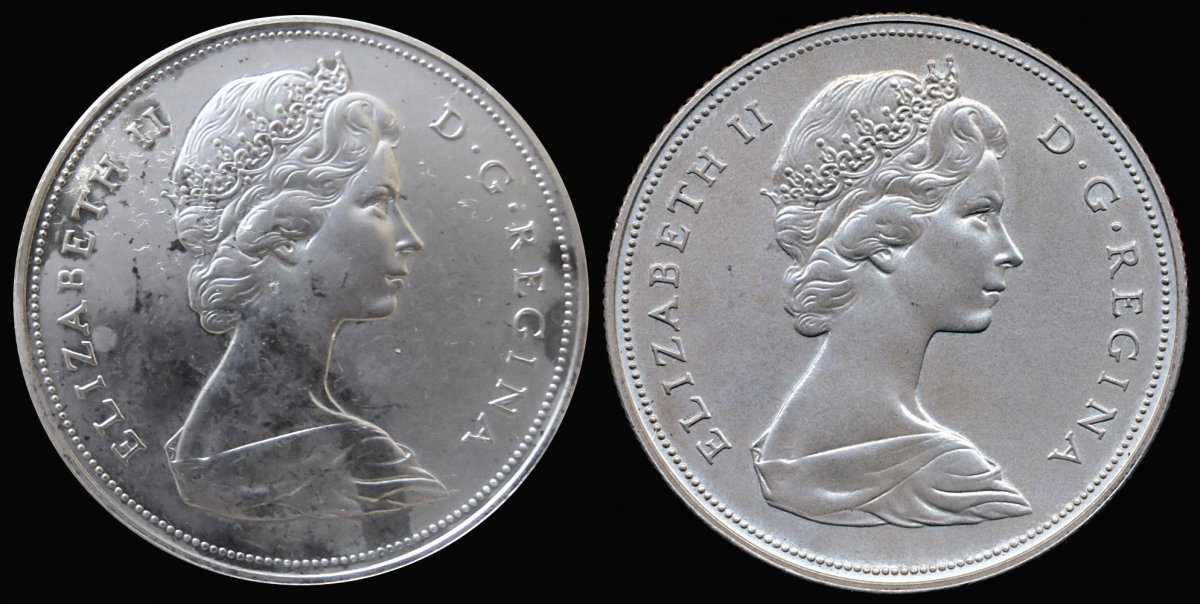 Which one would you care for? The coin on the left is from my pile of "junk" while the one on the right is much more appealing. It has a nice frosty feeling to it. Contrast is great. Nice overall details (so it seems). But look again carefully - they are the same coin. Chemical etching can produce enticing coins, but beware. The detail is in the devil. Edited by canadian_coins
09/13/2016 3:26 pm
|
|
|
|
Valued Member
Canada
192 Posts |
The frosting of modern coins is done by polishing the die then having a laser etch micro-details into it, yes? (certainly the RCM seems to employ plenty of laser-detailing in it's dies) I suppose I can see how even the slightest etching might then reveal microscopic details that, while interesting from a metallurgical perspective might not be the most fun for a collector... |
|
Pillar of the Community
United States
1609 Posts |
Being south of the border but interested in Canadian coins, I would love it if you could explain this in a little more detail. For example, how old is the coin you're talking about? Is the picture on the right "mint condition" and if so, how does it end up like the mess of the left?
In US mint sets (uncirculated issues for the year) from the 1970's (and before) some coins will get a film on them that looks like your Right photo. In person it's not at all attractive and comes from improper storage. Modern proof dies will be modified with laser etching to make the devices "frosty", creating a cameo effect that is desirable. Still another surface, not used often, can be found on "matte" surfaces on special strike coins.
So, what's what with your frosty coins? How do they get that way and are they desirable?
|
|
Pillar of the Community
Canada
1747 Posts |
Bieder that coin is from late 60's to early 80's I think the issue might be with the planchet having flaws prior to the strike, but I thought these coins were supposed to be hand selected and inspected etc so that this would not happen?
|
|
Pillar of the Community
Canada
2845 Posts |
Quote:
Chemical etching can produce enticing coins, but beware. The detail is in the devil.
I wasn't aware there was such a thing as artificial frosting but Google found a couple articles about the tactic. So you bought the coin in the condition as photographed on the right, then after a certain amount of time had passed it appears as in your left photo? If that's correct, I can certainly understand the damage it causes, that you refer to. Yet another example of buyer beware of unscrupulous sellers. Edited by wildflowerAB
09/13/2016 12:08 pm
|
|
Pillar of the Community
 United States
2408 Posts |
This is a 1972 nickel dollar. The coin on the left is what I started with. I'm unsure of its origin, all I know is that the coin had severe blemishes, some scratches and dings here and there. I soaked the coin in vinegar for 24 hours. 12 hours would have produced a softer frost, but probably wouldn't have eliminated all the blemishes. My whole issue with heavy RCM frosting is this: it is an easy way to mask defects. For sure, the results shown here are pretty convincing and it's probably not a coincidence that more and more NCLTs are frosted. |
|
Pillar of the Community
Canada
2845 Posts |
Thanks for the explanation, but as the dollar isn't silver, any idea what is the black stuff is that looks similar to tarnish? And I'm not able to tell from the photo on the right but is the entire surface now frosted?
|
|
Pillar of the Community
United States
2408 Posts |
My guess is that the coin came from one of those old black clam shells with red velvet interior that rot and caused some issues. Maybe a few failed attempts at cleaning... Not sure. The "black" areas are where the nickel is less affected.
Yes, the right side is completely frosted. Drop a nickel coin in vinegar for some period of time and that's what you'll get. You are essentially etching away the details and will end up with a layer of frost.
|
|
Pillar of the Community
Canada
2845 Posts |
That's very informative, I've never heard of pickling coins before. I agree, it likely was a victim of those early '70s rotting flocked cases.
And to your original point, frosting indeed is a means to mask defects. Thanks for the excellent visual illustration!
Edited by wildflowerAB
09/13/2016 10:50 pm
|
|
Valued Member
Canada
192 Posts |
Thanks for the further explanations Canadian_Coins... I misunderstood what I was looking at. It's pretty remarkable, the difference your acid bath made. Thanks again!
|
|
Pillar of the Community
 Canada
9902 Posts |
Quote:
I've never heard of pickling coins before. In the 50's 60's and early 70's the mint routinely pickled the new dies (I don't recall why). Before use the flat surfaces were polished while the incuse devices remained etched. The first coins struck had cameo appearance of varying degrees until the etching was worn. Nothing more beautiful than the MS business strike cameo coins of that era IMO. "Dipping" is not considered cleaning...
-from PCGS website
|
|
Pillar of the Community
United States
1609 Posts |
Thanks for the info, I appreciate it.
|
|
Pillar of the Community
Canada
2531 Posts |
|
| |
Replies: 12 / Views: 4,780 |
|










 Posted 09/13/2016 06:48 am


