Kenneth You say
Quote:
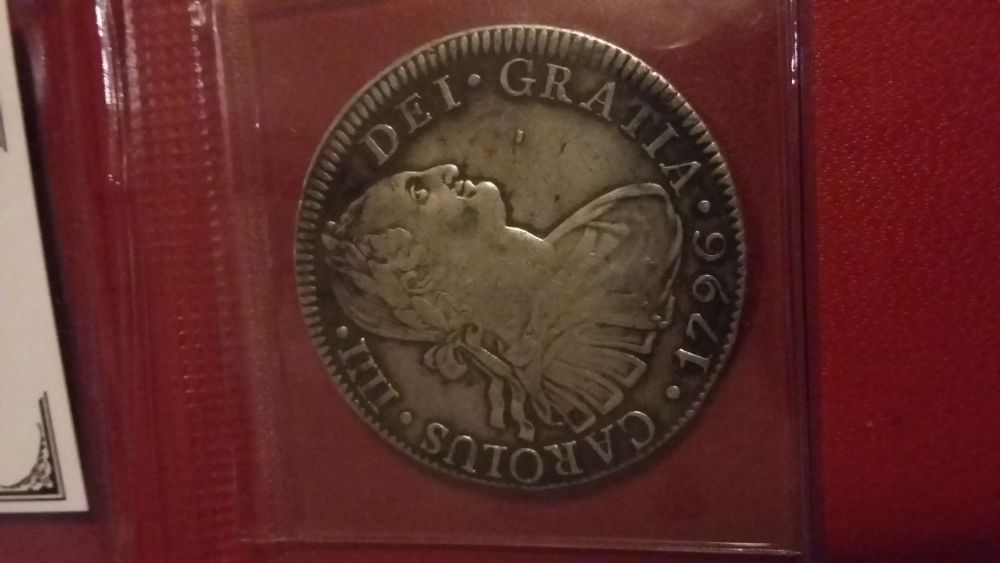
After reading Swamper Bob's post on the denticuls running all the way to the edge. I see that this one doesn't look like it does. They stop short on the obverse from the above forehead area all the way to the 'R' in GRATIA.
I think you have misunderstood what I was referring to.
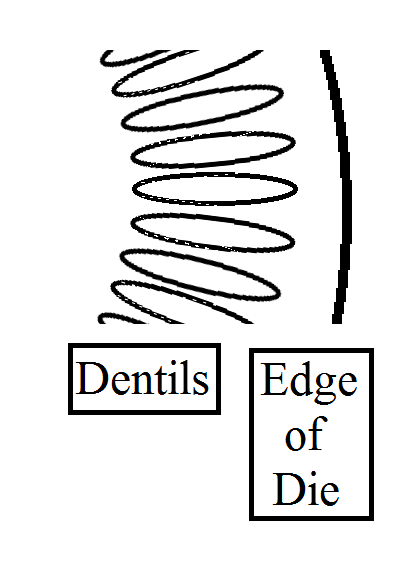
The dentils are lozenge shaped figures. The entire figure has a rounded end at EACH end. If you see both rounded ends you may simply have an off center strike or a strike on an oversized planchet.
Here is a sketch of the dentil arc in relation to the edge of the die.
The next sketch is of a planchet placed on the same die. The planchet is smaller than the die and when placed properly centered it will show about half of the dentil lozenge arc around the entire perimeter of the coin.
Since the planchets were actually positioned by hand there were irregularities.
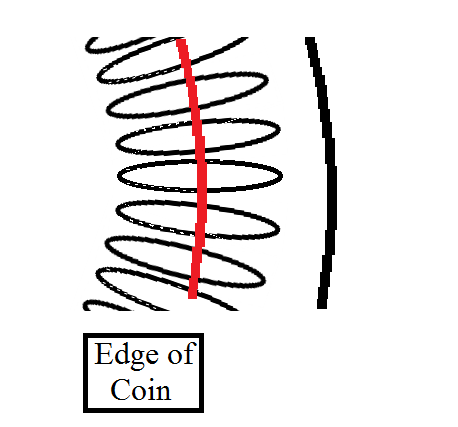
This results in striking a coin with a perimeter like this.
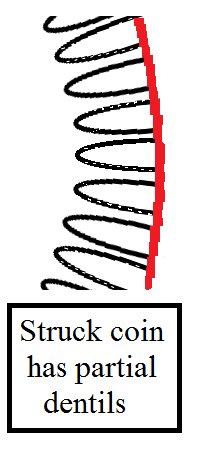
When a modern forger copies an original coin he can make only what the coin shows. If he places his blank off center he will get a coin that has the dentils ending too soon.
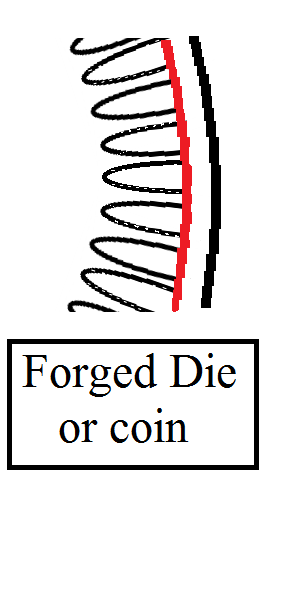
Some forgers add the missing part of the dentils to their die faces but usually this is poorly done. Most forgers just don't bother. The clue to forgery you are looking for are dentils that are TRUNCATED before the edge of the coin. That was not seen on genuine coins.
As to the issue - Is this coin genuine? My answer is "I don't know with 100% certainty"..
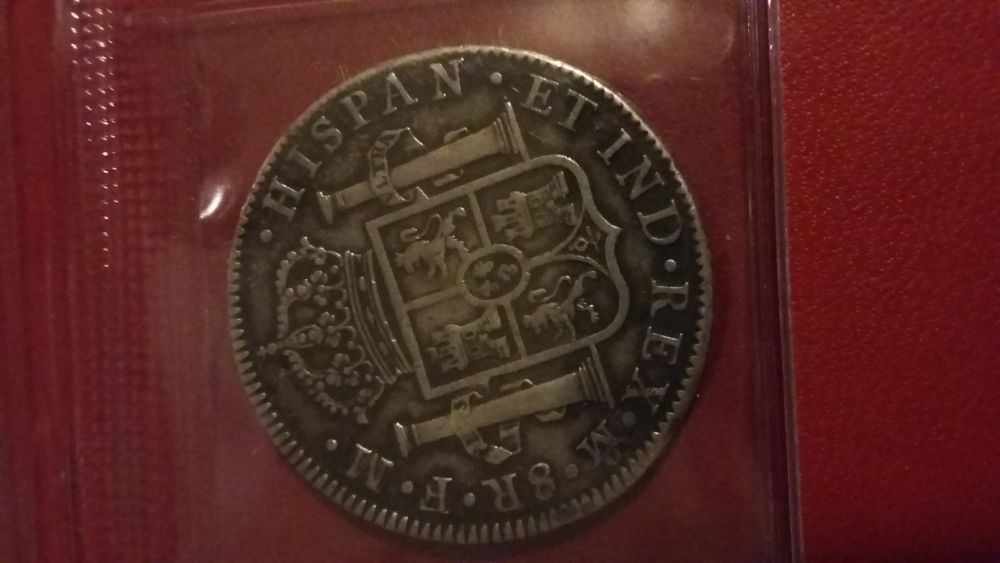
The edge looks like it may be a silver "restrike" a Class 2 counterfeit in silver made for the Chinese trade. They sell as if they were real because they are really not well known yet and 99% of dealers only look to see if the coin is silver. Most coins in this category can be identified by similar bad edges.
There are few tests that can, in some cases, determine exactly what you have. Some of the earliest copies made about 1835 in England were only 85% silver. A very accurate specific gravity test may indicate an SG of under 10.22 not 10.31 in this case. Chinese made silver copies will have lower SGs and the dies will be engraved copies of the design that do not match.
The best test is laboratory XRF. A genuine Mexico City 8R from 1806 will contain GOLD. The amount varies but 0.4% is the average of tests run to date. The high is over 2% and the low is 0.2% gold. Silver purer than that could not be produced commercially in 1806 in Mexico. Silver mined in the UK and most of Europe will have traces of lead as a contaminant.
Coins made after the 1870s, primarily in the US, will have no gold.
Making a final determination at this point in time does not warrant the XRF test because of cost. However, if you value originality you have little choice.








 Posted 11/10/2016 6:33 pm





 The drawings here and on your other recent posts plus the annotated photos that you have done on other posts would be a great addition to the 2nd edition.


