I woke up three hours earlier than normal to bid live in a German auction this morning, and this is what I came away with. I was bummed to win only a third of the lots I was after, but I can only spend so much money. ;)
Anyway, here they are:
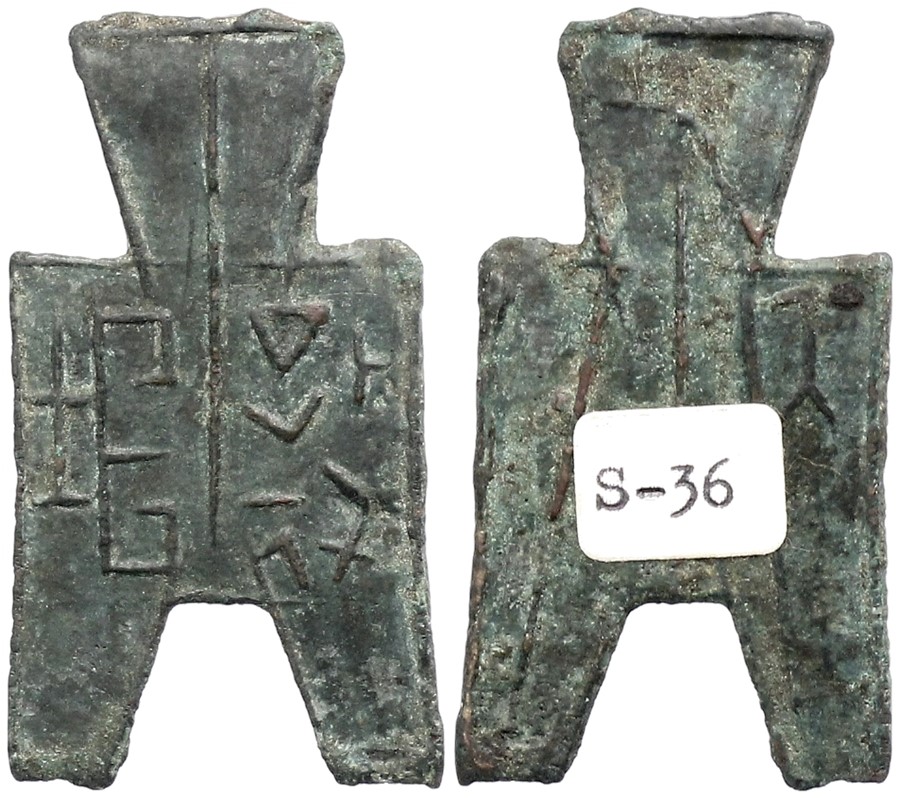
Square-Foot Spade Coin (ca 350-250 BC)
Obverse: Xiang Yuan (right left), a city in the state of Zhou
Reverse: Da (?) in upper right corner
H-3.403
This coin was from an old German collection, and each coin had a label with a Schjöth number on it.
I bought this coin because of the "Yuan" character. This character translates into "city wall," and the city of Xiang Yuan was a city that was fortified by a city wall. Xiang Yuan, which would later become the Zhou capital, was located on the Zheng He river near the southern border of Zhou. As this river formed much of the border between the Han, Wei, and Zhou states, such fortifications are quite understandable as this period in China is called the Warring States Period.
Aslo, this same character appears on one of the first round coins in China, and I felt that such a lingustic connection across different states was interesting.
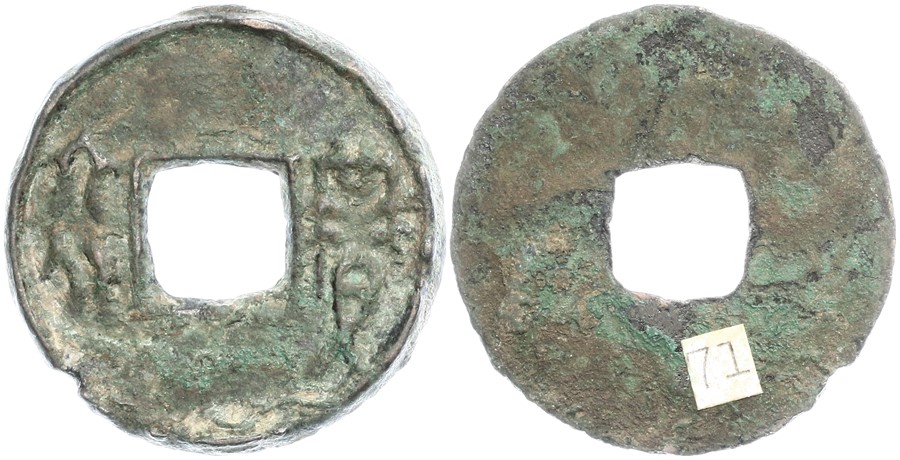
Early square-holed round coin (ca 300-220 BC)
Obverse: Yi Liu Hua (City of Yi, value Six Hua) (right, top left, bottom left)
Reverse: Blank
H-6.25
This coin is from the same German collection.
This type is fairly scarce type that I had been wanting to get for several years. These were cast by the State of Qi in the city of Yi up until they were conquered and annexed by the state of Qin.
Interestingly, this coin is denominated in terms of "Hua," which was often used for the knife coins of the same era. As this coin was produced by a knife-coin state, using the term "Hua" is quite understandable. However, in comparing the size and weight of these coins to knife coins, one can see that there is a huge weight discrepancy. This means that the "Hua" seen on this coin refers to a monetary unit seperate to that of the knife.
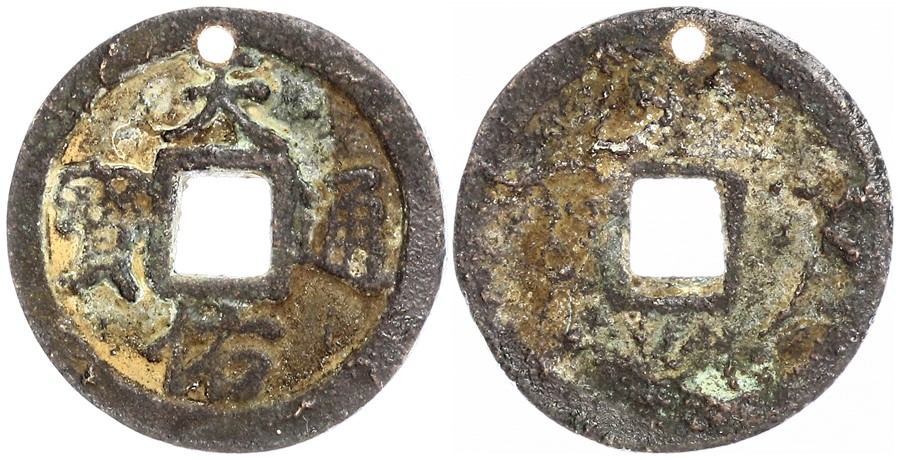
Tian You Tong Bao (ca 1354-1357)
H-19.136 (?)
This coin was an impulse buy. It is incredibly rare, and a cursory search brought no auction results. The size (28mm) is consistent with a 2-cash size, but there is no numeral on the reverse that I can see, which is inconsistent with Hartill's guide. I may keep it as it may take years (and $$$) to find another authentic specimen, or I may sell it. We'll see what happens.
This coin was cast by Zheng Shicheng, a rebel to the Yuan (Mongol) Dynasty. According to Hartill, he took the title of Prince Wu of the Da Zhou ("Great Zhou") and established his capital in Suzhou area. There, he took over monasteries and turned them into palaces, stripping them of their bells and Buddhist statues to be cast into these coins.










 Posted 11/06/2016 09:26 am


