| Author |
 Replies: 26 / Views: 3,404 Replies: 26 / Views: 3,404 |
|
|
|
Pillar of the Community
United Kingdom
2624 Posts |
Looks like a winner to me, Aphrodite always looks less beautiful than I'd expect but these coins are full of character and history. Nice addition to any collection I'd say.
|
|
Bedrock of the Community
Australia
21792 Posts |
Has anyone noticed the impressed "18" near the bottom edge on the obverse side? (I don't think the Lydians used the number characters that we use today  ) |
|
Pillar of the Community
United Kingdom
2624 Posts |
See page 1 Sel where it was refered to as a collectors punch mark. Unthinkable really.
|
|
Valued Member
 United States
54 Posts |
Yesterday I saw the description below for a similar coin.
"ANCIENT COINS. Greek. Caria, Knidos (c.465-449 BC), Silver Drachm, forepart of a roaring lion right, its jaws gaping and tongue protruding, rev head of Aphrodite right, within an incuse square, 6.12g, 8h (Cahn 85 (V 39 / R 54); Jameson 1534 (these dies); BMC 18-19 (these dies)). Attractive transitional style, cabinet tone, very fine to good very fine."
Where can I find additional information about the different die classifications, e.g., Cahn, etc?
|
|
Pillar of the Community
Spain
629 Posts |
Another example of "collector punch"... 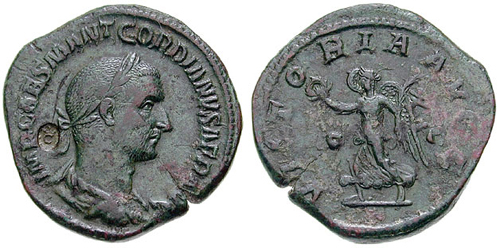 You can see a crowned "C" on this sestertius Edited by Athalbert
11/23/2016 12:29 pm
|
|
Pillar of the Community
Spain
629 Posts |
These "collector punches" are always on the field or the edge of the coin, clear from the images or portraits while the bank punches are usually on the hight relief of the coin to test the silver of the coin...
The powerful family of Gonzaga in Milano (Italy) used a winged eagle to mark the coins of their collection...
this was a very popular thing at the renaissance period...
|
|
Moderator
 United States
34549 Posts |
Quote:
Where can I find additional information about the different die classifications, e.g., Cahn, etc? This might be referring to "The Silver Coinage of Naxos" by Herbert Cahn. It was published in 1944, so could be pretty tough to find. "If you climb a good tree, you get a push."
-----Ghanaian proverb
"The danger we all now face is distinguishing between what is authentic and what is performed."
-----King Adz
|
|
Pillar of the Community
United States
949 Posts |
There are two things about the OP coin that bother me a bit:
1. The mashed appearance of many of the longer engraved lines on both sides and
2. At 5 grams the weight is too light by 17% at least. Most of the early examples at acsearch came in a 6-6.4 grams
CNG had a later version of this, with an inscription below bust of Aphrodite, that weighed 3.56 g but everything else was over 6.
I would have the metal checked before I accepted it as original. The mushyness of the lines hints at a reproduction.
The guess about the origin of the "1B" punched marker is just a guess, and not the only possible source/meaning for such a thing. To me it looks like it could be a ligatured "NB."
Edited by lrbguy
11/23/2016 4:40 pm
|
|
Valued Member
United States
54 Posts |
Thanks for the input. I'll recheck the weight but assuming 5g is correct, is that a definitive criterion to determine this coin is not authentic?
Also, what would be the significance of an "NB"?
Sorry for all the question...there's just so much to learn.
|
|
Pillar of the Community
United States
949 Posts |
Quote:
... assuming 5g is correct, is that a definitive criterion to determine this coin is not authentic?
The ancients were generally pretty consistent about coin weights in silver, but these varied over time, sometimes up, sometimes down. However, for a minting in the late 5th century BC, 5 grams would be suspect for this. More study would be required to pin it down for sure. Quote:
Also, what would be the significance of an "NB"?
Even if we could agree on that characters those are, I doubt that we can determine what they meant or why they were applied. We don't even know what language was used. Greek had an upper case N and B, as did Latin, and many languages since then (but not Cyrillic). The letters could be initials for a persons name, or a company, or a warning phrase, or ? If numbers, the use of Arabic origin numerals takes it out of the hands of the ancients for sure. Numbering for reference to a list, inventory, acquisition log, and so on could have been added to distinguish modern product from ancient original, or who knows what all else. The surest thing we can say is that we don't know what those characters mean. |
|
Moderator
United States
23731 Posts |
I think the mark is going to remain a mystery whether it's a collector mark or something else. I have to admit when I first saw it I had no idea what it was and it gave me some pause. But I think that alone can not condemn this coin. Now the weight is something else to consider. The Attic standard for a drachm of this time period is @4.3 grams, while the gram weight for drachm of this type from Caira is @6.25 grams. Just a thought, but could it be that the Corinthian standard was used where a stater weighed in at @8.7 grams and a half stater was @4.35 grams? This would make it a bit closer to the 5 gram weight of the OP coin.
|
| |
Replies: 26 / Views: 3,404 |








 First Page


 Posted 11/22/2016 04:47 am


