Quote:
It could have been made on quarter stock. Not sure if that would account for the weight lose or not.
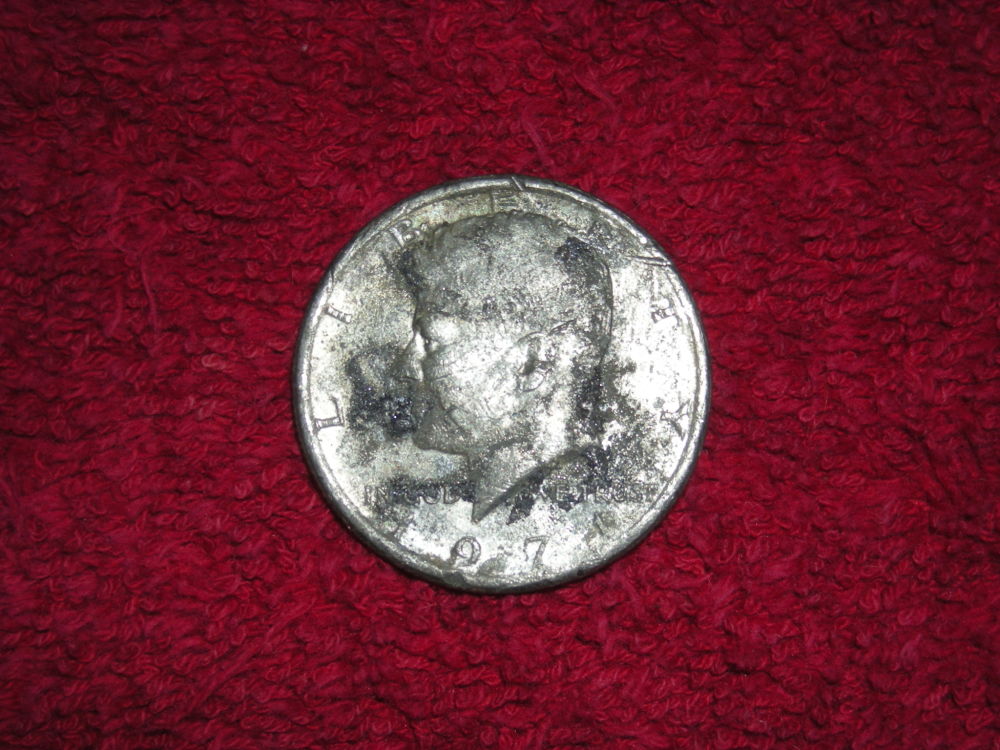
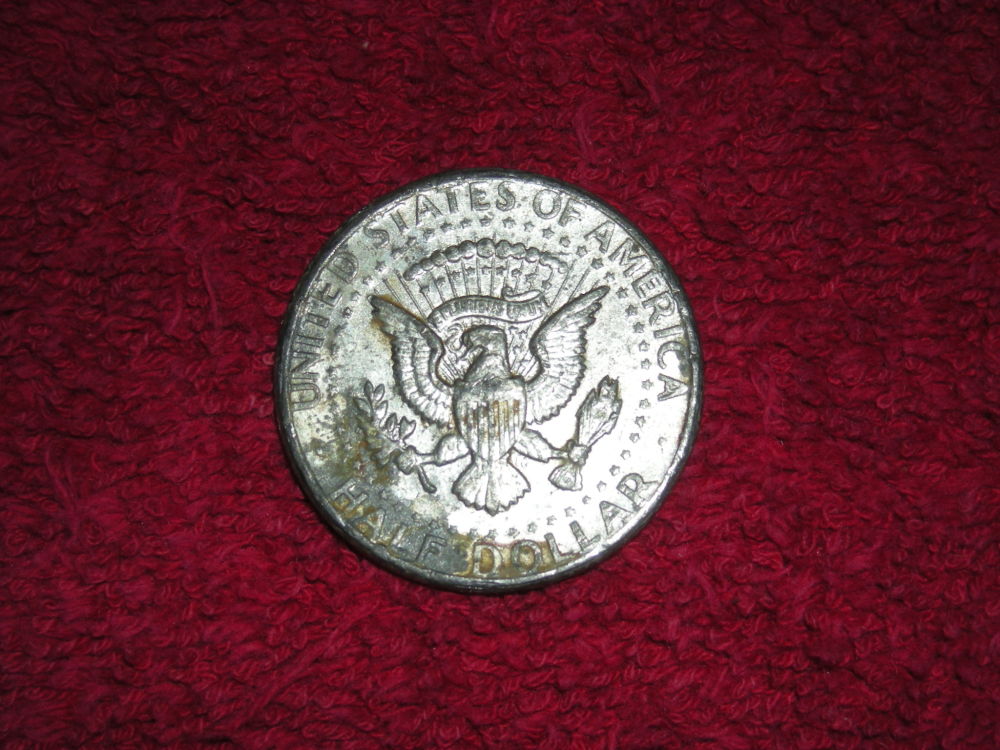
Thanks for looking at it. The odd thing is, no part of the coin has the appearance of a normal clad coin. The entire thing is an odd silver color (including the rim).
Quote:
My first thought was that it was left in an acid which removed a good portion of the exterior, but this does not have the appearance of an acid treated coin.
Next I considered it to be a contemporary counterfeit, which would actually make it more valuable than a genuine coin of that date. Kennedy counterfeits are very hard to find. But it doesn't show the typical surfaces of a cast counterfeit.
So perhaps there is that remote chance that it was struck on an improper blank, although I don't know what the weight variance might be.
Ill keep watching to see what the consensus might be on this oddity, although I can't give much help by only guessing what it isn't rather than what it is.
Thank you for examining the coin. I do not believe it the coin came into contact with acid either, as I see no signs of pitting, nor any other indications the surfaces of the coin were compromised. There is just extensive physical damage.
I didn't realize contemporary counterfeits were made of non-silver coins. Do you know of any available resources on these? I'd definitely be interested in looking into that further.
That's one thought I had too, as I pondered all of the "options." The coin does sound like a clad one when it's dropped, but oddly enough, no part of it actually looks like one.
Quote:
I did some calculations based on dimensions and weights I found and your Half is still lighter than quarter stock. I calculated 4.25 mm^3 per gram for the quarter and 4.46 mm^3 per gram for your Half. Hope this helps.
Thanks! I guess we can rule that out, then.
Quote:
Looks like a partial clip on the obverse.
Yes, I saw that too. It's strange that the coin has so many "issues"!
Quote:
Does it have a copper core?
No, I see no signs of one. The rim is silver-colored too. In addition, there are countless nicks, scratches, chips, etc. in the coin, and underneath every one of them there is that strange, not-quite-actual-silver color.
Quote:
I see a lot of crud plus a mark at about 2:00 on the first pic where it looks like it was forcibly pried from another coin. Maybe it got *really* dirty and someone soaked it in vinegar for a month to extract the coins from the goo?
There is definitely a lot of junk around Kennedy's bust, but the layer itself is really thin. It is also crystalline in appearance, almost like some kind of mineral. But the coin itself shows no signs of pitting or etching, as I think would be the case with a soaked coin.
Quote:
The coin appears to be Fire damaged by the look of it. Maybe that would account for the weight discrepancy.
Thank you for looking at it. It's difficult to see in the pictures, but the blackened areas on the coin are actually thin and crystalline in appearance, and seem as if they could be rubbed off with a solvent. Oddly enough, they are also only present on one side of the coin; the other side exhibits only physical damage.
Quote:
I would suggests having it tested to see what type of metal
it is. The more that you can confirm, the closer you might
get to figuring out what it is.
I am not sure why someone would fake a copper-nickel coin.
I would definitely be interested in doing so, but will have to look into where I might be able to do that. I'll keep you posted!
Nor am I. There can't be much profit in doing so.
Quote:
I have a few counterfeit halfs that look very similar to the one posted. If you can find a local shop with and xrf scanner they should be able to tell you the exact composition so you'll know if it's real or counterfeit.
GR58 there was a big bust not long ago where people were sending in massive amounts of mutilated coins to the mint for destruction and getting paid by the weight of the shipment. The only reason the mint caught on was they had redeemed more half dollars than the mint ever minted. If it cost 3 to 4 cents to counterfeit and the government was paying them face value. That's not a bad scam.
Thanks for the suggestion. I'll try looking around and see if there are any possibilities in that respect.
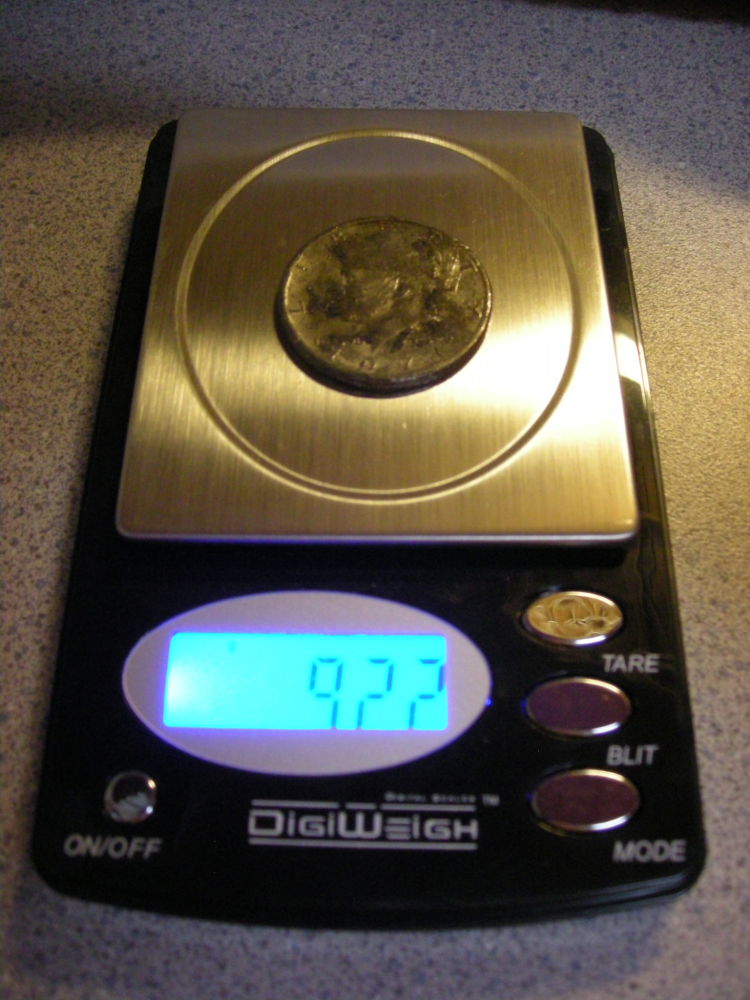
That's actually the first thought I had when I weighed the coin and found out it was underweight by over 2 grams. This possibility would seem to be supported by the massive physical damage all over the coin, as well as the appearance of being struck from some kind of off-metal.
Quote:
My first thought was that the planchet was missing the core- just two cupronickel layers bonded together. However, I think the core must account for more than 19% of the weight, and the resulting thin planchet wouldn't strike up too well.
I'm leaning toward acid or fire damage.
Thanks for taking a look at it. In response to your statement about the core, I cannot actually see it through the rim. The rim itself is very thin and heavily nicked/ chipped. Underneath the chips, there is just that same off-silver color.
Underneath all of the damage, the strike itself does appear to be fairly regular; it's just the overall appearance of the coin that has us all puzzled!
I'm actually not sure about the fire or acid. The blackened areas are thin and crystalline in appearance, and I do not see any signs of bubbling, pitting, etching, etc. (as I think would be the case when the surfaces of the coin were attacked in some fashion).
Quote:
It looks like some sort of damage. If this was a perfectly clean coin, We might think otherwise, but because there is a big hunk-a-junk all over the coin, it leads you to think it is damage.
Thanks for looking at it. The coin has definitely seen better days, but I cannot imagine any number of nicks, scratches, etc. adding up to 20% of the overall weight of the coin. Just to see how much weight excessive circulation wear might strip away, I weighed a "bare disc of silver"
Barber half dollar. It was about 1.4 grams off from the standard of 12.50 grams, yet this particular half dollar shows nowhere near that kind of wear.












 Posted 12/02/2016 01:02 am


