Coin Community Family of Web Sites Join Thousands of Coin, Bullion, & Money Collectors
Royal Canadian Mint products, Canadian, Polish, American, and world coins and banknotes. Vancouvers #1 Coin and Paper Money Dealer Join Thousands of Coin, Bullion, & Money Collectors Shop for APMEX Bullion on eBay!Specializing in Modern Numismatics Coin, Banknote and Medal Collectors's Online Mall 300,000 items to help build your collection!


Username:
Password:
Save Password
Forgot your Password?


This page may contain links that result in small commissions to keep this free site up and running.

Welcome Guest! Registering and/or logging in will remove the anchor (bottom) ads. It's Free!

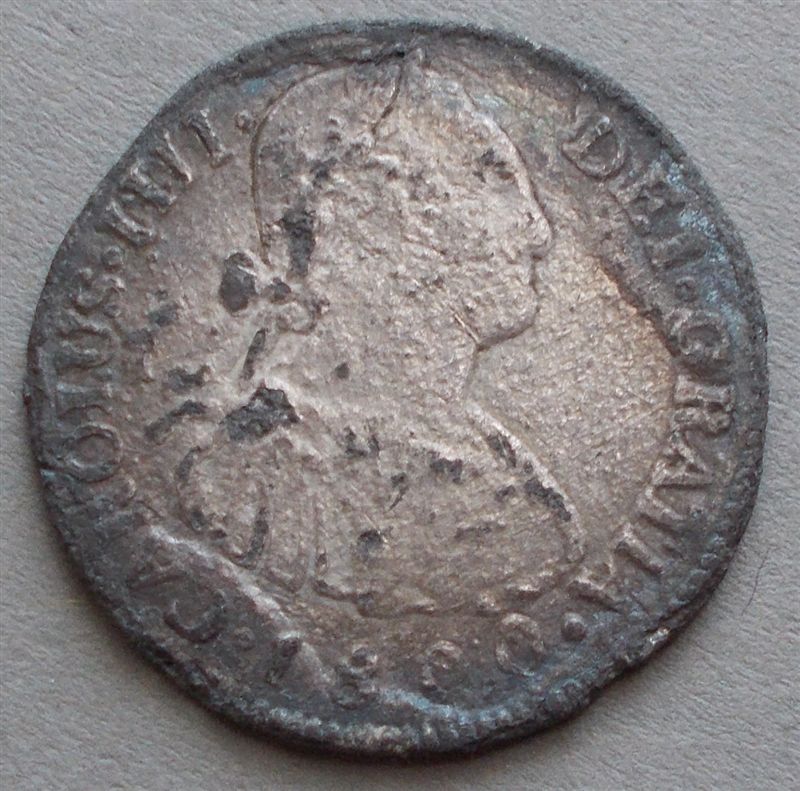
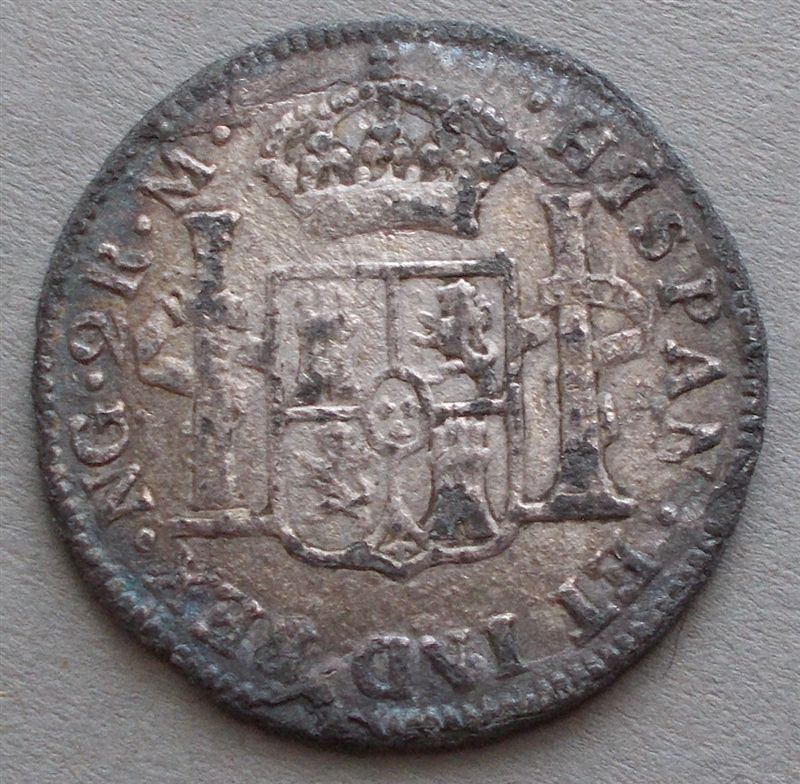
Contemporary (?) Counterfeit 1800 Dos Reales

To participate in the forum you must log in or register.
Author Previous TopicReplies: 7 / Views: 1,564Next Topic  
Pillar of the Community
Lucky Cuss's Avatar
United States
4883 Posts
 Posted 12/13/2016  6:11 pm Show Profile   Bookmark this topic Add Lucky Cuss to your friends list Get a Link to this Message Number of Subscribers
27.5 mm in diameter, weight 4.95 grams. Appears to have been plated. I imagine an analysis via xray fluorescence might be interesting.

Contemporary-?-Counterfeit-1800-Dos-Reales

Contemporary-?-Counterfeit-1800-Dos-Reales

Colligo ergo sum
Pillar of the Community
colonialjohn's Avatar
United States
1757 Posts
 Posted 12/14/2016  11:02 am  Show Profile   Bookmark this reply Add colonialjohn to your friends list Get a Link to this Reply
In my new book I do the final treatment of these Portrait Carolus III-Ferdinand VII Two Reales known as Kleeberg's. Book due out around March 2017 via Amazon. Not surprisingly most advanced Mexican collectors are totally IGNORANT of the Kleebergs and also in contemporaries in general - its changing as the Gurney book infiltrates into Mexican numismatics and CCCs become a collectible item rather than a nuisance item.

If a MNA member see my Colonial Newsletter update in the library link of the MNA site for clarification/information on these coveted types always bringing low-mid three figures.

In terms of your piece silver plated pieces do not really qualify for Kleeberg status as well as debased silver issues. Just pure off-metals. As an example we do see silver washed brass or bronze or brass/bronze mixed alloys given Kleeberg designations.

As you suggest this appears to be a silver plated over a copper core two reales. Rare. But not worthy of a Kleeberg variety classification. Its simply a rule set-up in the beginning. No silver plated or debased issues in this CCC Family.

I admit its unfair for this Sheffield type since these are RARE whereas debased issues are much more common - as you know.

I will check it tonight and see if I can plate match this 1800 dated specimen - perhaps its a die pair that exist in another off-metal alloy.

The peeling effect indicates a plate and its 100% certain its not a wash. Most washes used BTW are of a mercuric silver wash amalgam type for this time period with this type.

NICE.RARE.

John Lorenzo
Numismatist
United States


Pillar of the Community
colonialjohn's Avatar
United States
1757 Posts
 Posted 12/15/2016  08:56 am  Show Profile   Bookmark this reply Add colonialjohn to your friends list Get a Link to this Reply
Will check your coin tonight. If my book is ready I may do a talk at the 50th Anniversary of the EAC in Philly this April 2017. Let's see if its ready by March 2017 and if there is a spot open in the talk forums?

JPL
Pillar of the Community
colonialjohn's Avatar
United States
1757 Posts
 Posted 12/16/2016  09:54 am  Show Profile   Bookmark this reply Add colonialjohn to your friends list Get a Link to this Reply
Sorry no die match but its a keeper. In general lower denominations are much more rare. For these issues increasing rarity follows: 8R, 2R, 4R, 1/2 & 1R (most rare). See S. Albumn's new Jan. auction. UNIQUE. Good luck ...

JPL
Pillar of the Community
swamperbob's Avatar
United States
5362 Posts
 Posted 12/16/2016  4:03 pm  Show Profile   Bookmark this reply Add swamperbob to your friends list Get a Link to this Reply
Lucky Cuss - I will second what John has said. The "rules" for Kleeberg 2Rs are a bit out of date because Sheffield Plate was not well known as a counterfeiting method when that study began. I think Sheffield Plate deserves a place at the table. It was a popular and very successful method used in the UK and also in the US.

There has been a tendency to assign late dates of manufacture to Sheffield Plate coins, particularly those made in the US. I only partly concur with that as appropriate. Kleeberg was most focused on counterfeits that circulated in the US in colonial times. A coin from 1800 does not fit the bill. The US existed at that time.

However, if you include the early US Republic (Federalist ear) you get a different mix of potential methods including Sheffield plate and coins dated after 1789.

The one aspect of Sheffield Plate that Kleeberg seems to have missed was that there were shipments of raw Sheffield Plate that were made to the US in the colonial era. Meant for use as plates, cups, bowls or other pieces - the raw material was in the Colonies before 1789. So theoretically the smaller scraps of Sheffield Plate could have been diverted to counterfeit production.

Leaving speculation aside, your coin actually falls into a different category. I do not believe it is necessarily a Sheffield Plate coin. It is clearly a two layer production with a silver color metal over a darker core. But when you look at the details of the coin, they appear to be thicker than they should be. They are also not as sharp and lack fine details of a struck Sheffield. I believe you have a cast coin that was subsequently plated in order to pass for silver. The added metal thickens the details and reduces sharpness. The method of plating is uncertain.

The casting molds used appear to use a genuine host coin as a starting point. That raises an issue of what matrix (molding material) was used to create the impression. Casting liquid metal into a mold before the mid 1830s necessitated a mold usually made of fine sand and clay. After the mid 1830s other types of materials and new methods became available in very rapid succession. I think your coin could not have been produced before 1835 unless it can be proven to be a Sheffield Plate. I believe such a coin could still be produced today using old techniques and you could achieve the same appearance.

That is the crux of the issue on cast coins - age. Usually age of a casting is very uncertain. The mold dictates appearance and old techniques can still be used.

Cast counterfeits are not included in Kleeberg because of the issue of dating the point of manufacture. For the same reason, most cast copies were eliminated from the GNL numbering system. The ones that made it in were either extremely early casting types (sand cast) with apparent wear from circulation or in a few cases were known to be over well over 100 years old based on provenance. The oldest provenance I could trace for a GNL coin was 1830.

Your cast coin should be tested with XRF. The silver layer tests hopefully will determine how that silver layer was applied and of course the core metal should be tested to see if the components were all normal in period alloys of the same type. Most often trace contaminants will exclude coins as contemporary (because of inclusion of rare earth elements found in modern recycled metals). XRF can not provide positive proof of age only the possibility of age based on the trace elements included.

I do agree that the coin is interesting, it should be studied further and it should not be treated as junk.

Pillar of the Community
Lucky Cuss's Avatar
United States
4883 Posts
 Posted 12/17/2016  1:00 pm  Show Profile   Bookmark this reply Add Lucky Cuss to your friends list Get a Link to this Reply
I thought at this point that it'd be appropriate to provide a link to Counterfeit 2 Reales of the Bust Type: Charles III, Charles IV, Ferdinand VII 1771-1821 A Survey and a Die Study that's been uploaded to the web by John Kleeberg.

This is a 55 page pdf file that can be accessed via: http://www.academia.edu/7648586/Cou..._a_Die_Study


Quote:
But when you look at the details of the coin, they appear to be thicker than they should be. They are also not as sharp and lack fine details of a struck Sheffield. I believe you have a cast coin that was subsequently plated in order to pass for silver. The added metal thickens the details and reduces sharpness.


You've zeroed in on the main reason I was initially having some doubts about the "authenticity" of my counterfeit, as it's a bit hard looking at it now to envison how convincing it might've been when it was unworn and first being passed into circulation.

Colligo ergo sum
Edited by Lucky Cuss
12/17/2016 7:28 pm
Pillar of the Community
colonialjohn's Avatar
United States
1757 Posts
 Posted 12/19/2016  11:55 pm  Show Profile   Bookmark this reply Add colonialjohn to your friends list Get a Link to this Reply
If you send me a PM I can do an XRF in the laboratory. $10 for P&H. But after January 1. My analyst is out till the NEW YEAR. I still believe its a silver plated base metal issue. Interestingly the two Ringo pieces which were high silver issues but very crude designs made into Kleeberg. I remember arguing (a bit) with Dr. Kleeberg actually in the ANS Museum in his office on the rule - only off-metals - but on these two issues from Ringo they were so crude we made an exception. Besides his mind was made up - LOL. Today I own one of these two pieces. To be honest perhaps in the beginning we should have considered silver plated pieces but they are SO RARE we never considered them into the equation of acceptance. My excuse or his excuse - its only a hobby <BG>. The lettering is too sharp for a cast IMO and that blue hue suggest a silver oxide surface. We will check the underneath area and its LEAD content. Your move ...

JPL
Pillar of the Community
Lucky Cuss's Avatar
United States
4883 Posts
 Posted 01/31/2017  7:52 pm  Show Profile   Bookmark this reply Add Lucky Cuss to your friends list Get a Link to this Reply
I took colonialjohn up on his offer. Xray fluorescence shows the plating to be in fact silver. Not meaning to speak for him, but he identifies this as a "Sheffield" contemporary counterfeit.

Colligo ergo sum
Edited by Lucky Cuss
02/01/2017 10:47 am
  Previous TopicReplies: 7 / Views: 1,564Next Topic  

To participate in the forum you must log in or register.


Disclaimer: While a tremendous amount of effort goes into ensuring the accuracy of the information contained in this site, Coin Community assumes no liability for errors. Copyright 2005 - 2026 Coin Community Family- all rights reserved worldwide. Use of any images or content on this website without prior written permission of Coin Community or the original lender is strictly prohibited.
Contact Us  |  Advertise Here  |  Privacy Policy / Terms of Use

Coin Community Forum © 2005 - 2026 Coin Community Forums
It took 0.27 seconds to rattle this change. Forums