| Author |
 Replies: 9 / Views: 1,677 Replies: 9 / Views: 1,677 |
|
|
Valued Member
Italy
81 Posts |
Hi everyone, you'll probably be able to help me in understanding what happened to this coin of 2 Francs 1913. On the reverse side there is a a part slightly concave and circular, around the date. On the rims there are not other signs and so also at the obverse. Is it a defecting planchet normally struck? Or something else? Thanks, ciao! Roberto 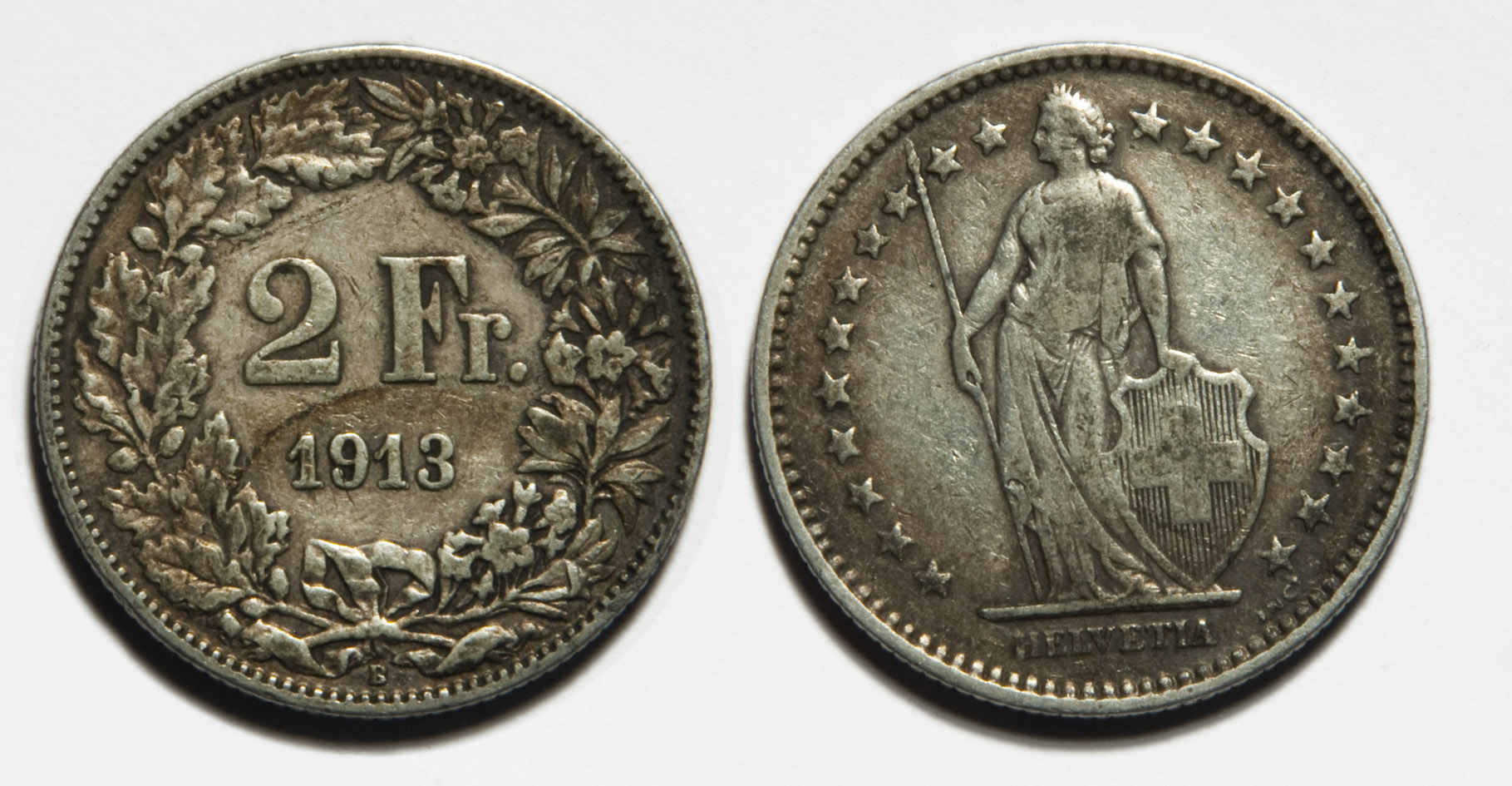 |
|
|
|
Pillar of the Community
United States
4883 Posts |
This has the appearance to me of impact damage incurred while in circulation, and as such would only diminish its value at any grade.
Colligo ergo sum
|
|
Rest in Peace
United States
7075 Posts |
 I think I can see a little damage on the obverse that would be opposite the damage on the reverse. I think if the planchet was defective before being struck the design on the coin would show some sign of an uneven strike. However, I am not really sure about that. |
|
Valued Member
 Italy
81 Posts |
With the coin in my hand I cannot see any damage on the other side. If this was a bump, and a big one, there should be a sign on the opposite face. And probably there should be a trace on the numbers which are just in the middle of it. Or not? But the numbers are perfect.
|
|
Pillar of the Community
United States
4883 Posts |
I'd remark additionally that even if this is a "mint error", any enhancement to its value would likely be minimal, especially at this rather advanced stage of wear.
Colligo ergo sum
Edited by Lucky Cuss
12/16/2016 6:18 pm
|
|
Rest in Peace
United States
7075 Posts |
Quote:
there should be a sign on the opposite face. I don't think that always happens. It would depend upon what the coin was resting on when it got hit. I looked through the section on planchet errors here: http://www.error-ref.com/part-v-planchet-errors/I didn't see anything that matched what you have on your coin. It is an interesting defect and a puzzling one, too! |
|
Rest in Peace
United States
7075 Posts |
So -- after giving this some more thought I thought that perhaps if the coin had been hit with with something heavy enough to dent the coin but still soft enough to absorb some of the impact -- for instance, a rubber mallet -- the devices (the date, leaves) would not show any damage and the impact would get displaced into the fields causing the indentation. If I could remember anything from college -- but it was too long ago -- I think that if you were able to measure the circumference of every device, you would find that they had all increased in size, the total of which would equal the volume/size of the indentation. The devices have spread a tiny bit in every direction from the impact. I can't think of how you'd be able to measure that, but it would explain how the coin got damaged and yet the date appears to be undamaged. Maybe. I've been thinking about this but I'm not sure I have it all right.  |
|
Valued Member
Italy
81 Posts |
Interesting idea Buddy, but when you have time just try to make a bump on a silver coin of no value with a rubber mallet or a wooden one. and you'll tell me what happens. For what I can imagine it will happen nothing and the mallet will get the shape of the coin on its surface. Metal is quite hard to damage.
And, in any case, with a post-strike bump of that kind the numbers would really get seriously damaged.
What I think could have happened is that a planchet got a kind of bump before the strike and the collar kept the circular shape of the coin regular during the striking process. Could it be?
|
|
Bedrock of the Community
Australia
21792 Posts |
Post mint damage, unfortunately.
Nevertheless, I understand why the O.P. has asked about it, because the date area looks to be undamaged.
Incidentally, the Swiss are extremely tough, when it comes to the grading of their own coins.
U.S. slabbing standards virtually irrelevant.
|
|
Rest in Peace
United States
7075 Posts |
Quote:
make a bump on a silver coin of no value with a rubber mallet or a wooden one. and you'll tell me what happens. I'd probably just smash my thumb.  I did not word my post very well. I meant that a rubber mallet would be the sort of thing that could absorb some of the impact. I don't think a mallet or a hammer would not make that elliptical shape. I can't think of anything that would -- before or after the coin was struck. So the puzzle continues...but I like a mystery. |
| |
Replies: 9 / Views: 1,677 |
|










 Posted 12/15/2016 8:21 pm


