|
This page may contain links that result in small commissions to keep this free site up and running.

Welcome Guest! Registering and/or logging in will remove the anchor (bottom) ads. It's Free!
To participate in the forum you must log in or register. | Author |
 Replies: 92 / Views: 15,754 Replies: 92 / Views: 15,754 |
|
Pillar of the Community
United States
6130 Posts |
Here it is guys; the big unveiling of my "hush hush" project from the last six months. I am probably done accumulating, but I am not done with the laborious task of imaging, measuring, and documenting. I will attempt to upload the next increment on a semi-regular basis. Enjoy! This thread will serve as my living draft; I openly encourage discussion and correction, and the numbering given to the coins should at this point be considered preliminary at best. If you stumble across this thread at any time in the future, please do not hesitate to bump it back up with any questions or insights you may have. Here we go! To paraphrase an old XKCD webcomic: "All fields of human interest are nested fractally; there is no bottom." From the mind-numbing patchwork of geopolitical entities that is late classical and medieval India, comes one particular coin series that is especially common and cheap, yet woefully under-studied. Collectively, these coins are typically called the Gadhaiya Paisa (Gadhaiya = derived from an older name for what is today called Gujarat; Paisa = Generic Indian name for small change, similar to the English "Penny"). They are all silver of varying fineness, stretch over a period of history spanning nearly a thousand years, and are all derivatives of the same base type, a Sassanian drachm of Peroz I or similar. They are all (with a few exceptions) anepigraphic, highly stylized, and probably impossible to pin to any particular ruler. I won't pretend that I know enough about the history behind these coins to firmly attribute them, but I intend to show, through the systemic analysis of features on these coins, that a clear lineage can be established. I have not read the expensive, hard to find, and generally out of print catalogs that touch on these coins, so I apologize if I am repeating anything, and welcome any corrections or further explanations. I hope this guide will be the most comprehensive and useful study that is freely available on the Internet, and hope that it will generate enough interest that others will come after to expand and improve my work. Before I get started, let me give credit where credit is due: Doug Smith's excellent guide over at FORVM: http://www.forumancientcoins.com/do...adpaisa.htmlNumista listings of the type: https://en.numista.com/catalogue/in...l#devise2540And of course my ebay dealers who made this all possible! So here we go! =================================================================================== A study of the "Gadhaiya Paisa" and similar derivatives of Indo-Sassanian silver drachms used in India and central Asia =================================================================================== BACKGROUND - The Sassanians and the Huns ------------------------------------------ The Sassanian drachm was introduced at the onset of Sassanian rule over Persia under Ardashir I in 224 AD. The coins were wide and thin, weighing roughly 4g each. The obverse features the ruler in an ornate headdress, and the reverse features a Zoroastrian fire altar, which was a symbol of the dynasty's purported divine favor with their god Ahura Mazda. Beginning Shapur I, two attendants were added to the reverse, flanking and guarding the fire altar. Also added were a pearl necklace and ribbons, which according to Sassanian legend, were conferred upon the King of Kings by a divine and magical bird or gryphon to legitimize his rule and represent divine favor. This prototype was maintained through to the end of the dynasty at the hands of the Rashidun Caliphate in 651 AD. Over time, the design became more abstract and stylistic, and the legend diminished from verbiose titles to simple statements of ruler, regnal year, and mint city. The Sassanian empire was situated conveniently on the Silk Road, controlling the vast passable region between the Kushan empire above India, and the Roman and Byzantine empires. Thus, their silver drachms circulated widely in the lucrative trading routes that stretched from China to the West. In the 400s, a nomadic people from central Asia, collectively known as the Hunas or Huns, migrated into the area today known as Afghanistan and Pakistan and began to settle, often violently expelling the native populations. Relations between the Huns and Sassanians were reasonably peaceful, until 469 when they betrayed Sassanian ruler Peroz I. He launched a campaign to punish them, but was captured in battle and held ransom for a huge sum, which greatly enriched the Hunnic tribes (Specifically the Hepthalites) and caused a great deal of financial headache for the Persians. In 484, Peroz launched a revenge campaign against the Huns, and was soundly defeated. 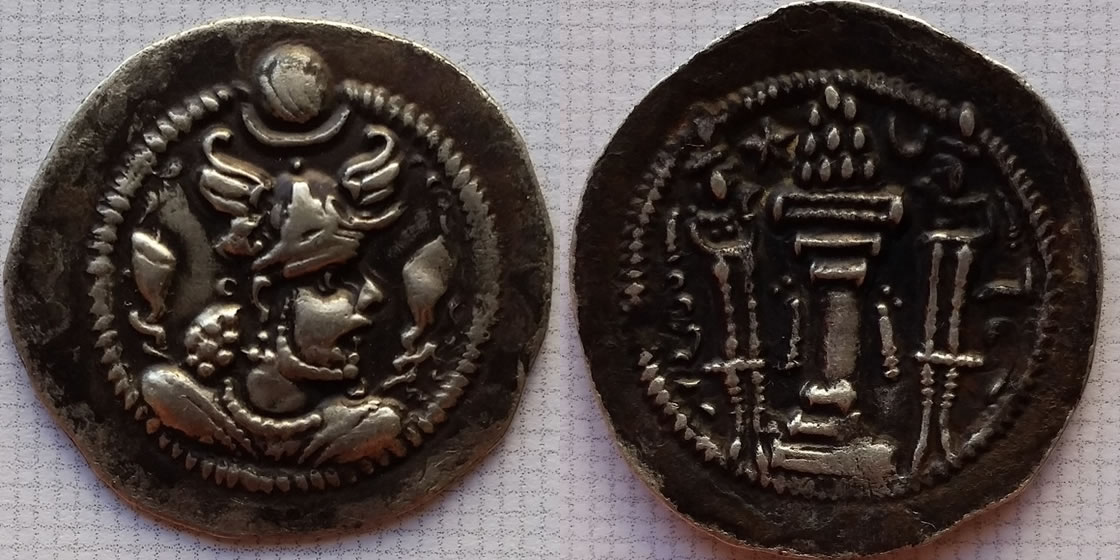 Sassanian Empire Peroz I 459-484 AD AR Drachm 27mm, 3.69g Bust of Peroz right in winged helmet topped by globe, ribbons before and after portrait Fire Altar with attendants; Pahlavi legend "Peroz" (left) "NI-NY" (Right; Nihavand mint) The huge accumulation of Sassanian silver coins inspired the Huns to adopt their own imitations of the type. Early issues were purely imitative, but over time their engravers stuck to the Sassanian prototype while developing their own artistic flair. These won't be covered in depth in this study, as they are both expensive and already well-documented. I do however, have a low-grade billon example of the Nezak "Napki Malka" type; one of the commonest and cheapest of the definitively Hunnic coins of the Sassanian style. 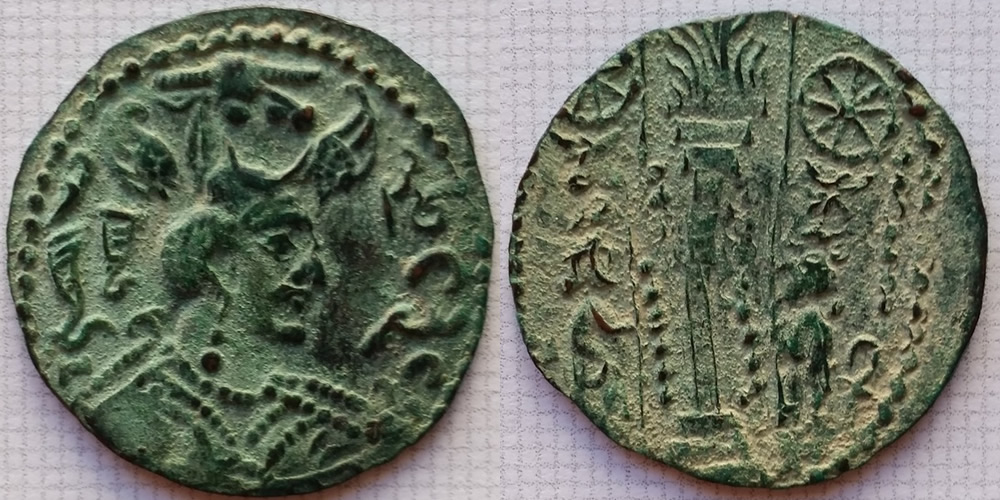 Nezak Huns (Afghanistan region) "Napki Malka" (Unknown if this is his name, or a generic title) ca. 6th or 7th century AD BI Drachm 26mm, 3.59g Hunnic bust right with winged helmet topped by bull's head, ribbon behind, Pahlavi legend "NPKY MLK" Fire altar with spear-holding attendants, each with a wheel (sun symbol?) above Over the centuries, the Huns mellowed out and faded from history, presumably dissolving into the local populations through successive generations of intermarriage. Their presence at the very heart of the Silk Road helped to spread their coinage and culture even as they faded into obscurity. One of the most lasting cultural impacts of the Huns was in North-Central India, where the coins inspired a series of imitations that stretched multiple dynasties over the better part of a thousand years. This begins our study. How coins will be analyzed ------------------------------------ The biggest struggle with this series is that most lack any sort of legend whatsoever. The impossibility to assign a coin to a particular king (or often even a particular dynasty) turns most people away from these coins, or else drives them to acquire one example and write off the rest as inconsequential. This lack of interest leaves an enormous void in our current knowledge of the series, which is something I hope to remedy. Through the comparison of features within and between series, I hope to clearly establish a "lineage" from the very earliest imitations of Hunnic Peroz imitations, all the way through to the Omkara monastery coins. A few reasonable assumptions must be made to map the evolution of the series: - These are all silver of varying fineness, and all weigh within a few tenths of 4.0 grams. Therefore, they all constitute variations of the same denomination, equivalent to and drived from the Drachm, as passed from the Greeks to the Parthians to the Sassanians to the Huns. - Using the Peroz drachm as a baseline, these will be grouped into separate paths; the Gadhaiya Paisa path, the Gurjara-Pratihara-Pala path, and the Bukhar Hudat path. - Within the two paths, any abrupt changes with no intermediates will be treated as a "series". A clear parallell development within a series will be treated as a sub-series. Individual coins will be grouped within a series, or sub-series as applicable. - Once a particular feature degrades and becomes unrecognizable, it will be assumed that lost features will not re-appear. In the big picture, this is the factor leads to the degradation of the design into unrecognizable shapes. - As with any evolutionary tree, a child branch does not mean that the parent branch must come to a screeching halt. Indeed, the presence of continued development along different lines can help us to discern exactly how much overlap the two civilizations shared. That said, each series will be given an introduction and overview, with a detailed analysis of the general features within the series, and each coin listed with attention called to significant features, and listed roughly in chronological order from beginning to end. |
|
|
|
Pillar of the Community
 United States
6130 Posts |
--------------------------------------------------------- Track 1 - The "Gadhaiya Paisa" | Huns -> Chavda -> Chaulukya and related --------------------------------------------------------- Series 1 - Hunnic and related early imitations Area - NW India/Afghanistan/Pakistan Time period - 500-700 AD? Attributed to - Huns, Gurjuras, Chavdas Overall rarity - Scarce to Rare Price range - $10 - $100+ Fabric Flan diameter - Large (20-25mm) Die size - Size of flan Typical centering - Fair/Poor Strike quality - Poor Thickness - Thin Weight - 3.7 - 4.1g Typical wear - Heavily worn Silver purity - High (early) / medium? (late) Design Engraving skill - Good/fair Design relief - Low (early) / outlines (late) Obverse Head shape - Large head related to coin; usually large, square jaw with small forehead. Beard - Early coins show textured bumps in relief running along the jaw line. Later examples depict beard as one or two rows of dotted lines running from beneath the lips to the brim of the hat, Hat - Wide brim with prominent wings, topped by antenna or globe. Ribbons - Long thin curvy line, usually forming a roughly "S" shape on both sides of portrait, topped by three lines. Earlier coins mimic what is seen on certain offical Peroz I drachms; later coins enlarge the lines and bring them in line with the brim of the hat. Shoulder pads - Early coins show realistic shoulder details; later examples display shoulder pads as textured clubs attached to circular brooch beneath necklace. Reverse Fire Altar - Generally tall and thin, with a cone-shaped bowl standing atop a thin pillar. Bowl displays as three horizontal lines flanked by parentheses shape. Base displays as three horizontal lines. Flames represent as either a triangle, textured triangle, or cluster of tightly packed dots in a triangle. Attendants - Usually both female. Represented as tall and thin, with small heads, a prominent necklace of very fine dots, a single long arm holding a ribbon or sash coming from the center of the fire altar, and a "pointy" dress that presents much like a bunch of thorns. Breasts are small dots above the arm. Body generally curves back, away from the fire altar. Sun and moon - Sun presents as six-pointed star, always on the left except for very early examples. Late examples present sun as six dots around a central dot. Moon presents as a large thin semi-circle, always on the right except for the earliest examples. This, overall, is the most widely varied series in this study, and probably constitute at least several different civilizations across several centuries. Attributions for these coins are all over the board, ranging from the Huns to the Gurjaras to the Chavdas. They might be completely unrelated, but I feel that the absence of even degenerated legends on all but the absolute earliest examples indicates that these are the first series in the Gadhaiya Paisa coinage track. 1.1 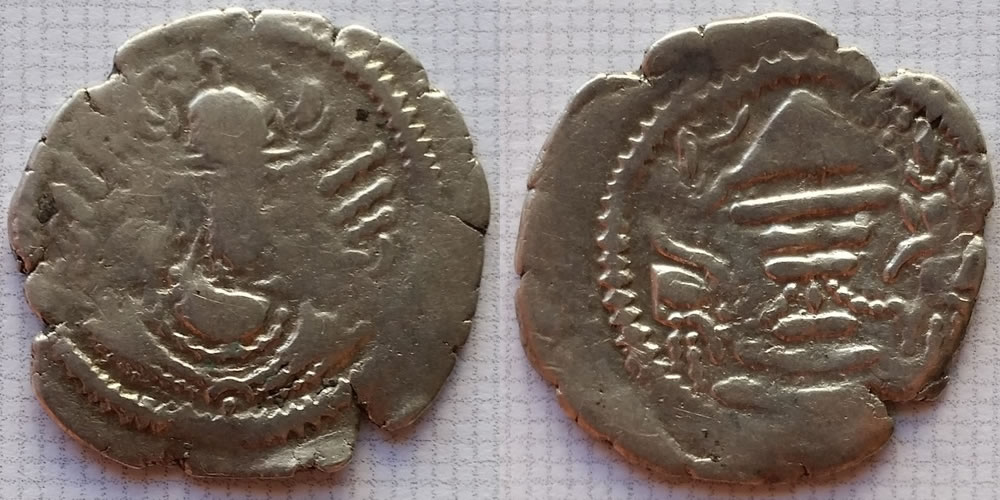 25mm 3.80g This early imitation is almost certainly Hunnic, and stylistically very similar to the Peroz drachm. The poor strike quality is especially apparent due to the fact that the face is completely missing. When striking such large, thin coins, it is often difficult to get all of the metal to move up into the deeper parts of the die. Stylistically, this coin is somewhat better than average; it actually has relief in the design, and at least copies the shoulder pads very well. The hat however, has lost its large ornamental globe, and is simply a beanie with wings and what looks like a robot antenna. Likewise, the reverse hits all the main points, but the fire altar is too large; the flame is just a big triangular block, and the attendants are sloppily done. As is reasonably common within this series, the sun is on the right and the moon is on the left; this orientation will be flipped on later coins. I also see no attempt to replicate a legend anywhere on this coin. 1.2 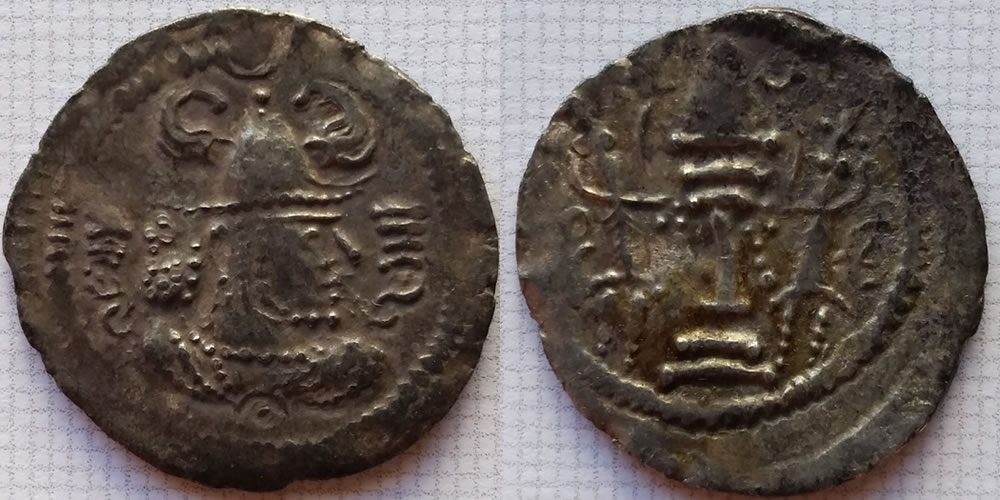 25mm 4.00g There is a fair bit of uncertainty surrounding coins like this one. This one in particular was sold as being from the Gurjura dynasty, and would thus belong in Track 2, but I have my doubts. Stylistically, this is a very good copy of a Peroz drachm. The overall style is admittedly much more crude, indicating that the die engraver was going for a technical copy, rather than an artistic copy. The key feature of this coin is that the attendants have now donned what I would call the "Thorn dress" which is pretty much the only common element of this series. Additionally, and unique to all the coins in this entire track, this coin has either Pahlavi or pseudo-Pahlavi legends in the proper place on the reverse.  1.3 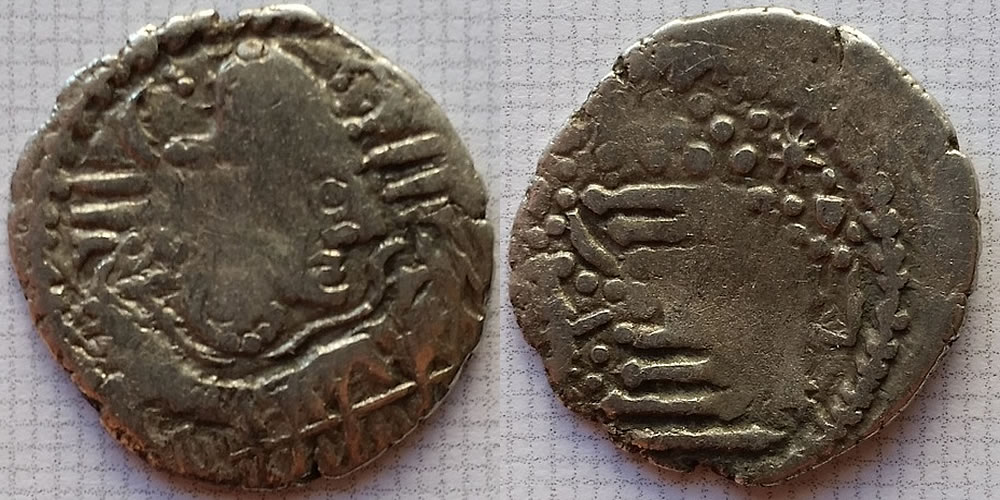 21mm 3.91g I love the unusual, very Hunnic bust on this coin! The design elements are poorly executed here, and large sections are either worn smooth or flat-struck. We can however see that the attendants on the reverse are wearing the typical "thorn dress", and also that the sun and moon are still on the "incorrect" or opposite side of what would be seen later. Note also the very unusual textured pattern in the portion of the flan that did not make contact with the dies. I do not know how or why it looks like this, but we will see it again later. For comparison, here is an artist's impression of a Hun warrior-chief, based on historical accounts and archaeological temains:  Photo credit: http://www.ernak-horde.com/Hun_origins.html1.4 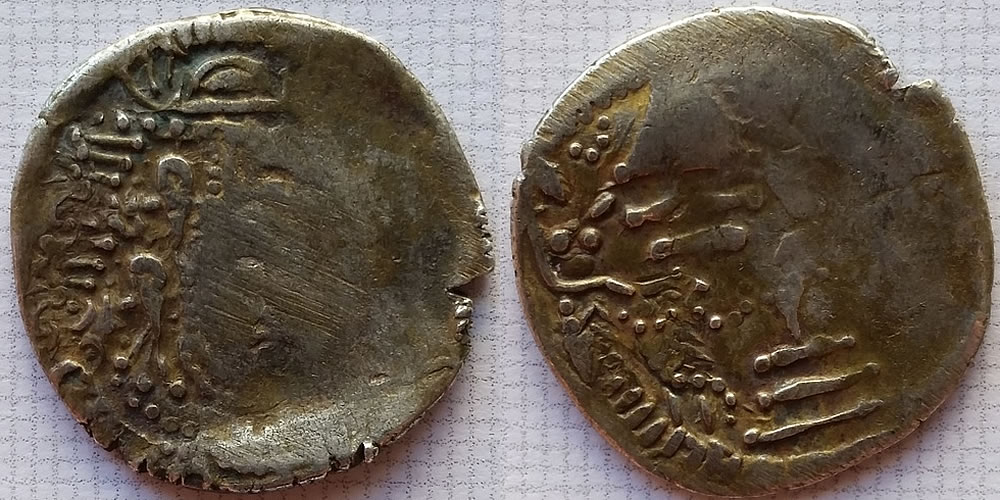 23mm 3.98g Holy striking issues, batman! Not only is nearly all of this coin flat-struck, it was struck a minimum of two times! Futher evidence that these coins were struck by the Huns, who were notorious for their policy of "Just keep hitting it until it turns out good". 1.5 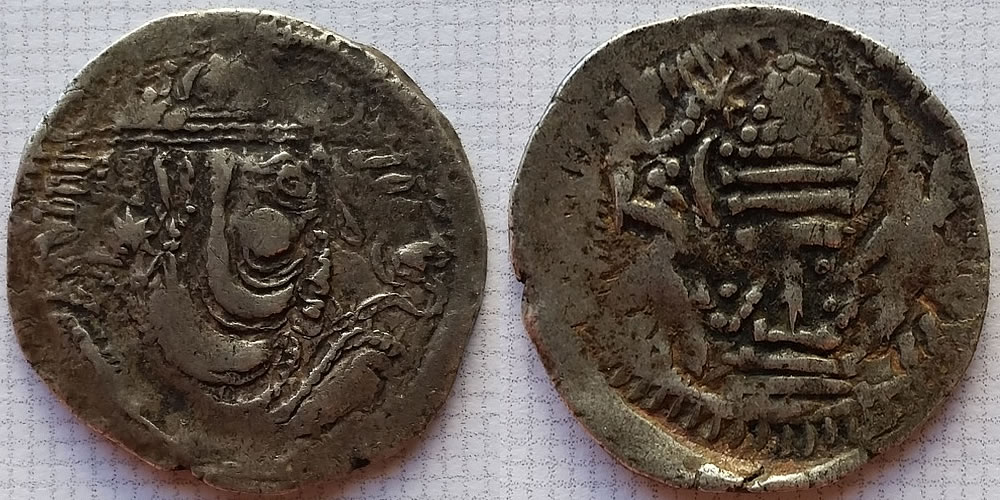 24mm 4.03g This particular coin type shows up much more often than the previous examples. Stylistically, it is more similar to 1.2, however the design has been reduced to line etchings. Whatever "legend" may have been present on 1.2 is gone now. Chrsmat on CoinTalk noted that the portrait on this coin looks an awful lot like Mr. T; a comparison I quite like to agree with. The attendants are both wearing their "thorn dress", but the sun and moon are in the "correct" orientation here. Very peculiar to the reverse on this one is how the necklace worn by both attendants seems to swing upward in front of the face. I am unsure whether this was due to carelessness, or an indication that the die engravers were starting to forget exactly what they were supposed to be copying. 1.6 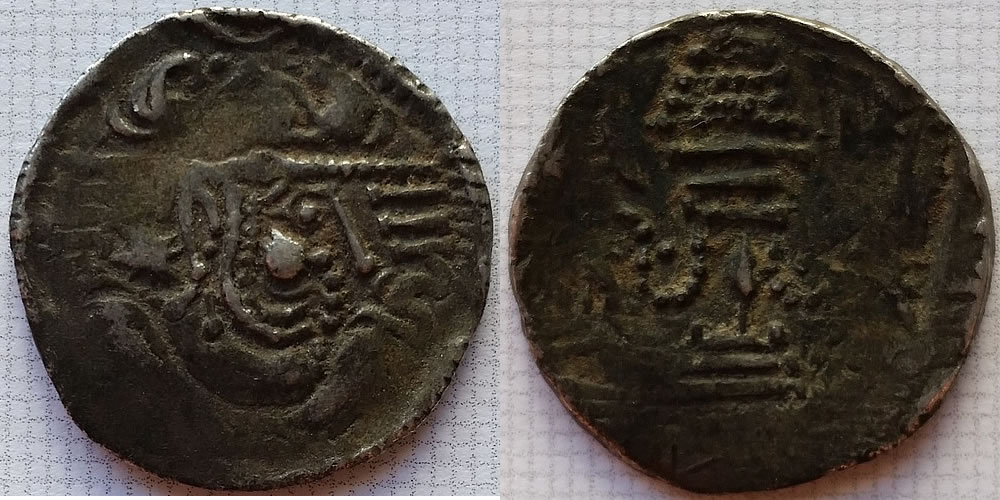 24mm 4.00g By far the most commonly seen of this whole series; this takes the line art style a step further down into abstraction. A lot of the design elements are lost to either striking issues or the passage of time, but we can see a greater degree of care in the manufacture of this coin; at least it was only struck once with a decent amount of force. 1.7 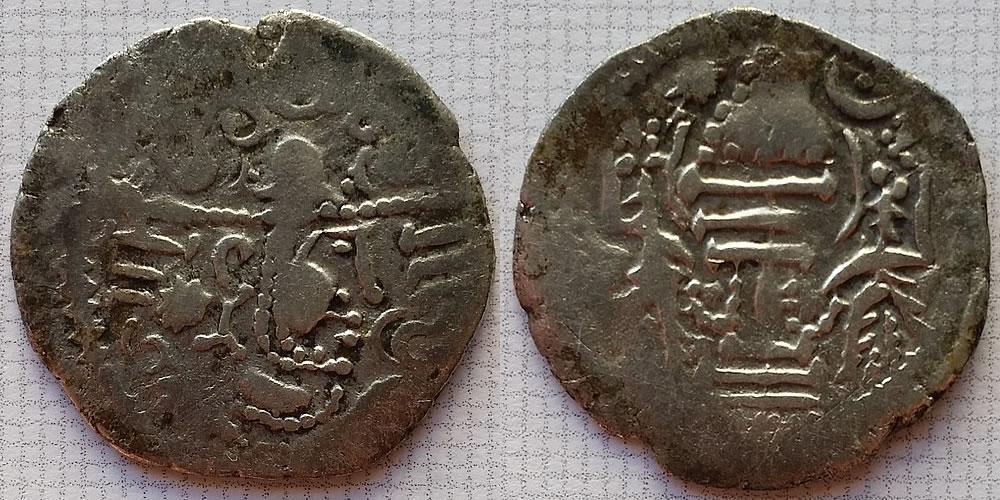 3.72g As above, but much more simplified. Here we can see the attendants in their "thorn dress" very clearly, and again the sun and moon are in the "correct" position above them. 1.8 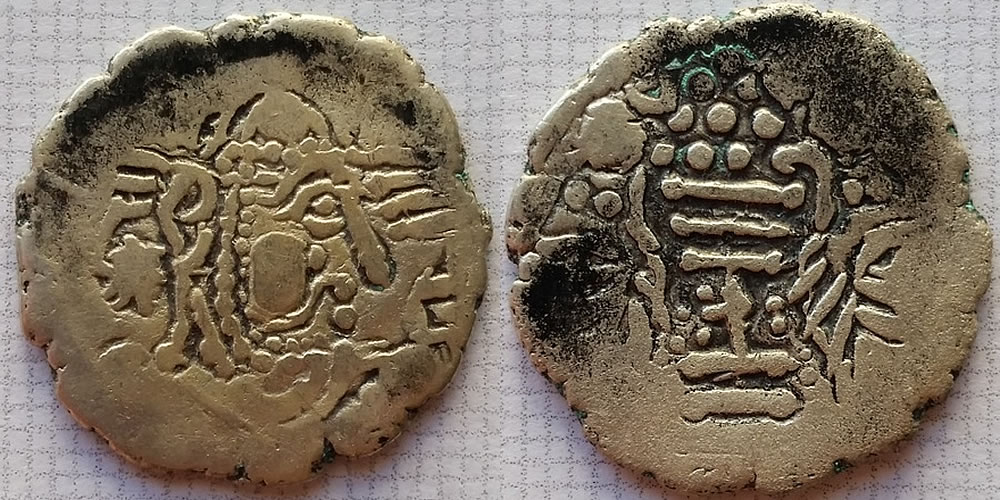 20mm 3.75g This one is an interesting variant of the line style. Perhaps it was more heavily worn, but the lines appear much thicker, and the whole coin is in very low relief. The portrait is at least distinct, and we can see a greater degree of stylization in the attendants, especially with their dress becoming more "fish bone" like. Note that on this coin, the sun and moon are back to their "incorrect" positions. 1.9 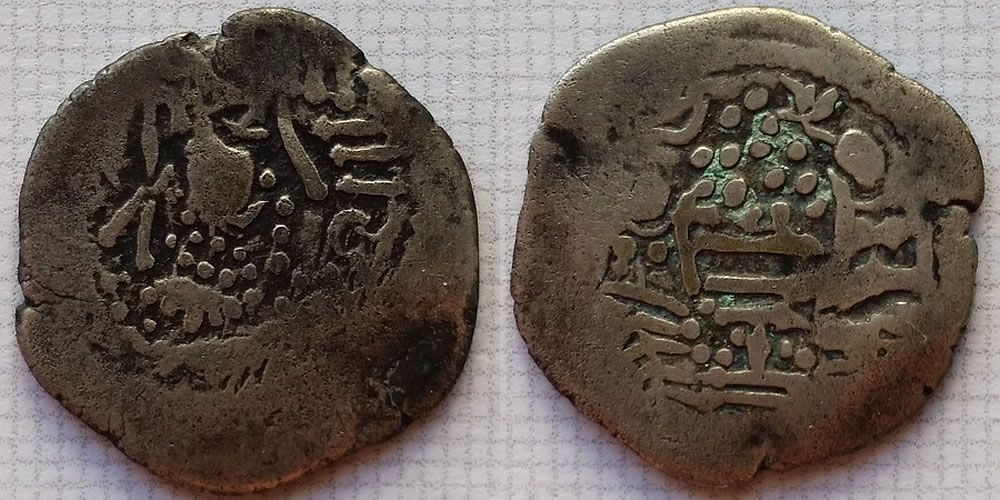 20mm 3.82g Also of the thick line variety, but the face has an unusual style to it, and the attendants' dresses are even more "fish bone" in appearance. Most importantly, the attendants show striking similarities in the size and arrangement of the head, necklace, breasts, and arms to our next series. Sun and moon are "incorrect" and sun is a horribly botched indistinct shape. Edited by Finn235
12/29/2016 6:54 pm
|
|
Pillar of the Community
 United States
5029 Posts |
Holy cow...this is impressive work. Nice job!  |
|
Moderator
United States
23731 Posts |
Impressive and detailed work. Some of these coins I haven't seen before.
|
|
Pillar of the Community
Canada
1118 Posts |
I love fire alter coins. You should send a link of this to the new guy asking about Gadhaiya Paisa coins. Great right up Finn. Thank you.
|
|
Pillar of the Community
United States
7067 Posts |
Great work and great coins! I always enjoy following the lineage of progressive abstraction - both in fine art (e.g. Mondrian's trees or Van Doesburg's cow, for example) and certainly in numismatics. In the world of ancients I think the abstraction over time from Sasanian prototypes is the most interesting, although the Celtic coins inspired by Greek prototypes are fun too.
|
|
Pillar of the Community
United States
6130 Posts |
Thanks all! In total, I think I have about 60 coins to share; some pretty commonly seen, others that don't show up often. Also as a side note, the grid pattern is a piece of 1mm graphing paper, and each photo is the size of a standard 2x2 (I traced it on the graphing paper, then cropped the image in Paint) so the photos accurately portray the size of the coins, relative to each other. |
|
Rest in Peace
United States
17900 Posts |
Thank you, thank you, thank you.
I thoroughly enjoyed that presentation.
Please be sure to keep us updated.
Strictly for my own reference, is it okay for me to keep a copy of your work? I would not make any part available to anyone else.
|
|
Pillar of the Community
United States
6130 Posts |
You are absolutely welcome to copy, store, or share this info! I only ask that credit is given if you share or post it anywhere else. My goal here is to compile the most complete and useful free guide on the Internet; there are a couple of reference books on these coins, but they are extremely expensive; generally $50-300.
Also, is anyone here fluent/good with Pahlavi inscriptions? I am really hoping to be abe to make sense of what might be written on coin 1.2.
|
|
Valued Member
United States
100 Posts |
I'm very, very impressed. Gotta love the XKCD reference, too.
|
|
Pillar of the Community
United Kingdom
2624 Posts |
Good work, and I really like the first couple of coins there I really should pick up an example. Now the only example I have of Gadhaiya Paisa is the Chulukya's of Gujarat type fire alter coin, mine is looking a bit different from those above. (This is a stock image but the coin I received was very similar, I just haven't got a shot of it to hand) I guess maybe I am jumping the gun, posting it if you have more to come, so apologies. 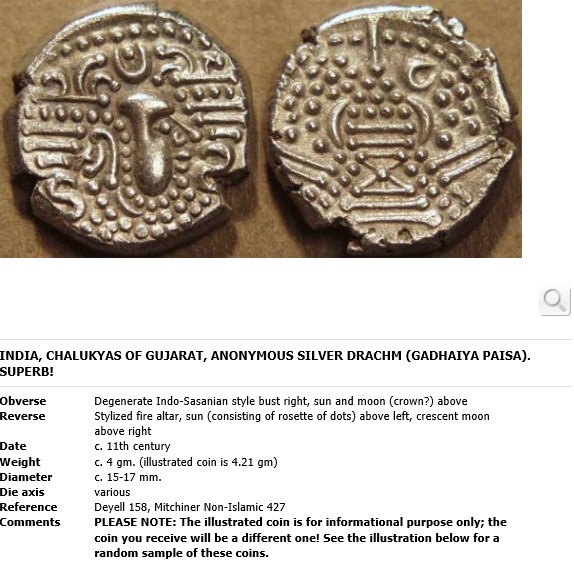 Edited by DavidUK
12/29/2016 7:29 pm
|
|
Pillar of the Community
United States
6130 Posts |
No worries David! That series of coin (made by the Chaulukyas) will be series 4 in the current track. I have all of mine imaged, but trying to place them in chronological order is making my head hurt.
I'll try to get series 2 up tomorrow.
|
|
Pillar of the Community
Belgium
1194 Posts |
very interesting , I saw already these coins on ebay , but as I know nothing , I have never bought .albert |
|
Pillar of the Community
United States
6130 Posts |
Series 2a - Attributed to Chavda dynasty Area - Gujarat region Time period - 600-900 AD? Attributed to - https://en.wikipedia.org/wiki/Chavda_dynasty]Chavdas[/URL] Overall rarity - Less common Price range - $10 - $20 Fabric Flan diameter - Large, decreasing to Medium (21-16mm) Die size - Slightly larger than flan Typical centering - Poor Strike quality - Poor Thickness - Medium, getting thicker over time Weight - 3.9 - 4.2g Typical wear - Heavily worn Silver purity - High? Design Engraving skill - Good, decreasing over time Design relief - Medium/High Obverse Head shape - Tall head with narrow forehead, large cheeks, always in high relief. Brow is usually prominent and sometimes gives the impression of a facial expression; e.g. stern and powerful or placid and wise. Most well-preserved specimens show a long, curvy mustache running from the upper lip dot to the back of the cheek. Nostril, lips, and chin display as four dots in a vertical row, separated from the head. Beard presents as string of fine dots running from the bottom lip, curving around the head shape and up to the brim of the hat. Beard usually separates ear from head. Hat - Wide brim with dotted line beneath, usually going over the head. Wings are arcs pointing from the hat down to the brim; globe presents as upward-facing semicircle with dot. Ribbons - Long thin curvy line, usually forming a roughly "S" shape on both sides of portrait, topped by three lines. usually leave a short gap in front of the nose and run to the edge of the die. Shoulder pads - Elongated "tear drop" shape, surrounded by dots and connected to circular brooch beneath necklace. Some specimens have extremely small shoulder pads. Reverse Fire Altar - Generally hourglass shaped, with prominent star at the narrowest section. Bowl displays as three horizontal lines flanked by parentheses shape. Base displays as three horizontal lines. Flames represent as loosely packed dots in a triangle. Sash displays as two parallel lines of dots running from the bowl of the altar down the base. Attendants - Both female. Represented with large head with a necklace of very fine dots beneath. L-shaped arm points to fire altar, holding sash of two dotted lines which now runs parallel to the base. Generally large circles for breasts. Later examples show more steeply inclined arms, and features of the attendant slope downward accordingly. Dress is a blob underneath the arm, and is seldom preserved. Sun and moon - Sun presents as six dots around a central dot, always on left. Moon presents as a large thin semi-circle, always on the right. Another very highly varied series, these follow the same formula as the previous "hunnic" coins, but with a distinctive Indian style. These start out on very similar large, thin flans as the Hunnic drachms, but over time become more sturdy as the diameter shrinks. Some of the later types are home to some very unusual art style! A very important development in this series is the appearance of the appearance of a line through the portrait's eye--I do not know the exact significance of this, or why it appears suddenly, but this is perhaps indicative of a sudden shift in power from an Indian dynasty to a central Asian Hunnic dynasty. 2a.1   20mm 3.99g Well, I am not really sure where this one fits, so I will put it here. It is a bit smaller than the "next" coin in the series, and I cannot seem to firmly match the portrait style to any other coin in the series. It is notable for its markedly improved quality, and evident care to make an "attractive" coin. Notice that the upper half of the attendants on the reverse are very similar to our coin 1.9, but there is no "thorn dress" but rather a skirt with legs below. Unique to this coin, the necklace does not show as a string of dots, but rather as a short but thick line beneath the head. This is the last coin to show the lower half of the attendants so clearly. 2a.2   21mm 3.95g This was my first coin from this series, and remains one of my favorites. Here we can see a very distinct style emerging--the die engraver knew what they wanted from their coin, and was able to achieve it. Once again we can clearly see the fading resemblance to the Peroz drachm--the ribbons, the wings, the orb resting on a crescent--but artistic liberties have given the coin a life of its own. Any semblance of a "hat" on top of the head are gone for good. The beard is still a line of fine dots running around the chin, but they now fully separate the head from the ear and neck. Likewise, the lips now hover out in front of the face. The attendants are clearly based on those found on the previous coin, but now the dress is becoming less distinct and we cannot see legs at all. The attendants on this coin also have a thick line behind their head--I am not sure whether this is a part of the necklace, some sort of ornate collar, a fancy hair bun, or a pair of earmuffs. 2a.3   22mm 4.02g Here we see a slight step backwards in quality in terms of both art and workmanship. The head is stylisically similar to the previous coin, but disproportioned and just plain sloppy. Large areas on this coin were not fully struck, and the reverse is very off-center, to the point that the coin is somewhat bent from the striking force. Note also that same unusual textured pattern in the unstruck part of the flan. The portion of the reverse that was struck, however, is very crisply struck, showing both the head of the attendant and the sun very clearly. I am not certain if there is a significance, but it is worth noting that the sun depicted as a ring of dots around a larger central dot was found variously on Western Satrap and Gupta coinage before these coins came into existence. 2a.4   20mm 4.04g Basically the same as above, but here we can see that the "earmuff" has broken up into dots, and the skirt is nothing but a blob on top of two parallel lines that run along the edge of the die. 2a.5   21mm 4.16g Again the same crude style head, but curiously the attendants on this coin are missing their necklaces. 2a.6   20mm 4.19g Another of my favorites; this one is very strikingly toned with a portrait that seems very "angry" in a way. This example is much less worn than the others, as evidenced by the very clear moustache and line running along the brow. This coin, despite its technical flaws, is one of the very few examples of this type that I have seen that displays some semblance of a facial expression. This coin also seems to be a precursor to the "neanderthal" type which we will explore in series 2b. ---------------------- NOTE: This is where series 2a and 2b diverge. I consider series 2a to run in parallel with 2b based on the pronounced difference in the shape of the head; both will now have the line through the eye, but 2a will have a taller head shape with a gradually less pronounced brow. ---------------------- 2a.7   18mm 3.94g This is a very well worn coin that I bought because it was cheap. We can see some clear similarities with 2a.6, but the flan is rapidly shrinking. The obverse seems to be shrinking in pace, but large portions of the reverse are now being lost off the flan. 2a.8   17mm 3.96g As above, but we can see the brow is becoming much less pronounced while the eye line is becoming more apparent. On the reverse, we can now see that the dress has been reduced to an oblong shape beneath the arm. 2a.9   17mm 4.13g What a curious coin! The flan has now shrunk significantly, and large portions of the reverse are simply cut off of the die, which has now shrunk somewhat. Of particular note is that the "mouth" area is completely out of proporiton with the rest of the head! This raises some very interesting questions--was this done on purpose, or as an "oops?" Note at this point that the dots present everywhere on the coin seem to be present in only a couple different sizes. My hypothesis here is that the die engraver had a circular punch which was used to sink the dots for the nose, mouth, beard, "hat", and the ends of the ribbons. If the engraver used too large of a punch to create the nose, lips, and chin, they would have had to make the "cheek" area longer to compensate. If this hypothesis is correct, it might give some insight into how the dies were created for these coins. I have seen one or two more coins that exhibit this peculiarity, but they very seldom come up for sale. 2a.10   16mm 4.12g Here is the final coin of series 2a. The fabric of this coin is much more similar to the "bent head" coins we will explore in series 3--the flan is small and thick; the design is deep, clear, and even. However, the shape of the head, the shoulder pads connected to a circular brooch, and the design of the reverse all place this coin in series 2a in my book. I have not seen an example that could be said to be a later example of 2a than this. |
|
Pillar of the Community
 Spain
2752 Posts |
Wow  Super coins ...keep em coming  Paul |
|
Pillar of the Community
United States
7067 Posts |
Great new set, Steve...and a fantastic, informative thread.
|
| |
Replies: 92 / Views: 15,754 |
To participate in the forum you must log in or register.
Disclaimer: While a tremendous amount of effort goes into ensuring the accuracy of the information contained in this site, Coin Community assumes no liability for errors. Copyright 2005 - 2026 Coin Community Family- all rights reserved worldwide. Use of any images or content on this website without prior written permission of Coin Community or the original lender is strictly prohibited.
Contact Us | Advertise Here | Privacy Policy / Terms of Use
|
| Coin Community Forum |
© 2005 - 2026 Coin Community Forums |
| It took 0.78 seconds to rattle this change. |
 |
|
| |
| |







 Posted 12/29/2016 3:32 pm


