|
This page may contain links that result in small commissions to keep this free site up and running.

Welcome Guest! Registering and/or logging in will remove the anchor (bottom) ads. It's Free!
To participate in the forum you must log in or register. | Author |
 Replies: 92 / Views: 15,782 Replies: 92 / Views: 15,782 |
|
|
|
Moderator
 United States
23731 Posts |
|
|
Moderator
United States
34549 Posts |
Man, you are raising the bar with these posts! Very good idea to have all pics with a standard magnification.
"If you climb a good tree, you get a push."
-----Ghanaian proverb
"The danger we all now face is distinguishing between what is authentic and what is performed."
-----King Adz
|
|
Pillar of the Community
 United States
6130 Posts |
Series 2b - "Neanderthal" type Area - Gujarat region Time period - 800-950 AD? Attributed to - Chavdas? Overall rarity - Less common/Scarce Price range - $5 - $15 Fabric Flan diameter - Medium/small Die size - Much larger than flan Typical centering - Poor Strike quality - Good Thickness - Thick Weight - 3.8 - 4.0g Typical wear - Moderately worn Silver purity - High? Design Engraving skill - Fair Design relief - High Obverse Head shape - Tall head with narrow forehead, large cheeks, always in high relief. Brow is extremely prominent, giving the face an almost "caveman" look. Most well-preserved specimens show a long, curvy mustache running from the upper lip dot to the back of the cheek. Nostril, lips, and chin display as four dots in a vertical row, separated from the head. Beard presents as string of dots running from the bottom lip, curving around the head shape and up to the brim of the hat. Beard separates ear from head. Head is extremely large on the flan, usually taking up most of the coin. Hat - As above, but somewhat simplified. Usually off-flan. Ribbons - Long thin curvy line, usually forming a roughly "S" shape on both sides of portrait, topped by three lines. usually leave a short gap in front of the nose and run to the edge of the die. Shoulder pads - Elongated "tear drop" shape, surrounded by dots. Some specimens have extremely small shoulder pads. Usually off-flan Reverse Fire Altar - Generally hourglass shaped, with prominent star at the narrowest section. Bowl displays as three horizontal lines flanked by parentheses shape. Base displays as three horizontal lines. Flames represent as loosely packed dots in a triangle. Sash displays as two parallel lines of dots running from the bowl of the altar down the base. Attendants - Both female. Represented with large head with a necklace of very fine dots beneath. L-shaped arm points to fire altar, holding sash of two dotted lines which now runs parallel to the base. Generally large circles for breasts. Die has shrunk to omit dress. Sun and moon - Sun presents as six dots around a central dot, always on left. Moon presents as a large thin semi-circle, always on the right. This series I feel is a distinct sub-set of the Chavda, in that they tend to run smaller on sturdier flans, and the head tends to take up most of the coin as the diameter decreases, while other series remain proportional to the flan. All of these coins have the distinctive line through the eye, as well as the very prominent brow and large cheek/jaw. 2b.1   20mm 4.15g This is extremely similar to 2a.6, however we can see that a line has suddenly appeared through the portrait's eye. The shape of the head has changed slightly, so that the forehead is now somewhat elongated and sloped backward, while the cheek is both wider and taller. The reverse die is almost comically larger than the flan at this point. 2b.2   17mm 4.04g As above, but the head is getting more squat and artistically simplified; the line now runs all the way through the eye of the portrait. 2b.3   17mm 4.12g Starting to look a little bit more like the Gadhaiya Paisa here. Very interestingly, on the reverse of this coin, we can see that the arms of the attendant are now a straight line slanting down toward the fire altar, and the breasts are sliding down the reverse along with them. 2b.4   17mm 4.06g "I don't always look at my Indo-Sassanian drachms, but when I do.... Eyebrows them." Very unusual portrait and an extreme example of the "caveman brow" for this sub-series. The dotted line from the die also lets us know for certain that there is no longer any "dress" below the attendant's arms. This is a feature of all subsequent coins in this track. 2b.5   15mm 4.03g The final coin in the series. As with the last coin in series 2a, this one is remarkably Gadhaiya Paisa-like, but retains both the "neanderthal" head type and the reverse typical of this series. There is a very large amount of space between the head, necklace, and breasts of the attendant, and the reverse die was clearly much, much larger than the flan allowed for. |
|
Moderator
United States
34549 Posts |
Great continuation of your earlier work. I understand that the rev die was much larger than the flans. I wonder if you could draw a rough approximation of the entire die? That way, for those who pick up these pieces, they could look at a complete image to see where their portion originates? I'm thinking that this would be something like what @drnsreedhar has done with some of his Indian coin threads, where he draws the entire inscription on the pic, even though much of it is off the flan for any one particular coin.
"If you climb a good tree, you get a push."
-----Ghanaian proverb
"The danger we all now face is distinguishing between what is authentic and what is performed."
-----King Adz
|
|
Pillar of the Community
United States
6130 Posts |
Good suggestion @spence!
I did not have time to do it for the past few sets, since I have been relatively short on time. I can try to do so, but some coins will really be guesswork, as these coins can sometimes hold surprises in extremely off-center examples.
I am at any rate planning to show a side by side comparison to show how various features are preserved, abstracted, or lost as the track progresses.
|
|
Pillar of the Community
United States
6130 Posts |
Posting a sort-of update:
I recently purchased a handful of additional coins for the hoard collection which will both help me close some gaps and simultaneously shatter my notion of how several of the series relate to one another. I'm going to be out of town for a bit, but should have time to sit down and continue my work once I am back.
Thanks to all for your support, and feel free to share your own coins in the meantime!
|
|
Pillar of the Community
United States
6130 Posts |
Apologies for the delay in updating this thread, and also for only delivering a partial update tonight. Ever onward, as they say! Series 3 - "Bent Head" type Area - Gujarat region Time period - 900-1000 AD? Attributed to - Chavdas? Overall rarity - Common Price range - $5-15 Fabric Flan diameter - Medium/Small Die size - Larger than flan Typical centering - Good/Fair Strike quality - Very good Thickness - Medium Weight - 4.02 - 4.25g Typical wear - Moderate/Light Silver purity - High? Design Engraving skill - Good/Fair Design relief - High This series I feel is among the more neglected within the Gadhaiya Paisa track. In terms of size, thickness, and overall fabric, they are very much similar to the more common Gadhaiya Paisa, but they are distinguished in that they all sport a head with an unusually tall upper head, which usually curves backwards by as much as 45 degrees. They all have the distinctive line through the eye, and it becomes most prominent throughout this series. Nobody really knows how these fit into the "big picture" but the abrupt change in style and especially head shape, I believe is indicative of a separate imitation event, rather than a continuation of any earlier series. Perhaps an important note to make here is that in this general region, the Alchon huns were avid practitioners of infant cranial deformation (head binding), as is very well attested on their coins. These coins come at least a few centuries later, but it is worth investigating that these could have been produced by either the descendents of the Alchons, their vassals, or simply inhabitants of a region that was saturated with Alchon drachms. The very early coins within Series 3 sport the more spacious and proportioned reverses of late Series 1 and Series 2, while the later issues have moved to the more crowded, homogenous reverses of regular Gadhaiya paisa. This, I feel finally resolves that this series bridges the gap between the earlier Indo-Sassanian types and the Gadhaiya Paisa and later types. 3.1 17mm 4.10g   A curious coin from the 22 years when Gujarat was ruled by a space alien from venus! Kidding, of course. This curious coin is an outlier as far as the portrait style goes. It does have a tall, sloped forehead, which is pretty much the only reason why I placed it in this track at all. On the reverse we can see well-spaced attendants with a large degree of size differentiation between the head, necklace, and breasts. 3.2 18mm 4.08g   And suddenly we see a very different portrait style emerge. These I do not feel are quite different enough to constitute a sub-series, but they are very distinctive. There is little to no curve in the very large, tall forehead, and the ribbon is extremely large. On this example, the attendants on the reverse are still differentiated, but the spacing is becoming more cramped and the head is shrinking in relation to the rest of the attendant's features. 3.3 17mm 4.02g   This one clearly is related to our previous coin, but now the head has shrunk and the overall design compacted to fit the flan just a *little* bit better. Suddenly, the reverse shows a very small amount of differentiation in the attendants, although the dots are still arranged so that it is easy to tell the head from the necklace and breasts. Perhaps most unusual about this coin is a small extruding area beneath the portrait. The lines and dots are where the shoulder pads should be, and do not match what we would expect. What they do match, however, is the lines and dots that now represent what once was the brim of the hat and ribbon. My hypothesis is that these coins were made quickly, and this one was not moved off the striking area fully, being struck on top of another coin. And, when we line up another coin from this series:  A perfect match! 3.4 14mm 4.06g   While still worn, this coin demonstrates the high relief that one would find on a mint state coin from this series. Attractive and well centered on a smaller and thicker flan. 3.5 15mm 4.05g   As above, but the head is significantly smaller, and once again we can see the globe above the head, which has been a pretty rare sight since series 1. The attendants' head, necklace, and breasts are all nearly the same size, and the head sits at a very odd spot on top of the necklace. That's all for tonight! I'll have the remainder of the Bent Head series up soon, hopefully. Thanks to all who have been sticking with me!  |
|
Pillar of the Community
United States
7067 Posts |
|
|
Pillar of the Community
United States
6130 Posts |
Glad you are enjoying it, Bob!
After I get the study completed on here, I plan to review, revise, perhaps add die axis for each coin, and then host the study on my Google Pages that has been gathering dust for nearly a decade.
One thing in particular that I would love to learn is the composition of these. I always see them described as just "billon" but most up to this point seem to be good silver. Obviously appearances can be deceiving, but I would like to see if these follow a steady decline, or fluctuate.
Edited by Finn235
02/26/2017 10:18 am
|
|
Moderator
United States
34549 Posts |
@finn, another great installment to this discussion. I've been thinking a little bit about the two coins which seem to have been partly struck together. I haven't seen this before in hand struck coins, so it is very interesting to me.
"If you climb a good tree, you get a push."
-----Ghanaian proverb
"The danger we all now face is distinguishing between what is authentic and what is performed."
-----King Adz
|
|
Pillar of the Community
United States
6130 Posts |
That one puzzles me a bit also. Overlapping flans is the only logical explanation I can come up with. The designs match up, and the pinched area fits almost perfectly on top of another coin. Still, if these were made in the standard fashion (one die fixed to an anvil and one held in the hand) the level of negligence to fail to clear an already struck coin from the die area would be pretty astounding. Thinking about it a little bit more, I think we can draw two assumptions from this coin:
1. It is the portrait side that was affixed to the anvil; otherwise the struck coin would have had to be placed on top of the blank flan.
2. It indicates that these coins were made in very cluttered work areas under tight schedule. I will have to find it again, but I read online somewhere that it is not unusual to find huge hoards of thousands or tens of thousands of these coins. Someone even reported that a local found half a million in a single hoard!
Edited by Finn235
02/26/2017 10:18 am
|
|
Pillar of the Community
United States
6130 Posts |
Ever onward... 3.6 15mm 4.13g   Heavily worn, but still attractive, this one seems to show the face shrinking in relation to the head, giving the portrait a decidedly "alien" look. The reverse has settled to nearly homogenous, but the arms are much taller and more steeply slanted than we will find on later coins. 3.7 14mm 4.12g   This one still retains the unusual tall head of the previous coins, but the portrait now sports a (nearly worn off) tiny little moustache. There is something going on with the ribbons at the front of the bust here; I believe this was overstruck. As above, the attendants are a pile of dots sitting atop two very long lines to represent their arms. 3.8 15mm 4.02g   What a mess! I bought this one simply because of the dramatic double-strike and becasue the price was right. Too much going on here to give any meaningful analysis, except that whoever struck this coin didn't care one lick about the final product. 3.9 16mm 4.09g   This one seems to be the bridge between the "tall head" and "bent head" coins between this series; we can see some clear curvage in the head, which still goes up much more than back. We can also see the little moustache pronounced very clearly; this is the last coin in the entire Gadhaiya Paisa track to sport any sort of facial hair on the portrait. Of particular importance is the reverse; we can see some similarities with the previous coin, but now the head dot is the same size as the necklace beads, which now curve all the way around the head. The die has also shrunk considerably; we can at last see both attendants, almost the whole fire altar, and the sun and moon. 3.10 15mm 4.05g   This was my first from the series. Very similar to 3.4, except that the head is curving very slightly backwards, and the jaw slopes at a somewhat downward angle, rather than straight. 3.11 16mm 4.23g   I bought this one specifically to show the rarely seen lower portion of the portrait for this series. We can clearly see that the shoulder pads here are large, and each present as a curved line surrounded by dots. Not much else of note except the anomalously high weight, possibly due to the encrusted dirt on this thing. 3.12 17mm 4.12g   One of my very favorite coins in my collection (and my avatar)! Clearly related to the last handful, but with a very unusual and distinctive style to it. While other coins in this series feel cramped and crowded, the die engraver for this coin took artistic liberties to fit what they wanted on the flan. As a result, the shoulder pads are significantly smaller, but also further from the bottom of the portrait. The crescent that separates the beard from the necklace is also thicker and more carefully engraved (compare against previous coin). Unfortunately, there is not enough of the attendants on-flan to really make a judgement call there, but it appears to be more or less orthodox for the series. Also interesting to note is a series of very fine lines that run beneath the design elements; perhaps indicative of the flan preparation process? |
|
Pillar of the Community
United States
7067 Posts |
Nice to see the new avatar, Steve. Good choice! Quote:
I bought this one specifically to show the rarely seen lower portion of the portrait for this series. Wow...the dies must have been huge compared to the flans for some of these. |
|
Moderator
United States
34549 Posts |
Quote:
Nice to see the new avatar I agree! "If you climb a good tree, you get a push."
-----Ghanaian proverb
"The danger we all now face is distinguishing between what is authentic and what is performed."
-----King Adz
|
|
Pillar of the Community
United States
6130 Posts |
Sorry for the lack of updates here; had a lot going on lately! Now we come to the end of the Bent Head series at last! 3.13 15mm 4.15g   I'm not entirely certain where the transition between this piece and the previous examples of Series 3 lies. It is unfortunate that the top of the head is off the flan, but we can now see that the curvature in the upper cranium is becoming more pronounced. The dots and lines that now make up the reverse are becoming finer and more compactly placed on the die, and the coin as a whole shows much more relief. The portrait is also much more round and "chubby" than we have seen yet. 3.14 14mm 4.15g   As with the above, this one has a good bit of the head left off of the flan, but we can at least now see the evolution of hte shoulder pads, which seem to have lost the dash through the center. The ribbon is becoming more curved than the backwards "S" shape seen on the last handful of examples, and the attendants are now reduced to the same dot pattern that we will see on the Gadhaiya Paisa (I'll illustrate on a better example in a few coins). The portrait on this coin is a step back from the very round and chubby portrait found on our last coin. 3.15 15mm 4.18g   This may be the point where the Bent Head types and Gadhaiya Paisa diverge. There is definitely some curvature in the head, but it is perhaps one of the more "normal" looking portraits in this series. The flan is a good bit too small for the dies once again, but we can at least see the whole portrait and almost all of the fire altar. 3.16 15mm 4.05g   Quite unusually worn for this type! The head here is becoming more radically curved, and more of the die is squeezing onto the flan, despite a constantly small diameter. I have read the theory that the movement of these coins toward a more spherical shape was an engineering choice; less surface area means the coin can be handled much more with minimal loss of metal to wear. Considering the level of wear, I am still amazed that this example is only 0.1g light compared to those before and after. 3.17 13mm 4.13g   What a lovely coin! At just 13mm, this one is abnormally small for this stage in its development, but a respectable amount of design is present nevertheless. For the first time, we can finally see almost all of the reverse die impression, which by this point is about as "abstracted" as it will get. A lot of sellers and reference guides mistakenly state that the reverse has been degenerated to dots, but that is simply not the case. Overly-engineerd and highly schematized, but no part of the reverse has been lost since the dress disappeared in series 2b. I have labeled and color coded to illustrate this point:  (Apologies for the Paint quality... I never said I was an artist!) 3.18 15mm 4.21g   This is the most extreme curvature of my coins in the series; making an almost 90 degree curve! The obverse die has finally strunk enough to fit both the ear and the ribbons in front of the face. Note the distinctive shape of the brow in this coin; this is probably more closely related to 3.16 than 3.17, and is probably a good indication of what 3.16 once looked like before being worn heavily. One very interesting feature to note on this coin is that the right side of the reverse is much better struck than the left; perhaps an indication of an uneven amount of force used when hammering the coin. This can be noted on several of the earlier style Gadhaiya Paisa as well. And while one may assume that this is a fanciful rendition of the ruler's head, compare against the Congan Mangbetu people, one of the few who still practice extreme cranial deformation in the modern age: 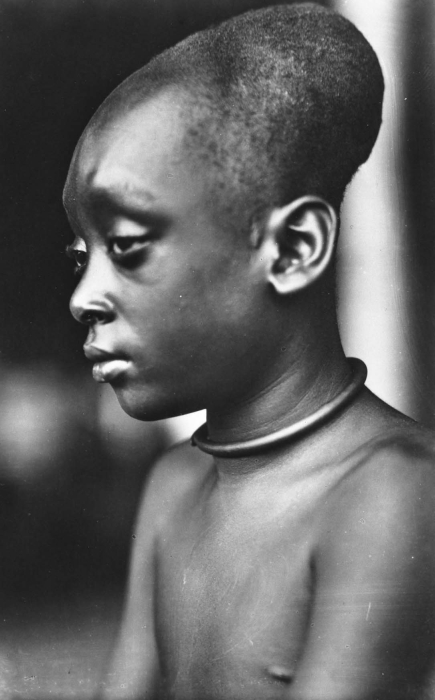 Image credit: https://hiddenincatours.com/elongat...o-in-africa/3.19 16mm 4.19g   Here we are where 3.15 left off. While we are back to a more reasonably proportioned portrait, it still retains a steep curvature like 3.18. Also, the dies have shrunk even further to allow not only the ear and the ribbon, but also the globe above the head as well! This example unfortunately has an off center reverse, cutting off the right attendant. 3.20 14mm 4.16g   And at the end we have another curiosity. I can honestly say I don't know what to make of this one, as it seems to diverge sharply from the trend of increasing artistic fineness we have seen over the last several coins. The slightly curved head and line through the eye place it in Series 3, but this may be an unofficial, imitative, or extremely late example. I have never seen one like this coin again since I won it at auction. Edited by Finn235
05/07/2017 3:36 pm
|
| |
Replies: 92 / Views: 15,782 |
To participate in the forum you must log in or register.
Disclaimer: While a tremendous amount of effort goes into ensuring the accuracy of the information contained in this site, Coin Community assumes no liability for errors. Copyright 2005 - 2026 Coin Community Family- all rights reserved worldwide. Use of any images or content on this website without prior written permission of Coin Community or the original lender is strictly prohibited.
Contact Us | Advertise Here | Privacy Policy / Terms of Use
|
| Coin Community Forum |
© 2005 - 2026 Coin Community Forums |
| It took 0.5 seconds to rattle this change. |
 |
|
| |
| |





 First Page


 Posted 12/30/2016 1:49 pm


