| Author |
 Replies: 42 / Views: 3,505 Replies: 42 / Views: 3,505 |
|
|
|
Pillar of the Community
United States
6370 Posts |
The problem with your theory is that you neglect how the metal moves when a coin is struck. When the dies hit the planchet, the metal was compressed at very high pressure so that the metal flowed into the recessed areas of the dies. This would effectively squish out any scratches that were previously on the planchet, like using a mould on Play-Doh. Usually, the only planchet imperfections that survive a die strike are planchet cracks and laminations.
|
|
Bedrock of the Community
 United States
11966 Posts |
Maybe if the planchet had the scratches, these should show up on the devices too...  Will think about it tomorrow. TypeCoin - I would add filing marks that show up both on the fields and the devices equally. Also, when a coin weighs 0.8 grams, I am guessing that you aren't moving a lot of metal. Agree that there are unresolved flaws in my theory. IN NECESSARIIS UNITAS - IN DUBIIS LIBERTAS - IN OMNIBUS CARITAS THE MAN IN THE ARENA, Theodore Roosevelt at the Sorbonne Paris on April 23, 1910: " It is not the critic who counts; not the man who points out how the strong man stumbles or where the doer of deeds could have done better. The credit belongs to the man who is actually in the arena, whose face is marred by dust and sweat and blood, who strives valiantly, who errs and comes up short again and again, because there is no effort without error or shortcoming, but who knows the great enthusiasms, the great devotions, who spends himself in a worthy cause; who, at the best, knows, in the end, the triumph of high achievement, and who, at the worst, if he fails, at least he fails while daring greatly, so that his place shall never be with those cold and timid souls who knew neither victory nor defeat." My coin website: https://fairfaxcoins.comEdited by numismatic student
01/05/2017 01:01 am
|
|
Pillar of the Community
United States
1970 Posts |
|
|
Pillar of the Community
United States
6370 Posts |
Also, don't forget that planchet filing was no longer in practice by the US mint by the time this coin was struck. Any scratches like these have to be PSD. |
|
Pillar of the Community
 United States
4621 Posts |
I'm conflicted too. Trimes are so thin, that the difference between a die clash and a weak strike is about a breath on the set screw. Still, this does not look like a weak strike - all of the elements on the reverse in the C are well formed. So I'm having trouble seeing the marks as anything except scratches...
-----Burton 50+ year / Life / Emeritus ANA member (joined 12/1/1973) Life member: Numismatics International, CONECA Member: TNA, FtWCC, NETCC, EveryCountry (online) coin club Owned by three cats and a wife of 40+ years (joined 1983) Author: 3rd Edition of the Sample Slabs book, https://www.sampleslabs.info/ |
|
Pillar of the Community
United States
634 Posts |
Looks like a ms-62 to me  |
|
Bedrock of the Community
United States
12057 Posts |
Quote:Also, don't forget that planchet filing was no longer in practice by the US mint by the time this coin was struck. Any scratches like these have to be PSD. This isn't entirely true. Planchet filing remained in practice at the branch mints (for weight adjustment) through the latter part of the 19th c. as noted by Doug Winter (Gold Coins of the New Orleans Mint), who documented the practice of planchet filing (still done by hand) @ NO in 1891; see also Andrew Madsden Smith's 1881 "Coins and Coinage: The United States Mint, Philadelphia." who documents the practice as follows: "..a couple of round pieces a little larger than the coins they are to make. These round pieces are called planchets. As the strips are of the uniform thickness if these two are of the right weight all cut from that strip will be. They are therefore weighed accurately. If right or a little too heavy they are allowed to pass as the extra weight can be filed off." Even though planchet filing as a whole even by the 1850s was only in use for adjusting weight, planchets were still handled roughly, and often had nicks, marks, and scratches before ever being struck. Such marks are not PSD, because they happened during planchet handling prior to the strike. In fact, many such opportunities for picking up visible marks were there, from drawing, to rolling, to filing, to polishing, to sorting, storing, and transport, all pre-strike. JMHO. Member ANA - EAC - TNA - SSDC - CCT #890 "Most of the things worth doing in the world had been declared impossible before they were done." -- Louis D. Brandeis |
|
Pillar of the Community
United States
4507 Posts |
I believe the filing done at the Orleans mint on gold as noted above was to only file the edge of the coin. They were not taking a rip across the face of the planchet like the the early 1800's.
|
|
Bedrock of the Community
United States
12057 Posts |
Yup, Slider, that's why I said in my post "only in use for adjusting weight." It's more accurate to say that the struck faces or surfaces of the planchets were not being routinely filed by the time OP's coin was struck. A minor nit-pick, but in the interest of detail.
Member ANA - EAC - TNA - SSDC - CCT #890 "Most of the things worth doing in the world had been declared impossible before they were done." -- Louis D. Brandeis |
|
Bedrock of the Community
United States
11966 Posts |
Thanks for sharing all of your thoughts. I was looking at an article in CoinWeek about the Unique Eliasberg Proof Type 1 3CS dated 1851. This coin sold for $61,600 in 1996 at the Eliasberg sale and sold for $172,500 in 2012, which still looks like a bargain for a unique coin, not only for the year, but for the type. I was struck by the fact that it has a lot of similarities to my coin. It is toned the same color. Also if you look at the left obverse field, you can see scratches very similar to the ones on my coin. They are not parallel, look like graffiti, touch the devices (the star) but never shows up on the device which is clean. This is a Proof-66 coin. 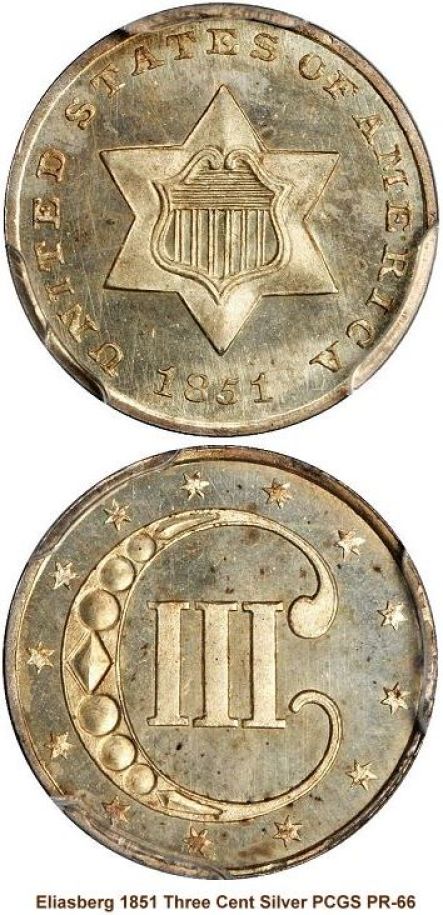 The same article also shows a business strike 1851 Type 1 3 Cent Silver trime. It looks even more like mine. This one doesn't have as many scratches - it is an MS66 coin. But there is a scratch in the reverse at 2 o'clock above the top crescent scroll. See detail and coin below. It shows a similar scratch to mine which is on either side of the crescent device, but not on the crescent device itself - the same as in my coin. So similar scratching is seen in both these coins. This coin also shows the same blurry transfer of the star and crescent on the opposite side of the coin, and the right edge of the middle of the crescent has the same triangular raised line between the crescent diamond and the III. See detail in the red circle. It is exactly what is seen in my coin. 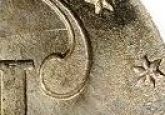 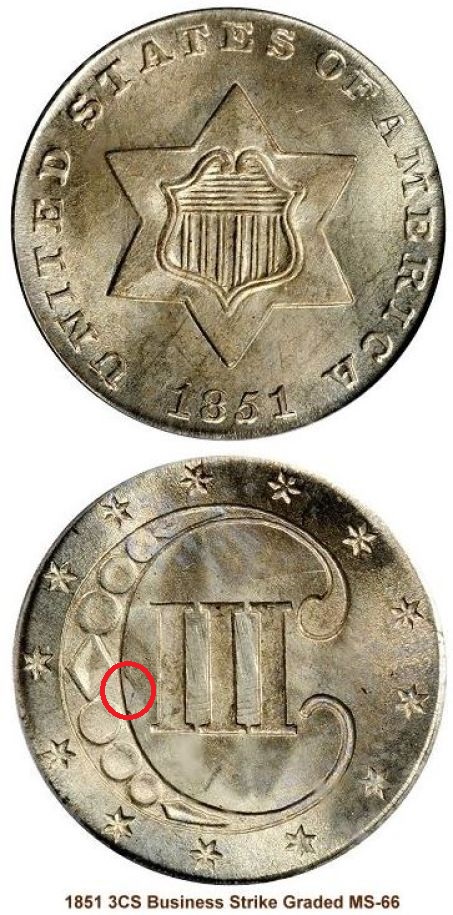 Finally we look at the 1872 3 Cent Silver Trime posted by BStrauss3. We see similar non-parallel scratches that look like graffiti on the fields but not on the devices. Why does this happen in all these cases? Are they all post mint damage? Do no 3CS trimes exist without post mint damage? 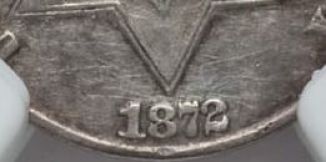 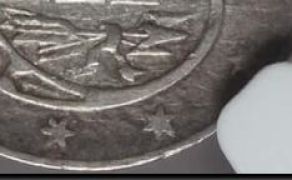 IN NECESSARIIS UNITAS - IN DUBIIS LIBERTAS - IN OMNIBUS CARITAS THE MAN IN THE ARENA, Theodore Roosevelt at the Sorbonne Paris on April 23, 1910: " It is not the critic who counts; not the man who points out how the strong man stumbles or where the doer of deeds could have done better. The credit belongs to the man who is actually in the arena, whose face is marred by dust and sweat and blood, who strives valiantly, who errs and comes up short again and again, because there is no effort without error or shortcoming, but who knows the great enthusiasms, the great devotions, who spends himself in a worthy cause; who, at the best, knows, in the end, the triumph of high achievement, and who, at the worst, if he fails, at least he fails while daring greatly, so that his place shall never be with those cold and timid souls who knew neither victory nor defeat." My coin website: https://fairfaxcoins.comEdited by numismatic student
01/06/2017 07:22 am
|
|
Bedrock of the Community
United States
11966 Posts |
IN NECESSARIIS UNITAS - IN DUBIIS LIBERTAS - IN OMNIBUS CARITAS THE MAN IN THE ARENA, Theodore Roosevelt at the Sorbonne Paris on April 23, 1910: " It is not the critic who counts; not the man who points out how the strong man stumbles or where the doer of deeds could have done better. The credit belongs to the man who is actually in the arena, whose face is marred by dust and sweat and blood, who strives valiantly, who errs and comes up short again and again, because there is no effort without error or shortcoming, but who knows the great enthusiasms, the great devotions, who spends himself in a worthy cause; who, at the best, knows, in the end, the triumph of high achievement, and who, at the worst, if he fails, at least he fails while daring greatly, so that his place shall never be with those cold and timid souls who knew neither victory nor defeat." My coin website: https://fairfaxcoins.com |
|
Pillar of the Community
United States
5720 Posts |
The fact that the lines on those coins seem to pass under the devices suggests that they are die polishing lines or scratches, which would be raised on the coin. You also have those on your coin. The question is whether the slightly coarser, curved lines inside the crescent on your coin are raised or incuse. If raised, they are probably from die scratches. If incuse, then they are scratches on the coin.
|
| |
Replies: 42 / Views: 3,505 |
To participate in the forum you must log in or register.
Disclaimer: While a tremendous amount of effort goes into ensuring the accuracy of the information contained in this site, Coin Community assumes no liability for errors. Copyright 2005 - 2026 Coin Community Family- all rights reserved worldwide. Use of any images or content on this website without prior written permission of Coin Community or the original lender is strictly prohibited.
Contact Us | Advertise Here | Privacy Policy / Terms of Use
|
| Coin Community Forum |
© 2005 - 2026 Coin Community Forums |
| It took 0.38 seconds to rattle this change. |
 |
|








 First Page
 Previous Page


 Posted 01/05/2017 12:57 am


