| Author |
 Replies: 8 / Views: 1,384 Replies: 8 / Views: 1,384 |
|
|
Valued Member
Australia
91 Posts |
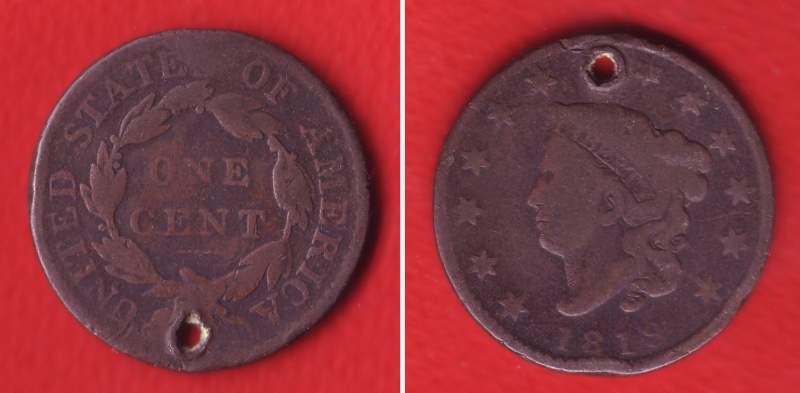
Hi all. Can't say I know too much about US coins but I found these pictures of an 1819 Large coronet head cent which has a 180 degree rotated obverse. Is this normal? Warning! Condition of this coin may distress some viewers. Image:  obverse.jpg obverse.jpg91.91 KB |
|
|
|
Pillar of the Community
United States
1424 Posts |
U.S. coins are rotated that way on purpose, when you find one that's not then it is an error.
|
|
New Member
United States
48 Posts |
That is standard rotation on all US coins. Most Canadian coins are Medal rotation. US coins flip top to bottom. Canadian side to side. Early copper is kind of my niche, and very common some dates more so than others are off rotation in varying degrees. |
|
Bedrock of the Community
United States
20753 Posts |
Sometimes confusing and usually not even noticed but all US coins are made in that way. It is really noticed when in a 2x2 holder or an Album where you can see both sides. In an album as you turn the pages you see the coins on the opposite side all upside down because the front, obverse, is right side up. Same with a 2x2 holder as you turn the holder over you can see this right away. Usually a coin in hand is just not noticed. Mercury dimes are notorious for being a little tilted on the reverses or what is called a rotated reverse. I've never been clear on that since some tell me the reverse can not be rotated it is the obverse that is rotated. HMMMMMMM. |
|
Pillar of the Community
United States
527 Posts |
Just Carl, It has to be the reverse that is rotated, the obverse always looks straight to me.  |
|
Valued Member
 Australia
91 Posts |
Being an Aussie collector I was unaware that US coins have a flipped reverse. Down here, ours are the right way up. lol...But thanks all; I've learnt something. |
|
Formerly nancyc
Australia
5385 Posts |
Although I also don't understand why..."the reverse can not be rotated it is the obverse that is rotated" it's the case here in Australia as well. So our coinage has at least something in common.  I dare say someone has an explanation why the reverse can't be rotated & will educate us soon. life is a mystery to be lived not a problem to be solved
|
|
Pillar of the Community
United States
3507 Posts |
Hi,
Actually, either die can be the one that is out of alignment. Only the press operator would be able to determine which one. Since we are looking at coins after they are struck it is assumed for the sake of measuring and labeling the degree of rotation that the reverse die was the one that was out of alignment.
The correct term therefore is rotated dies since it may not be only one die that was involved.
The installation of the dies into the coining press may have been incorrect to begin with. OR... a key used to align the die or dies can break allowing a die or dies to literally rotate in the press.
So, either die or both dies could be the culprit with respect to rotated dies.
Thanks,
Bill
Edited by foundinrolls
04/01/2008 10:09 pm
|
|
Bedrock of the Community
United States
17884 Posts |
In the early years the dies did not have a wider retaining base so if the set screws were loose enough to allow the upper (usually assumed to have been the obv die, but that was not always the case.) die to rotate, it would also allow the die to fall out of the press. The lower die (assumed to be the rev, see above.) on the other hand could come loose and rotate.
|
| |
Replies: 8 / Views: 1,384 |
|




 obverse.jpg


 Posted 03/31/2008 08:24 am





