| Author |
 Replies: 16 / Views: 2,743 Replies: 16 / Views: 2,743 |
|
Pillar of the Community
Poland
3201 Posts |
I know that many words in German begin with a capital letter but what about these? What's the reason for writing WOLL EN or ANRV FEN with random capital letters in the middle of the word? Not to mention that the bottom two examples aren't even in German... 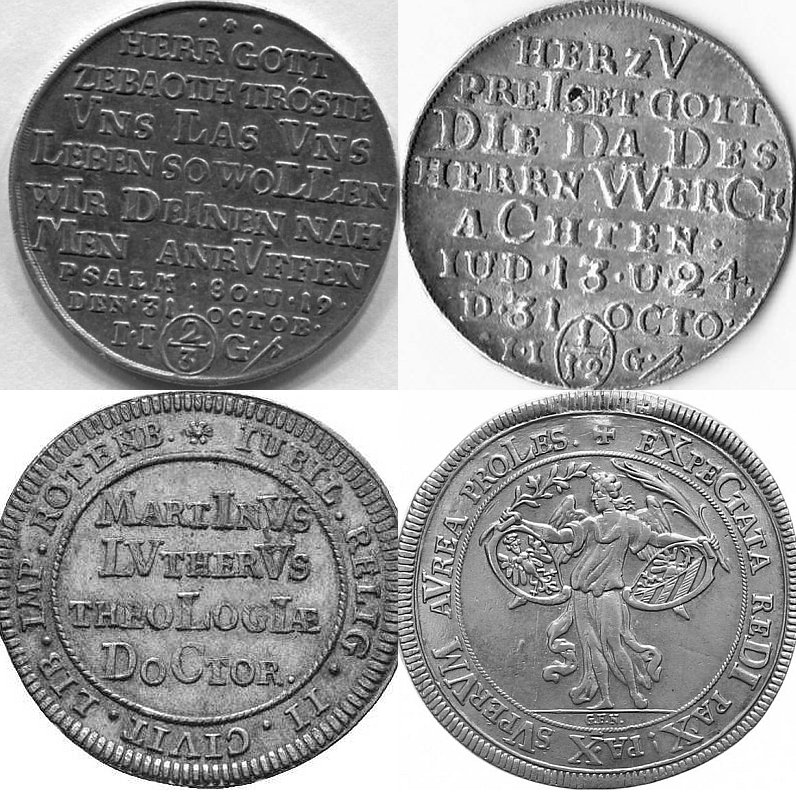 |
|
|
|
Rest in Peace
10197 Posts |
Big question! From my school days moons ago...some like "DeInen" is actually two words, de meaning "the" something?, which in today's German is spelled "die". Some like in your example "anrVfen" which I think is old for Antwerpen (Antwerp) is proceeded by "nahMen" which means named, hence "named Antwerp" maybe? Now a WAG...maybe that's all the letters that were left in the die stamping tray!  Edit: lower left= " Martin Luther Theological Doctor, why the cap C, see above! Edited by Crazyb0
02/12/2017 1:23 pm
|
|
Pillar of the Community
Russian Federation
5186 Posts |
IIRC - I've heard that somewhere, but can't recall the source - those letters were a fancy way to give the coin's date without actually mentioning the date numbers.
It so happens (purposefully, of course) that all the capitals are Roman numerals - I, V, X, L, C, D, M (the W counts as VV). As such, you're basically supposed to add up the numeric values of the capital letters, and the result will presumably be the coin's date.
No idea what the reason for stuff like this was - presumably some kind of numerology.
[EDIT: added missing letter.]
Edited by january1may
02/12/2017 1:34 pm
|
|
Pillar of the Community
 Poland
3201 Posts |
Thank you for your reply.
So if we write down all those letters from the Martin Luther coin, we get:
M
D
C
LL
VVV
II
- which makes 1717, the anniversary of the Reformation.
The fourth coin from Nurnberg gives us:
M
D
C
L
XXX
VVV
I
- which would be 1696.
That means the inscriptions would have to be selected for their date-encryption-usefulness as well - they had to have the exact number of Vs needed, as you don't see one V capitalized and then another V not (of course I see X could be substituted by VV but still you can only get so far with that kind of tricks). That's all quite strange, I must say.
Edited by DL20K
02/12/2017 1:50 pm
|
|
Moderator
 United States
34562 Posts |
Quote:
That's quite strange. nice work @january1may and @dl20k! I have never heard of this before--absolutely fascinating! "If you climb a good tree, you get a push."
-----Ghanaian proverb
"The danger we all now face is distinguishing between what is authentic and what is performed."
-----King Adz
|
|
Pillar of the Community
United States
1696 Posts |
Wow. I learned another thing today from this forum. Amazing!
|
|
Valued Member
Germany
303 Posts |
Wow. I've never seen anything like this before on German coins and I am quite amazed.
|
|
Pillar of the Community
Poland
3201 Posts |
Glad to have brought this to your attention, then  All praise should go to January1may for solving this mystery so quickly, though!  |
|
Pillar of the Community
United Kingdom
2490 Posts |
Coins are just round slivers of metal, but sometimes they blow your mind. This is my all time fave piece of numismatic trivia.
|
|
Pillar of the Community
Russian Federation
5186 Posts |
Actually, DL20K, I highly suspect that the place I've heard of it was one of your own links (the Cologne one, most likely).
Could have been during my own attempts to find weird denominations, however.
|
|
Pillar of the Community
 United States
5720 Posts |
Kudos to both DL20K and january1may for making an intriguing observation, then solving the mystery in such short order. Really fascinating that the Germans did that!
|
|
Moderator
Australia
17006 Posts |
Yes, january1may's theory is correct. Hiding the date in Roman numerals amongst text is known as a "chronogram", and was an artistic concept in fairly common use in Europe from the Renaissance up until the late 1700s. The Wikipedia article mentions the use on coins and medals. Don't say "infinitely" when you mean "very"; otherwise, you'll have no word left when you want to talk about something really infinite. - C. S. Lewis
|
|
Pillar of the Community
Norway
1358 Posts |
For those interested, the text on the coins is just plain old German or wannabe-Latin: a bit archaic bible language. As in good medieval biblical Latin-wannabe tradition, the you get substituted with a V. It's easy to read. Here's what it says: 'Herr Gott Zebaoth troeste uns las uns leben soh wollen wir deinen Nahmen anrufen' (psalm 80, verse 19, Lutheran bible). It literally means ' Oh Lord God (Zebaoth is old German for God or Jehova) comfort us and let us live so we will call out your name'. The second coin reads: 'Herzu Preiset Gott die da des Herrn werck achten' meaning ' Praise God for the Lords work' which apparently comes from Iud (Jude) 13 verse 24. DDDCC VVV II Or 1717. The third coin contains too many abbreviations in the edge to be fully understood by me (apart form that Martin Luther was a doctor of theology, as it says in the center). The fourth coin actually has two different Latin-ish sentences on it. Finally, I have use for my knowledge of that language! First: 'expectata redi pax', which means boldly 'waiting for peace to return'. Second: 'pax superum aurea proles' and now I'm a tad uncertain: 'the peace of Heaven's golden child' seems the most plausible translation. Now I don't have a German bible or history book here so I can't check what's there exactly, but hopefully some people can take this further. I just love hidden messages in things. @Crazyb0: only nouns, names and the first words in a sentence get a capital letter in German, so it's not so random or often. |
|
Pillar of the Community
Russian Federation
5186 Posts |
Quote:
The third coin contains too many abbreviations in the edge The legend is IUBIL. RELIG. II. CIVIT. LIB. IMP. ROTENB., which I'd guess to mean "Religious jubilee II  of Free Imperial City of Rothenb[urg?]" or something like that. (I don't know enough Latin to expand the abbreviations fully.) Not sure what the II stands for - could well just mean the numeral (i.e. "second religious jubilee", which does make a bit of sense for a 200-year anniversary). Not sure if it's actually Rothenburg or, say, Rotenborg or something either. |
|
Pillar of the Community
Belgium
1194 Posts |
the third coin is a ducat from Rothenburg on the Tauber ( Germany) from 1717 , commemorating the 200th anniversary of the reformation : CIVITas LIBra IMPerii ROTEMBurgae / IUBILatio RELIGiosa II ( secunda) ; I am not sure for the transcription and I can t check it now , but it is in this sense .
The fourth coin : then comes (redi) the expected peace , the peace of the golden Child (the Christ) of heaven . I would translate it in this way . albert
|
|
Pillar of the Community
Norway
1358 Posts |
Quote:
or something like that. Quote:
I am not sure for the transcription and I can t check it now This is why I didn't dare to go further into this. I'm not sure enough either. Quote:
then comes (redi) the expected peace , the peace of the golden Child (the Christ) of heaven Thanks. I think we're quite on the same page here with our translations. Edited by UltraRant
02/13/2017 12:53 pm
|
| |
Replies: 16 / Views: 2,743 |










 Posted 02/12/2017 1:33 pm


