Since Finn has given us an excellent historical summary, I will focus on the coins.
BMCRE (
Coins of the Roman Empire in the British Museum - vol IV by Harold Mattingly) groups the silver coins of Lucilla according to the obverse legend.
.....Group I: LVCILLAE AVG ANTONINI AVG F
.....Group II: LVCILLA AVGVSTA
RSC (
Roman Silver Coins by David Sear) also only recognizes two inscriptions. However,
RIC III (
Roman Imperial Coinage, vol III by H. Mattingly and E. Sydenham) adds a third inscription LVCILLAE AVGVSTAE on a very rare quinarius. It also reverses the group order of the inscriptions. Here we will show examples of the two obverse types for denarii.
LVCILLAE AVG - ANTONINI AVG F
CONCO - RDIA
Lucilla seated left, holding out patera and leaning on throne
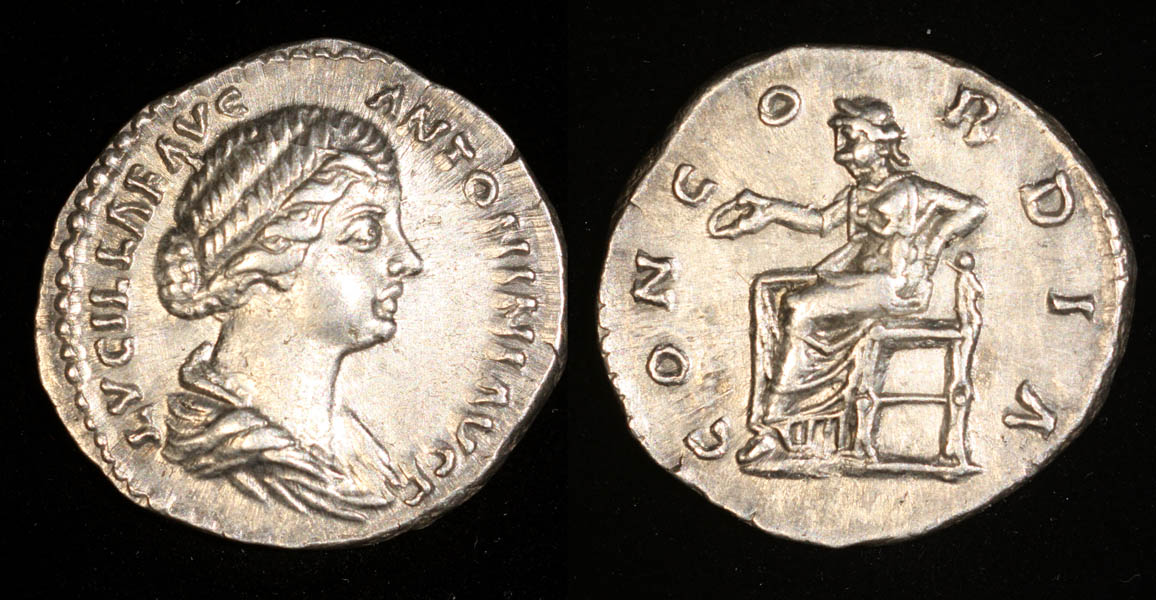
This break pattern for the reverse inscription is noted for the type of Concordia standing but not seated. The back of the seat is low and so is not a throne, and there is no cornucopiae under the seat. Except for the break pattern this coin is illustrated in
BMCRE plate 58 as number 306 (as CONC - ORDIA); corresponding to
RIC III plate XI #234. Therefore we may interpret the short figure with the ball at top (below her left arm) as a "statuette of Spes." This coin then is a variant of
RSC 6a,
RIC 758, and
BMCRE 306.
LVCILLAE AVG - ANTONINI AVG F
IVNO-NI - LVCINAE
Juno veiled standing left holding swaddled infant in left hand; extending right
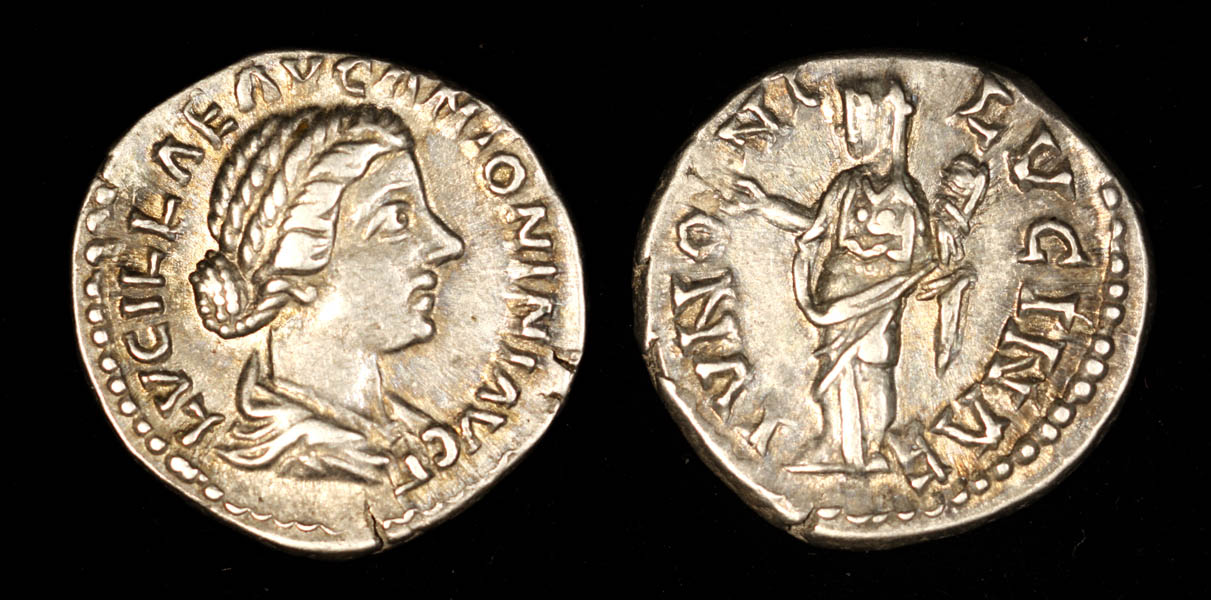
This reverse type is found in both groups, but with different forms.
BMCRE observes that this reverse type with Juno standing only occurs in group I with the longer obverse inscription. The break pattern for the reverse inscription is slightly different than the version in group II which reads IVN O NI - LVCINAE. This example corresponds to
BMCRE 313,
RSC 38, and
RIC 771
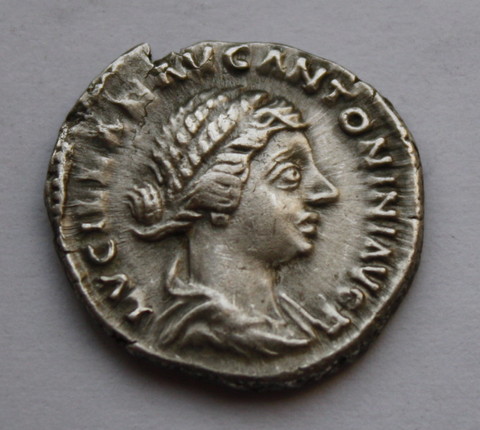
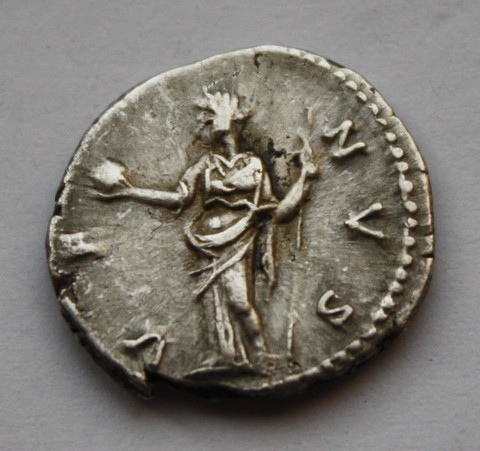
LVCILLAE AVG - ANTONINI AVG F
VE - NVS
Venus standing left holding staff/scepter in left hand and extending right holding ?
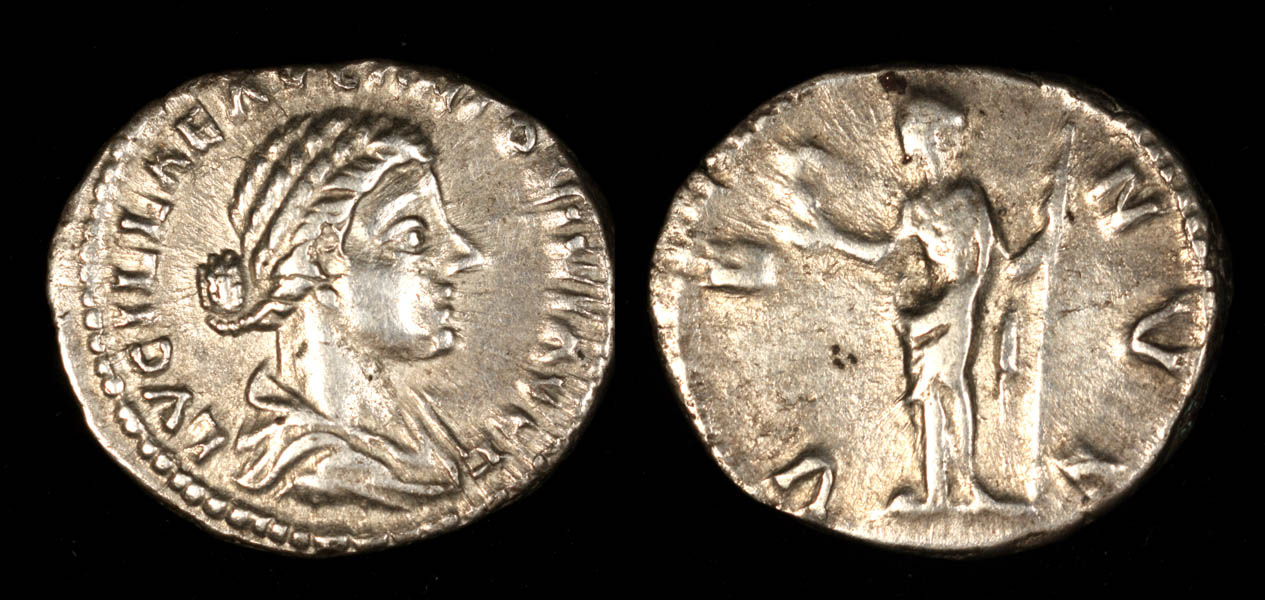
The reverse on my example was not struck well enough to show the details of what Venus holds in her extended hand. However, the only option is that it is an apple (if you can believe that). In this reverse the letters V E are widely separated but both are below the extended arm of Venus. There is a version which follows the pattern of an aureus in which the arm separates these two letters. This coin corresponds to
RIC 784,
RSC 70, and
BMCRE 322 (misprint in
RSC on this number).
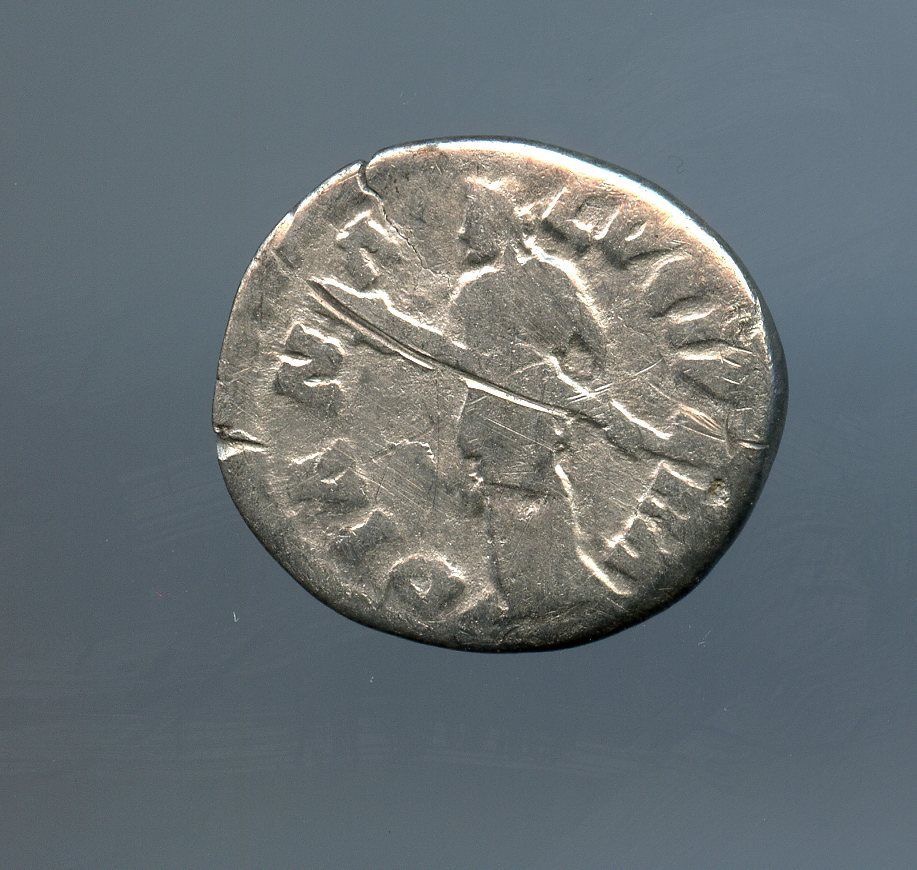
LVCILLA - AVGVSTA
VENVS VICTRIX
Venus helmeted standing left, holding out Victory in right hand, with left hand on shield.
Note the distended abdomen of pregnancy.
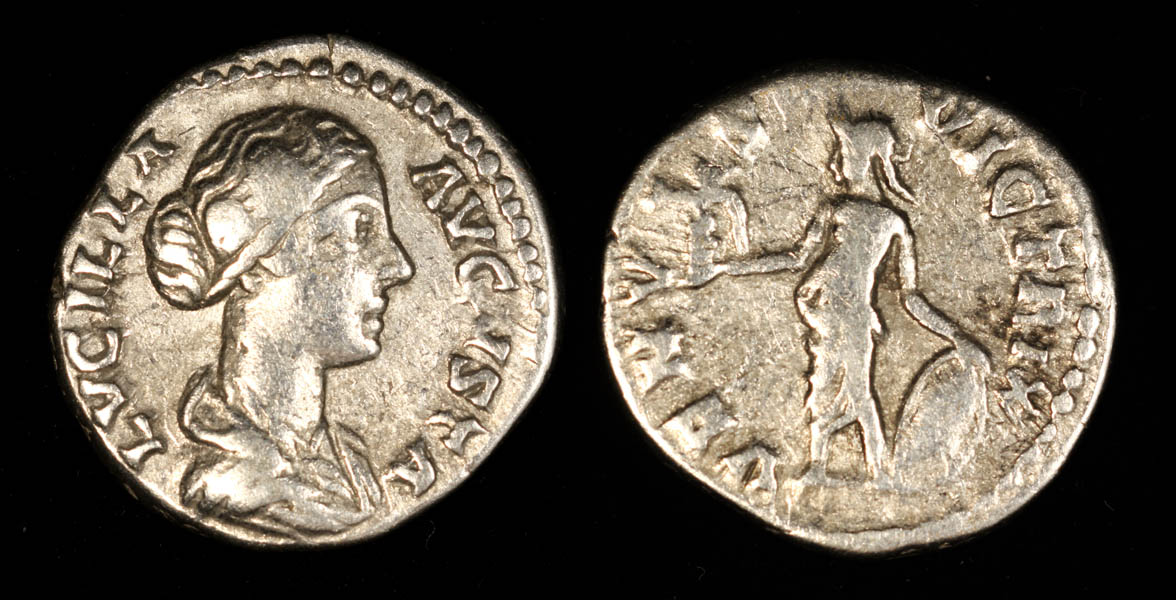
This reverse type only occurs in
BMCRE group II with the shorter obverse inscrption. It is very similar to the coin Steve shows above, but differs in the break pattern of the inscription. His coin follows the pattern VENVS VI-CTRIX; mine follows the pattern VEN-VS - VICTRIX. Neither of these is directly attested nor illustrated in any of the three standard catalogs I am using, which show only a break between the words and no interruption by the central figure. Both of our coins show a feature that is illustrated but not mentioned in the catalog descriptions, namely the distended abdomen of the central figure suggesting pregnancy. That feature is less ambiguous on my example. Since neither of our coins show a helmet under the shield, they will both correspond to
RIC 786 and
RSC 89. However, in the
BMCRE listings my coin corresponds most closely to #353 and his to #354 or 355.
{Here let me add the note that EFLargeCents and I had worked out the plan to introduce the remaining threads in order starting with Sabina. We have the material, and EFLC was setting the pace.}





 Posted 03/02/2017 10:28 pm








 Saludos Paul