|
This page may contain links that result in small commissions to keep this free site up and running.

Welcome Guest! Registering and/or logging in will remove the anchor (bottom) ads. It's Free!
To participate in the forum you must log in or register. | Author |
 Replies: 6 / Views: 1,829 Replies: 6 / Views: 1,829 |
|
|
Pillar of the Community
United States
6130 Posts |
Just received another package today, this one from Dr. Lanz which contained 240 Chinese cash coins that I bought in lots of 20. After weeding out the Qing coins (about 1/2 - 1/3 of each lot was Qian Long; of course) I was left with a nice pile of Han through Ming coins. Wanted to share some of the highlights, with a couple questions. First up, Wang Mang (7-23 AD) 50 cash (varied sizes and weights)  An interesting assortment of chiseled coins:  The bottom, at a minimum, is a chiseled Wang Mang Huo Quan coin, apparently the result of his desperate attempts to inflate the money supply (chisel off the outside of the coins to melt and cast more) for whatever reason seemed good to him at the time. Some really nice Tang dynasty Kai Yuan Tong Bao:   I looked up the crescent shapes, and just about every combination (top, bottom, left, right; inward and outward of each) is documented. I don't think anyone has been able to offer an explanation, but I am fond of the old legend that the emperor's wife would press her nail into the wax mold for the mother coin to make this shape on the coins. A couple questions on these: 1. Can anyone read the "mintmark" on the other two? Are these more scarce than normal types, or attributable to a more narrow range? 2. I don't doubt the authenticity of these coins (should I?) but I have never seen a 1,000+ year old coin with little to no patination, as with the bottom left coin in these pictures. Is this normal? Simply cleaned? I think most of the rest of the coins are Song dynasty, which I hope to turn into a modest set of emperors. Here are a few of my favorites:  (I'm a real sucker for seal script) Thoughts and comments welcome! If I find anything noteworthy in the piles of coins, I'll be sure to post it in this thread! |
|
|
|
Valued Member
Netherlands
91 Posts |
Yay, finally some more Chinese coins! Wish I had more time to write a decent reply (tomorrow is the last day of my mid-terms), but I figured I might have a couple of minutes of spare time to throw something together. The nail-mark story is indeed very interesting, albeit a little unbelievable. Keep in mind there is a difference between Nail-marks and crescents though. The latter one is pretty curved, a little like your top-left coin, the other is less so (down left).
1).These are from the so called "Huichang" Kai yuan-series. Huichang refers to the reign period of emperor Wuzong (840-846) who chose this as his Nian Hao. Wuzong was not a very nice fellow and he thoroughly hated Buddhist monks and monasteries. In 841 (other sources say 845), he raided and abolished more than a few of these monasteries, and ordered the copper and bronze Buddhist statues, bells and other ornaments to be melted down. Shjöth suggests that these special Huichang coins were exclusively cast using this copper, but this is a little unlikely, seeing as how common these Huichang coins are. What is known is that at least a part of these Huichang Kai Yuan's was cast using copper from these monasteries. The Kai yuan's with 'Chang' on the reverse are particularly interesting, seeing as they were the first Kai-Yuan ever to be minted with a reverse character. Li Shen, regional commander of Yangzhou, and a big supporter of Wuzong's anti-Buddhist regime, was the first to suggest casting coins from this looted copper and did so in his provincial mint in Yangzhou. As an homage to the emperor, an abbreviated form of his Nian hao, Chang, was used on the reverse. The idea of reverse characters apparently caught on, seeing as after a short while, all provincial mints were ordered to include an abbreviation of their geographical location on the reverse. I believe around 22-23 different reverse inscriptions are known; Chang (as an abriviation for the Huichang era name), Lan, Hong, E, Luo, etc. These reverse characters all stand for place names, be it prefectures or cities.
The character on both of your coins is 'Run', Hartill 14.81. unfortunately, one of the most common Huichang Kai Yuan's, worth only a tiny premium over normal Kai Yuan's, if any at all. The inscription however is highly interesting. The Run on your coins probably is an abbreviation of Runzhou, an administrative division in the eastern province of Jiangsu, close to Nanjing. To be more precise, it was cast in the Runzhou commandry, currently a district in Zhenjiang prefecture. End dates for these Huichang coins are not known, and it is likely, seeing as they were cast in huge numbers, that minting these carried on for a long time after the Huichang era.
2). I'm no expert in authenticating, and Thomas might be able to tell you loads more, but allow me to throw up an early comment. Should I doubt the authenticity? Absolutely yes! Assume even the most common Qianlong cash are fake. Start to look for things this coin 'does' well, that look right on this coin. Correct weight, diameter, calligraphy, etc. Then, move on to the patina. Recent fakes have been especially treacherous in this area, so you definitely have to pay attention here. Try to think: If I were a forger, would I be able to fake this? If everything checks out, you either have a genuine coin, or the best fake ever made. Assuming everything is a fake is the only way to minimize the purchasing of fake coins.
That being said, I don't think you need to worry about any of these. Chinese coin collectors have been around since the fourth century, and these early collectors sure didn't care whether or not the coins were cleaned, only if they were readable. To keep them that way, they sometimes even lacquered the coins as well! This practice still continues to this day, although far less often. Many European collections from the 19th and 20th century contain mostly these cleaned coins, even spades or knives that have been completely stripped of their patina. Indeed, completely unpatinated coin is fairly unlikely, although not unthinkable. Because these Tang coins were cast in such huge number, and because of their correct weight, these Kai Yuan's were sometimes still in use during the Qing dynasty, hidden between the Qing-cash on the large strings they would be carried on. Okay, they might develop some patina, but because of them being carried in strings, this patina would differ significantly from the crusty, earthen patinas these coins can also have.
I completely agree with you; seal script is absolutely stunning! Slender gold-script comes a close second though.
Mika (may have gone on a little too long there.)
|
|
Moderator
 United States
34549 Posts |
Quote:
may have gone on a little too long there Good luck on your mid-terms Mika, but I disagree about the length of your reply. I learn so much when you guys get into these great back-and-forth discussions. Keep them coming! "If you climb a good tree, you get a push."
-----Ghanaian proverb
"The danger we all now face is distinguishing between what is authentic and what is performed."
-----King Adz
|
|
Pillar of the Community
United States
6370 Posts |
Quote:
In 841 (other sources say 845), he raided and abolished more than a few of these monasteries, and ordered the copper and bronze Buddhist statues, bells and other ornaments to be melted down. Shjöth suggests that these special Huichang coins were exclusively cast using this copper, but this is a little unlikely, seeing as how common these Huichang coins are. I have read that it was just the "Chang" coins that were supposedly cast from these bells, and that they were cast for only one year only, 841 (or 845). Quote:
is a chiseled Wang Mang Huo Quan coin, apparently the result of his desperate attempts to inflate the money supply (chisel off the outside of the coins to melt and cast more) These are actually scarcer than Hartill makes them out to be, and I value them higher than intact specimens. I occasionally come across them, but I would not call them common. I have, however, come across one that was cast to look clipped. That was lively a private issue made to pass off as a genuine "clipped" coin. Now who clipped these? Your wording above seems to indicate that Wang Mang and his government chose to clip them themselves. I strongly feel that this is not the case, particularly because it would be much more efficient to cast "already-clipped" coins like my specimen than to cast normal coins and clip them afterwards. I think it was clipped by the general population. There were massive amounts of counterfeiting going on, and the metal needed to come from somewhere, so these low-value coins would have been the victims of metal-ciphoning. But if the low-value coins were used (huo quans, etc), then why are they so infrequently found clipped? I think the answer lies in Wang Mang's policies. In trying to instate his new coinage, Wang Mang outlawed the use of wu zhus (a move that supposedly had citizens weeping in the streets). The public was using these because they did not trust the new fiduciary coins (arbitrarily demonetizing them did not help). Since the wu zhus were illegal, I think they would have been used and mutilated since they were not good for anything more. That would explain why so many are found clipped with respect to huo quans (but, then again, wu zhus lasted much longer and were the economic staple even during other times of fiduciary coinage and economic turmoil, so a high number of clipped wu zhus could be explained through this). I have also read that the center was often punched out to create two lower-denomination coins. But this would only be useful if the two parts remained intact, which is why a punch would have been used (see comments below). Your coin has a jagged edge, meaning the outer part was cut off to be presumably used as scrap metal and placed back into circulation. So how bad was the counterfeiting under Wang Mang? Well, initially he instituted the death penalty to those found counterfeiting his coins. But this was not enough; he revised the law to becoming a slave for life. Then it escalated to enslaving the counterfeiter and his family for life, and finally to enslaving the counterfeiter, his family, and the five nearest households. Yet that still did not deter some.  I was able to acquire this pair of interesting coins. They are wu zhus and the centers have been partially punched out. Notice how the outer ring has broken on both pieces, and that the coins have remained unfinished in their clipping. The evenness of the cut and bowing of the metal strongly suggest a punch is being used. I presume the process was abandoned once the outer ring broke. This gives credence to the theory that the centers were punched out to create new denominations since the outer ring would have been less acceptable in commerce in its broken state. As a result, they clipper saw no incentive to continue with the coin and left it as it is. There are lots of holes in my theory, but it is excellent food for thought given these specimens. 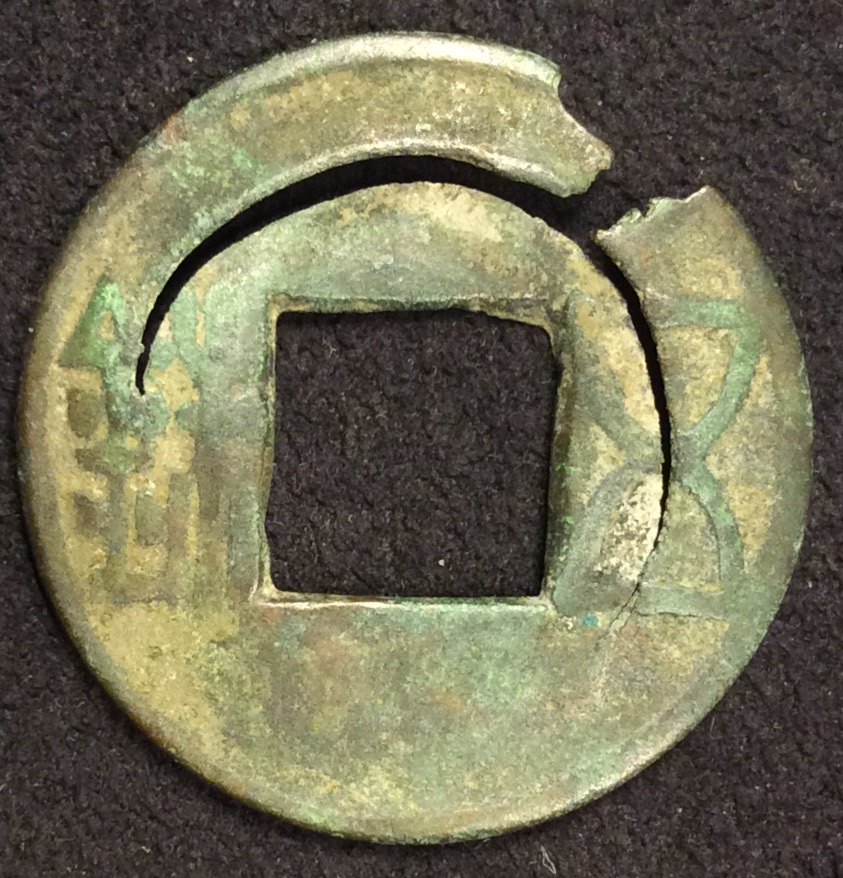 Quote:
2. I don't doubt the authenticity of these coins (should I?) but I have never seen a 1,000+ year old coin with little to no patination, as with the bottom left coin in these pictures. Is this normal? Simply cleaned? Nothing wrong with them. The patina was just stripped. Quote:
I'm a real sucker for seal script So am I  |
|
Valued Member
Netherlands
91 Posts |
Yeah, this is where it would be a good idea to have the original sources, all the numismatist have based their research on. I can tell you everything about 4th century BC Chinese politics, but I have fairly little to no sources dating past the Han dynasty. So we'll just have to rely on what others have written. As I said, Schjöth thought all of these, without exception, had been cast from this looted copper. Knowing the quality of Schjöth's textual research, I am more than a little sceptical of this claim. Hartill does not really touch on the history of this incredibly interesting series, other than that they were issued in or after 841 (or 845). I give a little more credence to Peng Xinwei's theory: The looting of these monasteries was not done by one single institution or organisation, but instead was arranged locally (we know this as a fact). This happened all over the country and according to him, this copper was brought to the closest mint, and then melted and minted in these local mints, not centralised in just one mint. I think I have a pdf of the metallurgical analysis of the coins in the British Museum somewhere, I'll start digging. Interesting to see if they checked kai-yuans with different reverses, and what the metal content of these Huichang coins is compared to normal Kai-Yuans. As for the dates; I have no clue; one says minting with reverse characters continued until the end of the Tang-dynasty, others say that this is also true, but that the 'Chang' reverse was only used in that one year. I am not sure what to think, but seeing as 'Chang' Kai-Yuan's are not extremely rare compared to other Huichang reverses, I am inclined to believe that for however long the minting the others carried on, the 'Chang' reverse was also still in use. This may be a little bit of a fallacy, after all, they could have just minted an awful lot in this year. But we are talking astronomical numbers here; millions and millions of coins, number comparable to the Song mints a few centuries later. I am a little bit doubtful that a single provincial mint (it wasn't even a large one) in 800 AD could mint such a large amount of coins in a single year (their outputs were rather large, but his large?). Still, I could be very, very wrong. I just don't know anything for sure.
Nice semi-clipped wuzhu by the way, Thomas!
Oh, and "don't" you dare post the most beautiful seal-script coin you have Thomas. You know the one I am talking about.
Mika
Edited by AnYangMan
04/01/2017 10:14 am
|
|
Pillar of the Community
Russian Federation
5186 Posts |
The huge coin in the upper right of the last photo looks a lot like my only identified pre-Qing Chinese coin. I wonder if they're the same type...
(Mine is, as far as I can tell, a fiduciary 10 cash of Huizong, Chongning era, Song dynasty, ca. 1102-6; apparently S-622 or 623 - I have no idea how they differ from each other.)
|
|
Valued Member
Netherlands
91 Posts |
January1may; that coin is indeed a Chong Ning - Zhong Bao, from the Chongning period within emperor Huizong's reign. The only difference between the two varieties 622 and 623 is the calligraphy. The main difference is the first stroke of Zhong; 622 has an entirely horizontal stroke, while the first stroke of 623 is pointed upwards, like the coin presented by Finn here. There are many, many more varieties, and Schjöth is not known for his attention to these minor differences. His work had been the standard reference within the area of Chinese numismatics, right up until Hartills work was published, but mainly due to the lack of something better. Don't get me wrong, the book is, for its time, rather comprehensive and relatively detailed. I am fortunate enough to have an original 1929 edition at home, and I must say that the plates are absolutely stunning. Unfortunately, they were drawn by his daughter, who wasn't that into coins. The drawings are therefore not always that reliable. Anyway, enough digressing. This variety pictured here is obviously 623, or Hartill 16.408, to be more precise.
Mika
|
| |
Replies: 6 / Views: 1,829 |
|
To participate in the forum you must log in or register.
Disclaimer: While a tremendous amount of effort goes into ensuring the accuracy of the information contained in this site, Coin Community assumes no liability for errors. Copyright 2005 - 2026 Coin Community Family- all rights reserved worldwide. Use of any images or content on this website without prior written permission of Coin Community or the original lender is strictly prohibited.
Contact Us | Advertise Here | Privacy Policy / Terms of Use
|
| Coin Community Forum |
© 2005 - 2026 Coin Community Forums |
| It took 0.44 seconds to rattle this change. |
 |
|
| |
| |





 Posted 03/30/2017 6:19 pm


