|
This page may contain links that result in small commissions to keep this free site up and running.

Welcome Guest! Registering and/or logging in will remove the anchor (bottom) ads. It's Free!
To participate in the forum you must log in or register. | Author |
 Replies: 10 / Views: 2,149 Replies: 10 / Views: 2,149 |
|
|
Pillar of the Community
United States
6370 Posts |
I was able to win this, at the opening bid. I was blown way out of the water on everything (even after a scary moment when I accidentally bid $900 on a Qi knife  ). Some good deals were to be had, but half of the coins in the collection were fakes, so I did not bid as strongly as I would have on the unpictured lots (if I could afford to, that is). This was by far my least expensive target, and my only win. I have never seen anything like it, and I doubt I will see another one again outside of a museum. I felt it would go nicely with my molds and casting flue. 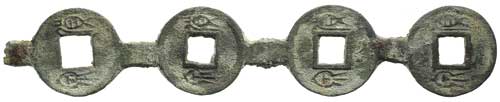 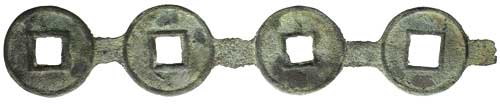 Ancient China, Wang Mang' Xin ("New") Dynasty (7-22 AD) Huo Quan (14-25 AD) Four cast together in a row, still connected by sprues. Hartill #: (left to right) H-9.40, H-9.32, H-9.34, H-9.34 Ex: Noble Numismatics Sale 114 Lot 4462, Patrick O'Rourke Collection, Colonial Rare Coins, Queensland July 1995 I find it quite intriguing how there are multiple varieties exhibited in this specimen. I would have thought that the impressions in the mold would have all been consistent, but apparently that was not the case. It does not look like the coins were cemented together. (Sorry I have not been around as much. I am working full-time this semester, and CCF is blocked by my workplace.  ) |
|
|
|
Pillar of the Community
United States
1911 Posts |
I love how I can see a thread title and guess who is posting it ;) Good job on the win! Always nice too when the opening bid does the trick!
|
|
Pillar of the Community
United States
7067 Posts |
Congrats on the win, Thomas - and for not having to shell out the $900 for the erroneous bid! What a neat pickup! Quote:
...intriguing how there are multiple varieties exhibited in this specimen Perhaps this will be illustrated in the book we all know you will eventually write. |
|
Pillar of the Community
United States
6130 Posts |
Super acquisition, Thomas!
As for the different varieties, it makes me wonder if perhaps this is evifence of how many people were involved in the minting process? Maybe something resembling an assembly line where 4 or more employees were involved with making the impressions for each mold, allowing for greater overall efficiency? Replacing all the money in a matured economy was not a small undertaking, but Wang Mang was remarkably successful considering he was able to outlaw the Han dynasty's Wu Zhu coins.
Surely Henry Ford couldn't have been the first to think of the assembly line business model?
|
|
Moderator
 United States
34542 Posts |
Amazing pick-up!
I had been thinking that varieties in Hartill were separated in time or place (or workman, as @finn is suggesting above). However, maybe your specimen is most explained by a single workman who got a little sloppy here and there (or was illiterate and was less successful with some of his script reproduction from one mold to the next). A very good thought experiment.
"If you climb a good tree, you get a push."
-----Ghanaian proverb
"The danger we all now face is distinguishing between what is authentic and what is performed."
-----King Adz
|
|
Valued Member
Netherlands
91 Posts |
Nice to see you had at least some success, albeit one the very last lot you were planning to bid on. I had hoped to score something as well, but you already knew that I got outbid of course.
I am truly intrigued by this acquisition of yours. I don't know all too much about the casting of 'later' cash, so I'm not sure how valuable my opinion is. Nevertheless, I think you should inspect it well when it arrives. So far I have only seen star-shaped moulds for Huo quan's, with either 4,5,6 or 8 coins. I don't have enough good quality Huo Quan's to check the edge. A star-shaped mould would produce coins with only one 'sprue' of metal leading towards them, thus only a slight part of the edge had to be filed off completely. A 'linear' mold would produce coins with sprues on both ends, except for the last coin. Some people argue that these star-shaped molds were purely and only used in making the seed/mother coins. I just don't know. The lack of 'linear' molds I have seen, is certainly no guarantee that this was the only type. And I am as stumped as you are on the different varieties in one casting. I have always thought that these imprints were made by the mother cash, so that every coin in one mold is precisely the same. Technically seeing, this thing shouldn't exist, yet it somehow does.. Interesting, let's see what it is like in hand. An unofficial casting might also be an option.
Mika
|
|
Pillar of the Community
 United States
6370 Posts |
Quote:
Nevertheless, I think you should inspect it well when it arrives. So far I have only seen star-shaped moulds for Huo quan's, with either 4,5,6 or 8 coins. I don't have enough good quality Huo Quan's to check the edge. A star-shaped mould would produce coins with only one 'sprue' of metal leading towards them, thus only a slight part of the edge had to be filed off completely. A 'linear' mold would produce coins with sprues on both ends, except for the last coin. Some people argue that these star-shaped molds were purely and only used in making the seed/mother coins. I just don't know. The lack of 'linear' molds I have seen, is certainly no guarantee that this was the only type. And I am as stumped as you are on the different varieties in one casting. I have always thought that these imprints were made by the mother cash, so that every coin in one mold is precisely the same. Technically seeing, this thing shouldn't exist, yet it somehow does.. You expressed all of my concerns about this piece. I have never seen a linear mold for anything except yu jia Ban Liangs. But, then again, I have never seen a clay mold of huo quans. I have only seen clay molds for Da Quan Wu Shi's, Da Bu Heng Qians, Qi Dao Wu Bais, and Yi Dao Ping Wu Qian's. I have seen bronze molds for huo quans, but not clay ones. An unofficial casting may explain it. There was a LOT of unofficial casting towards the end of Wang Mang's reign. The provenance seems solid, which is why I bid. |
|
Pillar of the Community
United States
6370 Posts |
Quote:
As for the different varieties, it makes me wonder if perhaps this is evifence of how many people were involved in the minting process? Maybe something resembling an assembly line where 4 or more employees were involved with making the impressions for each mold, allowing for greater overall efficiency? I have always thought that the molds were created with a single mother mold inpressed into a clay tablet. That was far more efficient than carving each impresion out by hand. If you are going to be casting millions (or maybe even billions) of a coin from clay molds, then you are going to need a lot of molds. To my knowledge, only the ant-nose coins were the only ancient Chinese (and maybe of all Chinese?) cast with metal molds. |
|
Pillar of the Community
United States
6130 Posts |
That is the same production method I had seen mentioned, but imagine that you are casting a "tree" with 25 coins--5 rows and 5 columns. The contemporary illustration in my Hartill Japanese coins shows one dude making an impression 25 times with the mother coin. If you have 5 people with 5 mother coins, each responsible for making one "row" of 5 impressions, you are going to get a LOT more casting molds than the 5 people could churn out individually. Henry Ford proved that concept.
|
|
Valued Member
Netherlands
91 Posts |
Quote:
To my knowledge, only the ant-nose coins were the only ancient Chinese (and maybe of all Chinese?) cast with metal molds. Just nitpicking here, but I am afraid this is not entirely true: 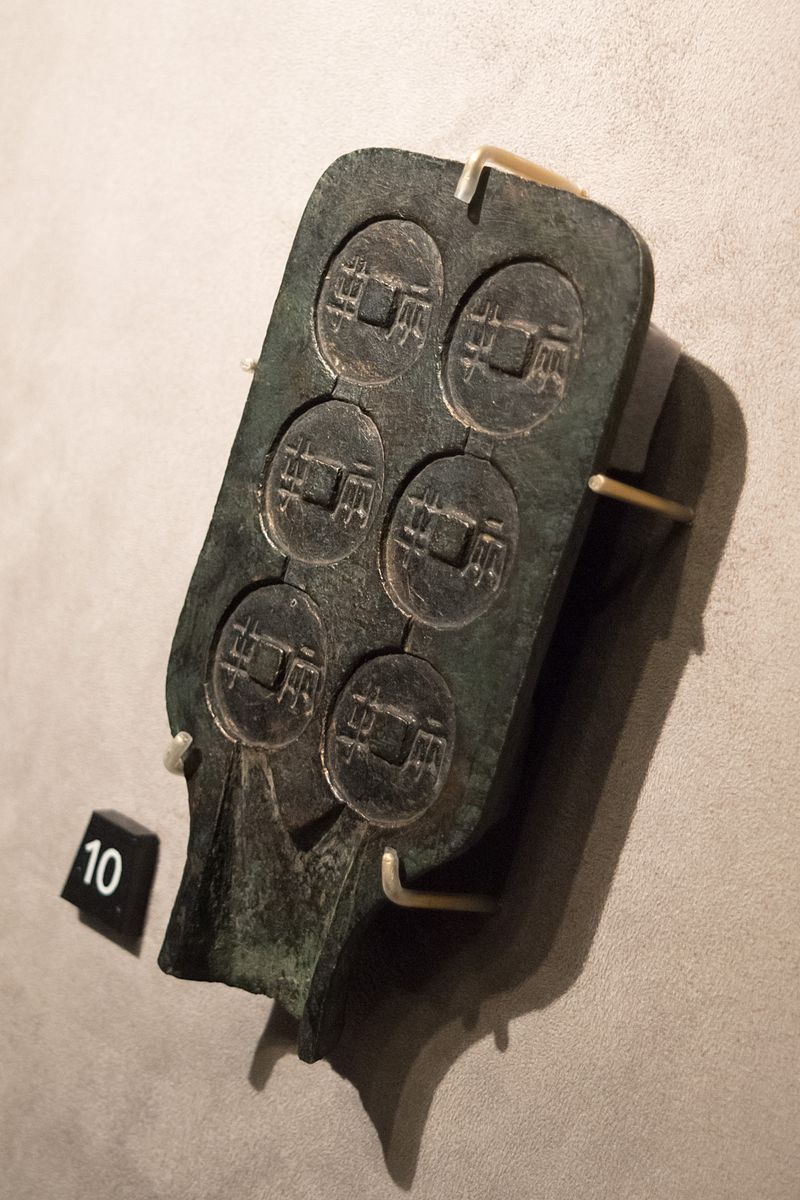 A Warring states Ban Liang mold excavated in Qishan county, easternmost part of the Qin-kingdom. Back in the day, the city of Qi(shan)-yi was known as the centre of bronzemaking in the Qin state (possibly even in the entire Zhou empire). Today, a museum stands on this ancient site, housing a large amount, 3000 I believe, of the bronze artefacts found here. This mold is also bronze. Found in an official workplace, so no illicit coinage in this case. Notice the linear casting! I am being more and more intrigued by this casting tree. Can't wait to see what you think of it in hand. Mika |
|
Pillar of the Community
United States
6370 Posts |
Thank you for sharing that mold. I learned something new. When I was reading about the ant-nose coins, there was an article stating that only they were cast using metal molds. So some of these ancient cash were cast linearly. Interesnting... this piece is getting more and more intriguing. Also, I had several Wu Zhu coin molds arrive in the past couple days. One is quite intruguing. Look at the leftmost impression. Look under the hole. This impression was used to cast Wu Zhus with a rim on the upper edge of the hole. None of the other impressions have this. This means that multiple varieties were cast from the same molds. 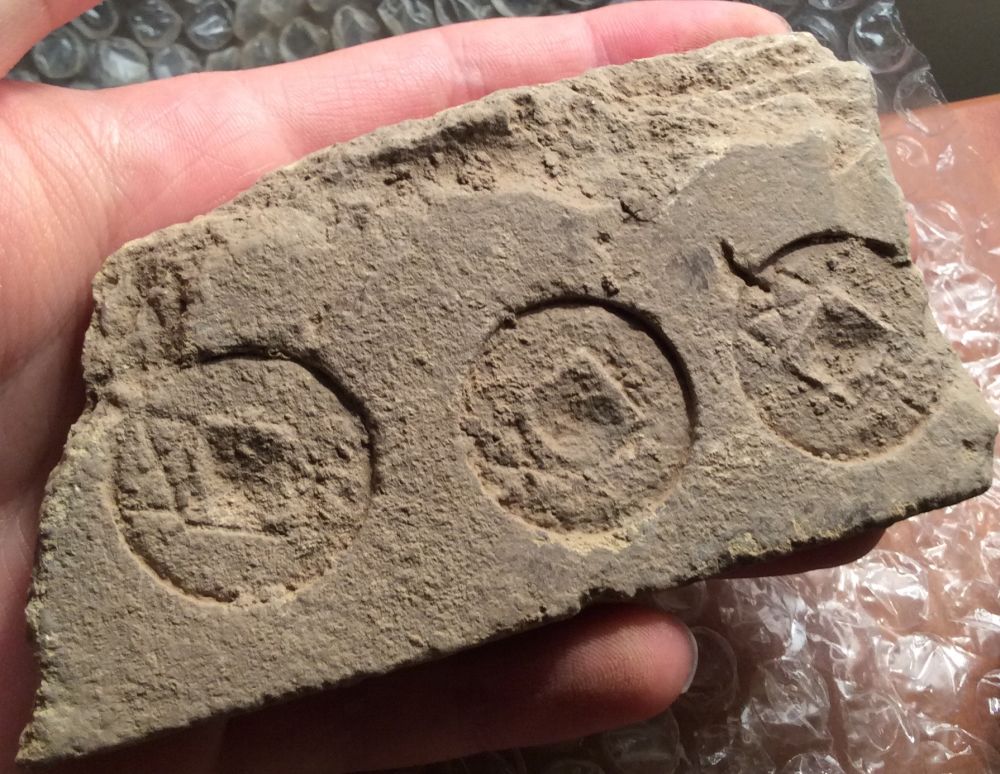 |
| |
Replies: 10 / Views: 2,149 |
|
To participate in the forum you must log in or register.
 
- How Dan O'dowd Built One Of The World's Greatest Ancient Coin Collections
- Top Coin Collecting Stories For The Week Of September 18, 2026
- 1949 Lincoln 1c Damaged 4?
- Help With Identification Please.
- 1969-S Lincoln Cent Machine Doubling Or Double Die Obverse
- 1999 Lincoln Cent - Die Clash
- 1809 Half Cent For Grading
- 1987 - D Lincoln Cent Grade Check
- 1987- D Lhc Possible RPM Or DDO In Date
- You Know What I Want That Final Number To Be
- Bronze Coin To Id. Greek Or Roman?
- A Ridiculously Badly Written Computer Aided Book, Coin Collecting Bible, 2024
- Liberty Head 10/11 Stars Obverse With A Sick Looking Eagle On The Reverse Holed 0.59g 13.06mm
- The Tyrant Collector - PCGS Youtube Interview
- Counterfeit Detection: ANA Video - Introduction, With Brian Silliman And Jim Robinson Ep. 1
- Counterfeit Detection: ANA Video - Mistakes, Risk Factors, And Counterfeits & Alterations, Ep. 2
- Counterfeit Detection: ANA Video - Pimples And Pits, Looking At Cast Counterfeits, Ep. 4
- Counterfeit Detection: ANA Video - What Year Is That Cent? Key Date Coins, Ep. 5
- Counterfeit Detection: ANA Video - Diagnostics Of The 3, 5, And 10 Cent Coins, Ep. 6
- Counterfeit Detection: ANA Video, Counterfeit Quarter Dollar Diagnostics, Ep. 7
Disclaimer: While a tremendous amount of effort goes into ensuring the accuracy of the information contained in this site, Coin Community assumes no liability for errors. Copyright 2005 - 2026 Coin Community Family- all rights reserved worldwide. Use of any images or content on this website without prior written permission of Coin Community or the original lender is strictly prohibited.
Contact Us | Advertise Here | Privacy Policy / Terms of Use
|
| Coin Community Forum |
© 2005 - 2026 Coin Community Forums |
| It took 0.38 seconds to rattle this change. |
 |
|
| |
| |







 Posted 03/31/2017 09:20 am


