|
This page may contain links that result in small commissions to keep this free site up and running.

Welcome Guest! Registering and/or logging in will remove the anchor (bottom) ads and the security checks. It's Free!
To participate in the forum you must log in or register. | Author |
 Replies: 41 / Views: 10,630 Replies: 41 / Views: 10,630 |
|
|
|
Moderator
  United States
34563 Posts |
Another week, another region of numismatic Christendom to explore. We are on to the Principality of Antioch. I'm hopeful for a bit broader participation from the folks at CCF on this series, as these coins are somewhat readily found. I will be posting my own contribution as well. Malloy's book does a really nice job describing the ping ponging fashion of ruling dynasties that Antioch underwent. In the early middle ages it was Abbasid and then fell to the Byzantine Empire in 969 AD. In 1084 AD, the Seljuqs took over. On June 3, 1098, it was captured by the crusaders and made a Latin Principality. In 1268 AD, it was sacked and mostly conquered by the Baybars, although the City of Lattaqiyah remained in crusader hands until about 1289 AD, when it was fully lost to the Mamluk Kalavun. I'm sure that a historian could provide a fuller picture of the warfare that seems to have been a constant fact of life for Antioch. According to Malloy, the early coinage of Antioch was likely intended for paying military expenses. There are two main portrait images typical of the coinage of Antioch. The first, the so-called "Bare Head" types, come in five groups. While being simply drawn, these right-facing portraits have long, luxurious locks of hair. The second readily identifiable image from the coins of Antioch is the "Experimental Helmeted Head" types. There are a dozen or more different variations, but all have a portrait with a chain mail helmet with one of those dangling nose guards. Of particular interest to me is Malloy's discussion of letter forms used by die makers from Antioch for their deniers. I had posted an analysis of the letter A a while back http://goccf.com/t/264653), and can see that most forms of this letter in Antioch are the six stroke style (see below), although several others have more than two annulets and are even more ornamental. 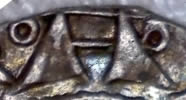 Coins of Antioch were issued by multiple rulers, including: Bohemond I (1098-1100 AD and 1102-1104 AD) Tancred (1101-1103 AD as regent and 1104-1112 AD) Roger of Salerno (1112-1119 AD as regent) Bohemond II (1126-1130 AD) Raymond of Poitiers (1136-1149 AD) Bohemond III (1149-1163 AD as minority and 1163-1201 as majority) Bohemond IV (1201-1216 AD and 1219-1233 AD) Raymond Roupen (1216-1219 AD) Bohemond V (1233-1252 AD) Additionally, perhaps a quarter of the variations of coins from Antioch were minted anonymously. In total, approximately 136 different variations of coins from the Principality of Antioch are cataloged in Malloy. The vast majority can be picked up for under $200, and about half should set you back under $100 in reasonable condition. Right now on vcoins there are more than 50 coins from this series available for purchase. I consider the coinage of Antioch to be a good entry point for those interested in dabbling in crusader coins. "If you climb a good tree, you get a push."
-----Ghanaian proverb
"The danger we all now face is distinguishing between what is authentic and what is performed."
-----King Adz
|
|
Moderator
United States
34563 Posts |
Here is my Denier of the Principality of Antioch. It was minted between 1163 and 1188 AD by Bohemond III and is attributed as CCS 65a. The obv inscription is +BOAHVNDVS and the rev inscription is +AHTIOCHIA.   "If you climb a good tree, you get a push."
-----Ghanaian proverb
"The danger we all now face is distinguishing between what is authentic and what is performed."
-----King Adz
Edited by Spence
05/20/2017 5:09 pm
|
|
Moderator
United States
34563 Posts |
Week seven means that we are moving on to the County of Edessa. According to Malloy, this region was not only the first to be taken by the crusaders (by Baldwin de Boulogne on March 10, 1098 AD), but also the first to be given back up (to Nur-ad-Din Mahmud on November 3, 1146 AD). As with some of the other regions in this general area, there had been a series of back and forth conquering prior to the first crusade, with the county going from Kurdish control to Byzantine, Turk, and finally Armenian control prior to Baldwin and his Franks. Edessa is now known by the name Urfa and is located in Turkey near to the Syrian border.
Over the course of those nearly 50 years of crusader state existence, copper coins were struck--some on new planchets but many as overstrikes. In design, most appear somewhat Byzantine in design, with either a cross or bust of Christ.
Coins were issued by Baldwin I, Baldwin II, Richard of Salerno, Joselin I, and Joselin II. Of the 18 varieties listed in Malloy, most are quite rare (and quite spendy). You can plan on dropping several hundred for one of these. I don't see any for sale on vcoins right now and, unfortunately, don't have any in my collection.
"If you climb a good tree, you get a push."
-----Ghanaian proverb
"The danger we all now face is distinguishing between what is authentic and what is performed."
-----King Adz
|
|
Moderator
United States
34563 Posts |
Moving on to the Kingdom of Cyprus this week--expect lots of history, multiple rulers minting coins, and a long range of dates from which to choose. According to Malloy, Cyprus is the third largest island in the Mediterranean Sea (with Sicily and Sardinia being larger). From 965 through 1184 AD, it was part of the Byzantine Empire. At that point, Isaac Ducas Comemnus seized the island for himself and bestowed the title of emperor on himself. To further legitimize his reign, he issued a whole slew of coins. However, fewer than ten years later, the island was invaded by Richard Coeur de Lion following the maltreatment of castaways from his ships by the native Cypriots. Richard's forces easily took the island, which he sold a few months later to the Templars for 100,000 dinars (including a 40% down payment). In April of 1192 AD, the Templars put down a revolt and decided to give the island to Guy of Lusignan (fresh off his loss of the Kingdom of Jerusalem--some guys just land on their feet I guess). Despite reigning for only two years himself, Guy's dynasty lasted for almost 300 years, with the following series of rulers issuing coins: Guy of Lusignan (1192-1194 AD) Aimery (1194-1205 AD) Hugh I (1205-1218 AD) Henry I (1219-1253 AD) Hugh III (1267-1284; no coins are known that can be attributed to Hugh II)) John I (1284-1285 AD) Henry II (1285-1306 AD and 1310-1324 AD) Amalric the Usurper (1306-1310 AD) Hugh IV (1324-1359 AD) Peter I (1359-1369 AD) Peter II (1369-1382 AD) James I (1382-1398 AD) Janus (1398-1432 AD) John II (1432-1458 AD) Charlotte (1458-1459 AD) Louis of Savoy (1459-1460 AD) James II (1460-1473 AD) Catherine Cornaro (1473-1489 AD, although coins were issued with James III in 1473 and 1474 AD) Additionally, Malloy lists a couple deniers issued during the Genoese occupation of the city of Famagusta between 1373 and 1464 AD). In all, there are some 175 different varieties listed. I hope that some other folks reading this will post their coins of Cyprus too. Currently, I see about 30 coins from the Lusignan Kingdom of Cyprus listed on vcoins, ranging in price from about 20 bucks to several thousand. My Cryprian coin was minted in Nicosia under the authority of Peter I. This Gros has an obv legend of +PIERE PAR LA GRACE D' DIEV ROI and a rev legend of +DE IERU3ALEM DE ChIPRE. Perhaps most memorable is the Cross of Jerusalem on the rev, with the tiny crosses in each of the four quarters. The attribution is CCS 76. The edge clipping, while unfortunate, is not that uncommon. At 4.5 g, it is still well within the range of 4.42 to 4.67 g for this series. Peter I also struck a so-called 'light-weight' coinage that matched better the weight of of the Gigliati of Robert of Anjou. These circulated widely in Turkey and as Peter I acquired the Armenian port city of Gorhigos, it is possible that the lighter series of Gros were meant to circulate in southern Turkey. 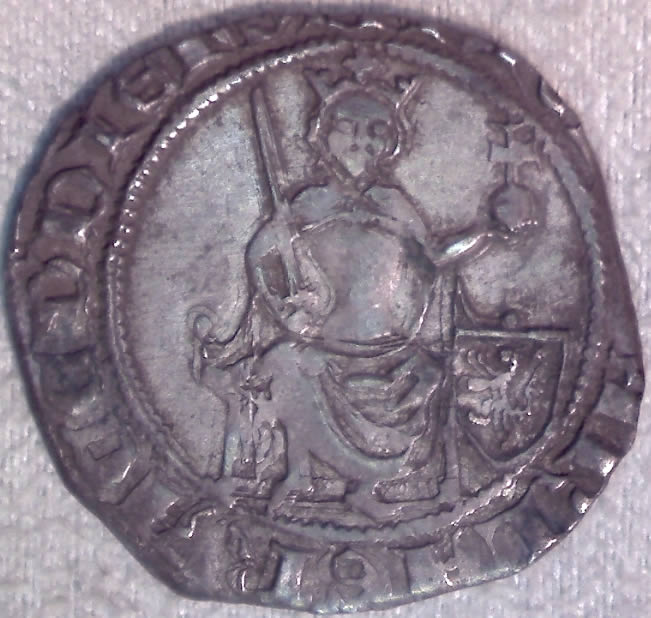 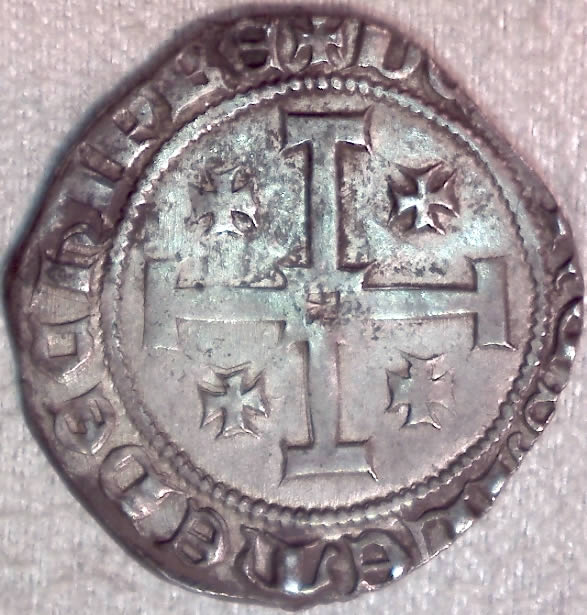 "If you climb a good tree, you get a push."
-----Ghanaian proverb
"The danger we all now face is distinguishing between what is authentic and what is performed."
-----King Adz
|
|
Valued Member
South Africa
331 Posts |
That is some old coins! My oldest coin is from 1518 a few hundred years later lol
|
|
Moderator
United States
34563 Posts |
This week we will be looking at the crusaders' scyphate or "cup-shaped" coins. These are often imitative of Byzantine scyphates. Many of these coins come from a particularly troubled time in the crusades, when the crusaders turned their sights on the old Byzantium in an effort to bring it into a more Western view of Christendom. For the first time in some 900 years, Constantinople was overrun, sacked and looted, with the Christians of the Western church fighting against Christians of the Eastern church. According to Malloy, Pope Innocent had this to say: Quote:
These defenders of Christ who should have turned their swords only against the infidel have bathed in Christian blood. They have respected neither religion, nor age, nor sex...They have dared to lay their hands on the wealth of the churches. They have been seen tearing from the altars the silver adornments, breaking them in fragments over which they quarrelled [sic], violating the sanctuaries, carrying away the icons, crosses, and relics. The Greek historian Nicetas Choniates backed up this story when he referenced the looting and melting of bronze statues for the expressed purpose of minting coins. For the purpose of this section of crusader coins, scyphates are known to have been minted in Constantinople, Thessalonica, and a whole bunch of types of uncertain mint. Here is a listing of coins, organized by mint and period by Malloy: Constantinople Early Period: Baldwin (1204-1205 AD), Henry (1205-1216 AD), and Peter de Courtenai (1216-1219 AD) Middle Period: Robert de Courtenai (1219-1228 AD) Late Period: Baldwin de Courtenai (1228-1261 AD) Thessalonica Boniface de Montferrat (1204-1207 AD) and Demetrius de Montferrat (1207-1224 AD) Uncertain Mint (potential contenders include Macedonia, Thrace, Thessaly, Albania, Bulgaria, and Corinth) A total of 63 types of crusader scyphate types are listed in Malloy, with about half of uncertain mint location. To an even greater extent than the Byzantine scyphates, the workmanship can be somewhat poor, with degenerate inscription and partial striking. From a price standpoint, these coins are pretty reasonable, with most varieties priced at under $100. However, I only seen one currently for sale on vcoins. As typical, it is pretty hard to see much detail: https://www.vcoins.com/en/stores/da...Default.aspxWe will finish out the remaining two weeks of June with our last two chapters: Frankish Greece and then the Knights of Rhodes. "If you climb a good tree, you get a push."
-----Ghanaian proverb
"The danger we all now face is distinguishing between what is authentic and what is performed."
-----King Adz
Edited by Spence
06/11/2017 5:14 pm
|
|
Pillar of the Community
 Spain
2752 Posts |
Hi Spence,just wanted to say that although this is not my collectng àrea I've been following and found it really interesting and informative thanks  Keep em coming!  Saludos Paul |
|
Moderator
United States
34563 Posts |
Thanks Paul! When I started this thread, I think that I overestimated the popularity of this series a little bit. I only have a handful Crusader coins and was hoping that there would be others who could fill in some of the gaps with their coins. In any case, this thread should be a useful reference in the future.
"If you climb a good tree, you get a push."
-----Ghanaian proverb
"The danger we all now face is distinguishing between what is authentic and what is performed."
-----King Adz
|
|
Pillar of the Community
Russian Federation
5186 Posts |
The dealer who sold me this coin claimed it to be a copper trachy of the Latin Rulers of Thessalonica, 1204-1224, from the description apparently SB 2057. Is it? I have no idea. I never did try for any better pics, either (not that I had anything to take them with). It is about the right size, shape, and metal. It probably is some kind of 13th century copper trachy - just not necessarily this particular (fairly uncommon) type. This coin and its slightly newer cousin (attributed by the seller to the Empire of Thessalonica, 1224-1246) currently hold the 13th century spot in my "One From Every Century" set (waiting for a better candidate that I don't need to trust the seller for... already have those from all the other centuries from 4th BC on). What can I say? I was really gullible that day. 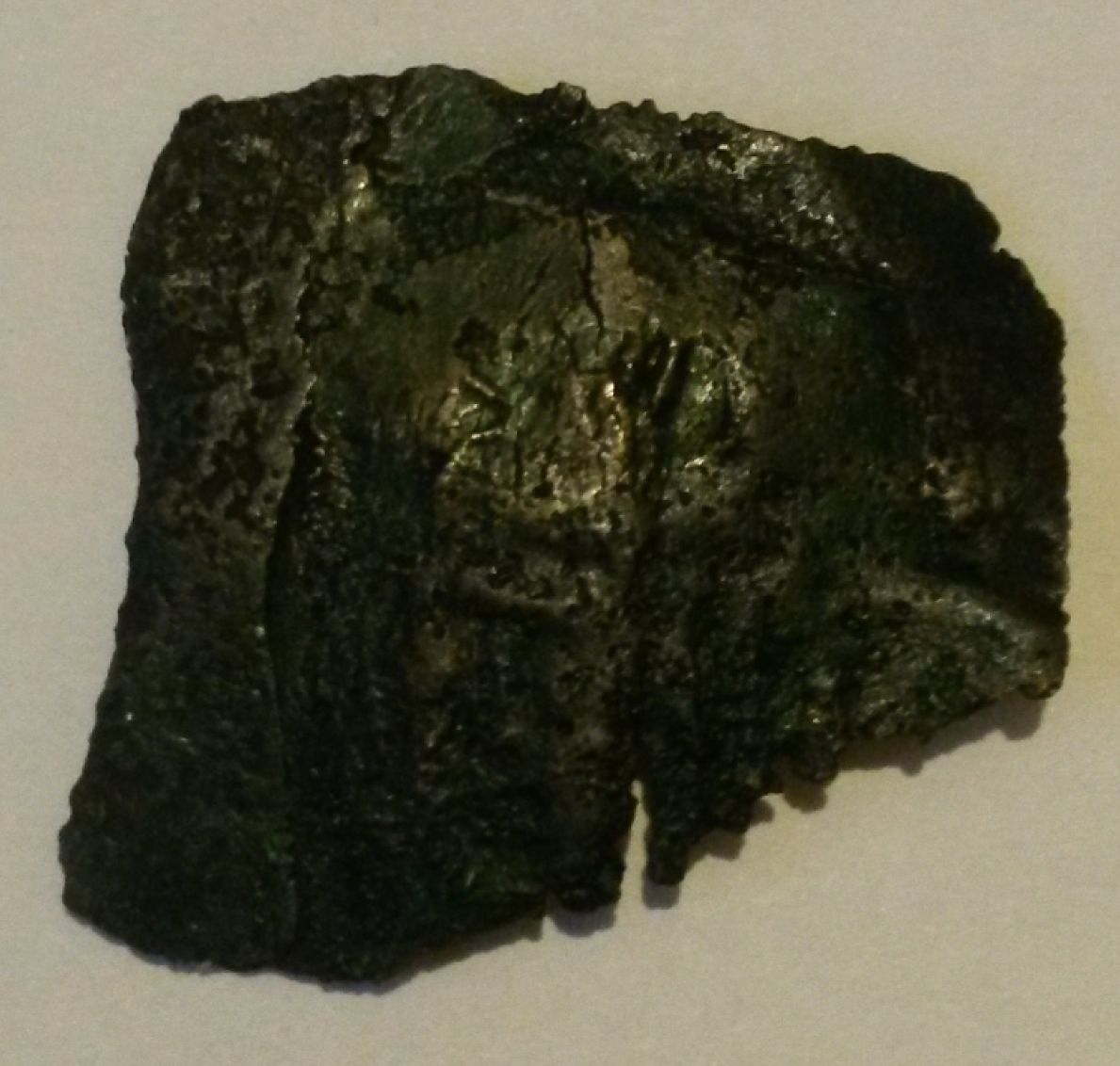 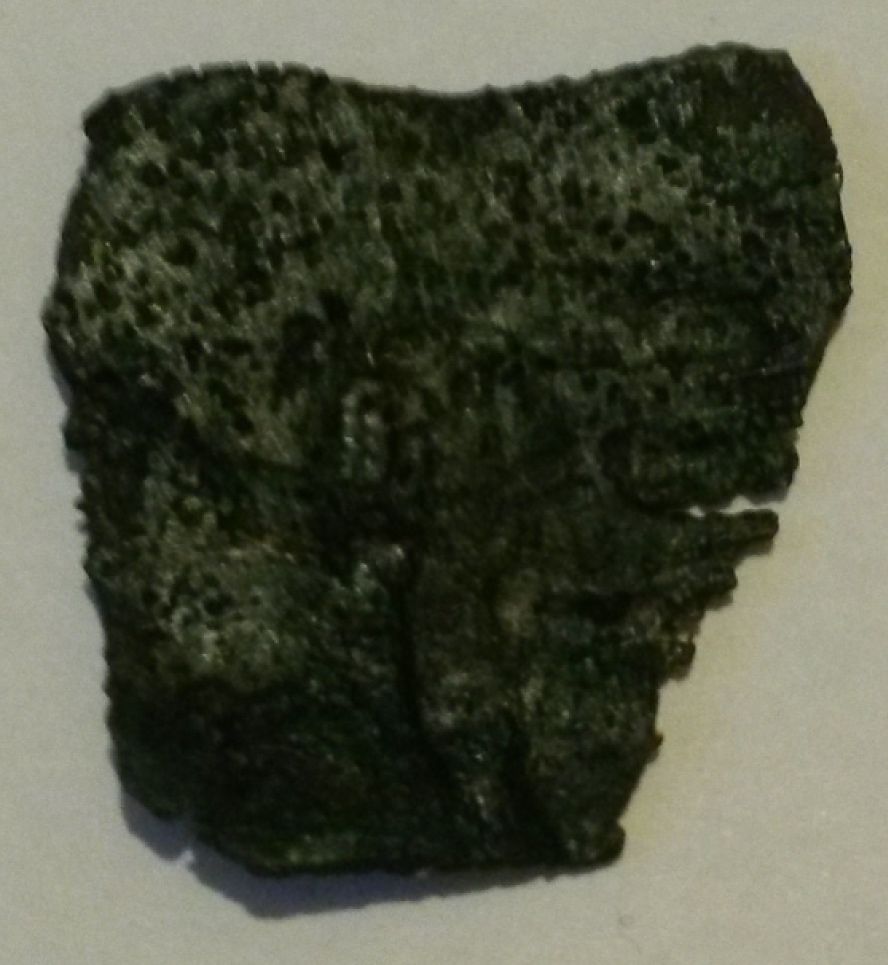 Unknown AE scyphate trachy, perhaps SB 2057. (No idea if that's in CCS.) Uneven squarish shape, ~24 mm side, 30 mm from one corner to another. Originally bought with some other stuff (some of which I might post eventually), for a price that came out to ~$5 per coin (in retrospect, way too much). And, um, sorry for disturbing your thread with those ugly pics  But this really is the closest I can get to a coin of the Crusaders (so far). |
|
Moderator
United States
34563 Posts |
@j1m, I'm so glad that you posted your coin. Your are correct that there isn't much detail left, although with better lighting, I think that some of it might be more visible. Based on my reading, I'm not sure that there was a whole lot of detail on the day it was struck, back in the 13th Century so maybe your coin is actually in pretty good shape. If you could provide a weight, I might be able to pin it down for you. Of the three Thessalonican trachy varieties, one weighs about 2.2 g, one weighs about 2.7 g, and the last weighs about 3.4 g. Yours has lost some material I think.
"If you climb a good tree, you get a push."
-----Ghanaian proverb
"The danger we all now face is distinguishing between what is authentic and what is performed."
-----King Adz
|
|
Pillar of the Community
Russian Federation
5186 Posts |
Quote:
Of the three Thessalonican trachy varieties, one weighs about 2.2 g, one weighs about 2.7 g, and the last weighs about 3.4 g. Yours has lost some material I think. As far as I can tell, 2.2 is right, maybe 2.1, but I'm not entirely sure of those figures (my current coin weighing system consists of a ruler balanced over an AA battery and some coins I know the weight of - usually Soviet kopeks - on the other end; that said, I checked with several other counterweight coins, and the 2.1-2.2 gram result was consistent). The problem is that, as it is, I have entirely no reason to assume, outside of whatever the seller said, that the poor little (well, big) thing is even Thessalonican. It can hardly be anything but an AE trachy, probably from the 13th century (earlier than that they were billon), but we're probably only going by size and weight other than that (that and the word of the seller). If it's one of those three, though, it's almost certainly the 2.2 g variety. |
|
Moderator
United States
34563 Posts |
Ok I've done a little more digging on your coin. As it turns out, SB 2057 was minted in Nicaea. The section attributable to John III from Thessalonica starts with #2058 and goes up through #2069. I have the 1974 edition, so maybe Sear did some re-numbering in subsequent editions?
The coin in CCS that weighs about 2.2 g (variety #27) does seem to be the best match for the one detail that I can see on your coin. On the second photo, there appears to be a somewhat stick-figure man with some sort of multi-pellet object near his/her right hand. That might be the beaded divitision (long robe with close fitting sleeves) worn by the emperor on the rev of CCS 27. Or maybe not--I'm just spit-balling here.
"If you climb a good tree, you get a push."
-----Ghanaian proverb
"The danger we all now face is distinguishing between what is authentic and what is performed."
-----King Adz
Edited by Spence
06/13/2017 06:27 am
|
|
Pillar of the Community
Russian Federation
5186 Posts |
I did intend to say SB 2057 - straight from Wildwinds (don't have any Sear). I agree, it's probably from a newer edition.
That said, the Wildwinds example is 0.82 grams, so it's probably not what I have!
Sadly I wasn't able to find an example of CCS 27, or even the equivalent SB number, so I have no idea if it's actually similar.
|
|
Moderator
United States
34563 Posts |
Week #10 brings us to the Crusader coins of Frankish Greece (including Achea, Carytaena, Damala, Athens, Salona, Negroponte/Euboea, Epirus, Neopatras, Naxos, and Tenos & Mykonos). This is admittedly a bit of a hodgepodge of Greek locations; however, I do note that for several of these regions, there are only one or two known coins produced. In contradistinction, the Principality of Achaea and Duchy of Athens were much more proficient.
Malloy describes in some detail the question of when exactly coins were minted by crusaders in Frankish Greece. On the one hand, Geoffroy I de Villehardouin seems to have been given the right to mint while other accounts indicate that the first right to mint was given to William of Achaea in 1249 AD. In either case, coins were likely struck first in the Frankish city of Glarentza at some point after 1255 AD. In the manuscript Practica Della Mercatura by Pegolotti (ca. 1280 AD), an interesting description of the Glarentzan mint was given. The basic unit of money was the gold Hyperpyron. This was subdivided into 20 Sterlini (a theoretical denomination that was not actually minted). Then, four Torneselli Piccioli made up one Sterlino. Pegolotti reported that Torneselli were being struck in Glarentza.
Here is a listing of coins, organized by mint and ruler by Malloy (quite a bit of information here):
Principality of Achaea
William of Villehardouin (1245-1278 AD)
Charles I of Anjou (1278-1285 AD)
Charles II of Anjou (1285-1289 AD)
Florent of Hainaut (1289-1297 AD)
Isabelle of Villehardouin (1297-1301 AD)
Philip of Savoy (1301-1306 AD)
Philip of Taranto (1306-1313 AD)
Louis of Burgundy (1313-1316 AD)
Ferdinand of Majorca (Pretender, 1315-1316 AD)
Maud of Hainaut (1316-1318 AD)
John of Gravina (1318-1333 AD)
Robert of Taranto (1333-1364 AD)
Barony of Carytaena
Helena Angelica Comnena (ca. 1291-1300 AD)
Lordship of Damala
Anonymous (ca. 1325 AD)
Duchy of Athens
Guy I de la Roche (1225-1263 AD) (?)
William de la Roche (1280-1287 AD)
Guy II (1287-1294 AD during his minority or 1294-1308 AD during his majority)
Gautier de Brienne (1308-1311 AD)
Anonymous Catalan Dukes (1311-1388 AD) (?)
Anonymous Florentine Dukes (1388-1394 AD) (?)
County of Salona
Thomas III de Stomoncourt (1294-1311 AD)
Triarchy of Negroponte (Euboea)
William of Villehardouin (1255-1259 AD)
Despotate of Epirus
Philip of Taranto (1294-1313 AD)
John II Orsini (1323-1335 AD)
Duchy of Neopatras (Great Wallachia in Thessaly)
John II Angelus Comnenus (1303-1318 AD)
Duchy of Naxos
Nicolo I Sanudo (1323-1341 AD)
Giovanni I Sanudo (1341-1362 AD)
Lordship of Tenos and Mykonos
Giorgi I Ghisi (1303-1311 AD)
Catalan Duchy of Athens(?)
Anonymous
Chios
"Palaeologus" and Benedict I Zaccaria (1304-1314 AD)
Martin and Benedict II Zaccaria (1314-1319 AD)
Martin Zaccaria (1319-1329 AD)
Maona Society (1347-ca.1385 AD)
Corfu
Philip of Taranto (1304-1314 AD)
I have two examples of Frankish Greek Crusader coins--I'll post them next. Especially if you are willing to pick up coins from Achaea or Athens, these coins are readily available and at pretty reasonable prices.
"If you climb a good tree, you get a push."
-----Ghanaian proverb
"The danger we all now face is distinguishing between what is authentic and what is performed."
-----King Adz
|
|
Moderator
United States
34563 Posts |
This Tournois Denier is from the Principality of Achaea under William of Villehardouin (1245 to 1278 AD). It is attributed as CCS 9a and Roberts 5302. The obv legend is G PRINCEPS while the rev legend is CLARENTIA. 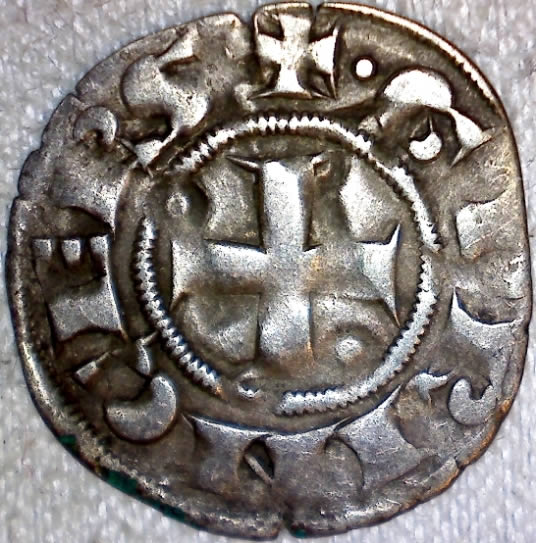 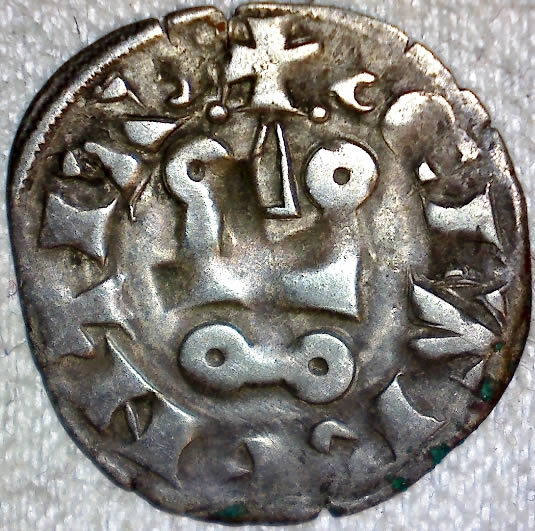 The second coin, a Denier, is from the Duchy of Athens. It was minted under the authority of William de la Roche, perhaps including Guy II's minority and dates to between 1280 and 1294 AD). It is attributed as CCS 86. The obv inscription is + G DVC ATENES and the rev inscription is ThEBE CIVIS. 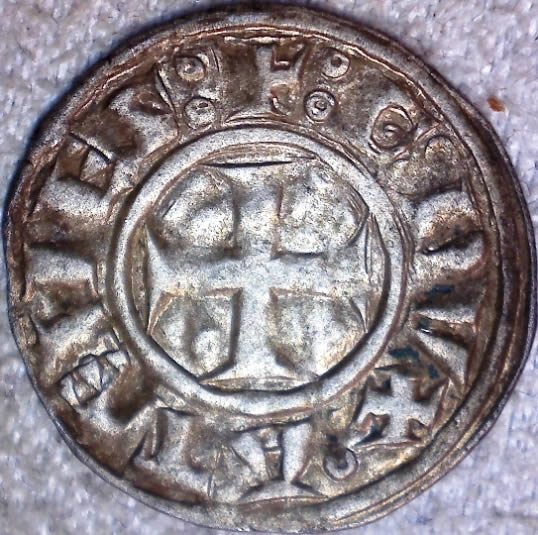 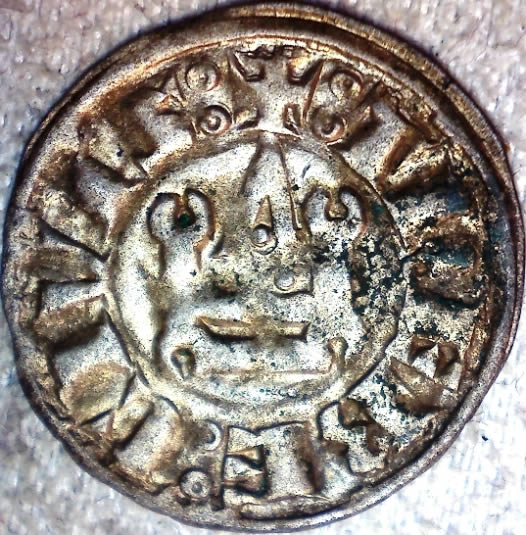 Next week will be the final week that I have planned for this thread, when we will look at coins from the Knights of Rhodes. "If you climb a good tree, you get a push."
-----Ghanaian proverb
"The danger we all now face is distinguishing between what is authentic and what is performed."
-----King Adz
|
| |
Replies: 41 / Views: 10,630 |
To participate in the forum you must log in or register.
Disclaimer: While a tremendous amount of effort goes into ensuring the accuracy of the information contained in this site, Coin Community assumes no liability for errors. Copyright 2005 - 2026 Coin Community Family- all rights reserved worldwide. Use of any images or content on this website without prior written permission of Coin Community or the original lender is strictly prohibited.
Contact Us | Advertise Here | Privacy Policy / Terms of Use
|
| Coin Community Forum |
© 2005 - 2026 Coin Community Forums |
| It took 0.52 seconds to rattle this change. |
 |
|
| |
| |







 First Page


 Posted 05/20/2017 5:08 pm


