| Author |
 Replies: 14 / Views: 4,057 Replies: 14 / Views: 4,057 |
|
|
Pillar of the Community
Norway
510 Posts |
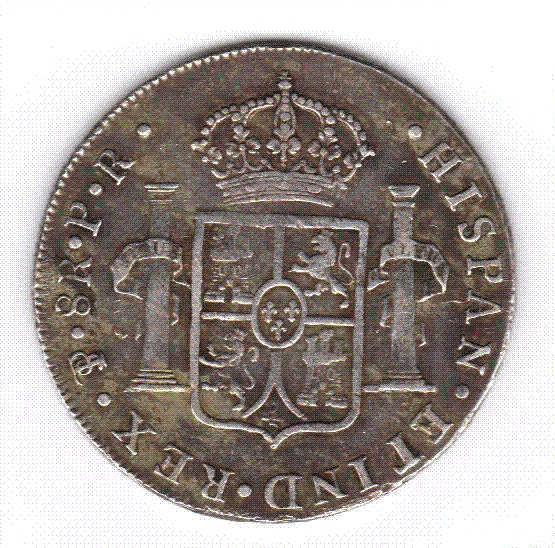
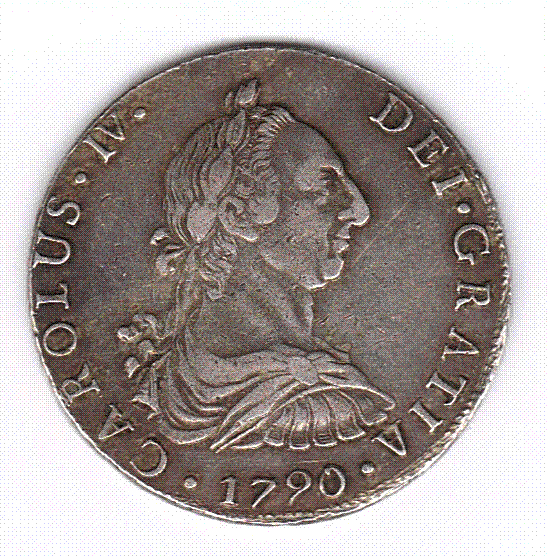
I received this coin recently and wondered if it was genuine. The edge bears no sign of the standard colonial egde, any circles and/or rectangles has been removed forcibly. I do not have a good picture of the egde but it is just somewhat jagged metal. I would be interested to know what this might be worth with a proper edge and also with an edge like mine. I was not aware of the improper edge when I bought it. Image:  8reales.GIF 8reales.GIF86.05 KB Image: 8reales2.GIF86.01 KB |
|
|
|
Pillar of the Community
United States
6429 Posts |
Hi Litotes,
Swamperbob is the guy to give you good information on this coin. Hopefully he'll be along soon to comment.
From what little I know, I'd be suspicious about this one. That's Charles III's portrait on the coin (I'd recognize that nose anywhere!) but the legend says "Carolus IV". Many coins were issued after Charles III died in 1788 that have his portrait with the Carolus IIII legend, but I've always seen the number shown as "IIII", not "IV". There is almost no spacing between ET and IND in the reverse legend and the T in ET is poorly formed. Lack of proper edge figures could mean it's a genuine coin that was filed or clipped, but it's not a good sign. The edges are diagnostic of a genuine specimen and the fact that they are absent is suspicious in itself.
Do you have an accurate weight? It should be around 27 grams, although perhaps it would be a few tenths light if in fact the edge was filed.
Did the seller guarantee it is authentic?
|
|
Pillar of the Community
 Norway
510 Posts |
Hi and thanks for your reply.
Your comments are enlightening, I do not know much about these coins myself - only what you can get out of Krause.
The weight of the coin is 25,7-25,8 grams, so it is underweight - possibly because of the removal of the edge. But it does appear to have the right diameter. The seller does not know more than me, he picked up the coin from a miscellanoeus antiques auction where no information of the objects were given. He resold it on the strength of the two pictures I have posted here, and did not guarantee anything besides delivering the pictured coin. He has even so offered me to return the coin if I feel uncomfortable with it, but I rather like it and would probably want to keep it if it is real. But I am not interested in fakes (irrespective of production date). I know some comtemporary fakes have higher value than the real coins they imitate, but still they do not appeal to me.
I paid approximately 90$ for it.
|
|
Pillar of the Community
Australia
3841 Posts |
I am quite suspicious as well - hope that whomever you bought it from has some kind of return policy.
|
|
Moderator
 Australia
16982 Posts |
The wrong portrait and the use of "IV" rather than "IIII" are in fact perfectly normal on the Potosi mint coins of 1789/1790 (see Krause, KM# 64), but the other things mentioned are cause for serious concern - notably, the lack of the squares-and-circles edge pattern.
I have a fake Spanish dollar, too. It looks pretty good (except for a couple of places where the silver has come away, showing a copper core) but the edge is like yours, just a crude attempt at reeding. It fooled me when I bought it (never having seen a real one before), but it didn't fool an expert in Spanish colonial I showed it to.
Don't say "infinitely" when you mean "very"; otherwise, you'll have no word left when you want to talk about something really infinite. - C. S. Lewis
|
|
Pillar of the Community
United States
3357 Posts |
Complete absence of the lotus rim figure on the obverse is suspicious, too.
"Two minutes ago I would have sold my chances for a tired dime." Fred Astaire
|
|
Pillar of the Community
United States
5362 Posts |
Litotes The design is correct for 1790. The portrait of Charles the III was used with the legend Carolus IV for about a year in 1789 and 1790 following the death of Charles III. In 1790 the legend was changed to Carolus IIII. These "transitional varieties" have always been interesting and have been sought out by collectors to complete type sets. For that reason they have been forgery targets for a long time.
This particular coin would have been edged with the Circle - rectangle design not the lotus blossom. The lotus edge was used on the Dos Mundos type not on portrait 8Rs.
The weight of your coin is in all liklihood TOO low to be real unless it was struck on an exceptionally large planchet. If you do the math, you need to remove about 5% of the weight (The coin is 95.4% of original). I have a few Bolivian coins with a diameter of 41 mm. So assuming a 41mm start you need to remove 1.92 millimeters from the diameter of the coin. That is a lot of metal considering the appearance of what is left.
You need to perform a specific gravity on the coin to see if the metal is dense enough to be silver. The color and the staining patterns look like an off metal to me.
I believe it is far more likely that the coin is a cast copy and that an edge seam was removed by filing. Copies made in the 1950s were sometimes made without adding an edge design. The edge was omitted so that they could not be charged with forgery. There are some suspicious lumps in the field and the details do look weak.
Let us know if you can get the SG.
|
|
Pillar of the Community
Norway
510 Posts |
swamperbob - thank you for the information.
As for the specific gravity test I fear my current equipment and/or knowledge is not up to the task. I intend to buy a more precise weight so I can give the weight accurately down to at least 0,01 grams, but even if I get this I am unsure how to measure the right amount of water displaced by the coin. I suppose a convenient method has been explained here earlier and would appreciate a link if anyone knows where it is.
I am puzzled by your calculation about the diameter, however. I cannot see a 5% reduction in weight because of filing reduce the diameter with the same 5%. The outermost 2mm of the coin obviously weighs more than the innermost 2mm. Otherwise a 4R coin would have exactly half the diameter of a 8R coin, which it does not. Is there something I am missing here?
|
|
Pillar of the Community
United States
5362 Posts |
Litotes - Specific Gravity is easier than most people think. I can't find the links but the displacement (volume) of the coin is equal to the change in weight of the coin weighed in air and the coin weighed immersed in water.
If a coin weighs 27.00 grams in air and 24.38 grams suspended in water. The volume of the coin is 27-24.38 or 2.62 cc. Water displaces 1 gram per cubic centimeter (pure water at standard temps). The weight in air divided by the volume gives the specific gravity 27/2.62. The only trick is to find a method of hanging the coin and making a small adjustment for the displacement and weight of the hangar.
I left out the math on the calculation of the diameter reduction it is not just a straight percentage. The thing you are missing is that I did a ratio of surface area of the coin. Any 2 square mm of the coin will weigh the same regardless of the position on the coin.
The weight of a coin is roughly proportionate to the area of the coin (assuming uniform thickness). That assumption is valid for this mathematical precision in this calculation.
The weight ratio is 25.8/27.03 = 0.9545 so therefore that is also the area ratio. The coin has been reduced in surface area by nearly 5%. I wanted to calculate the amount of lost surface area and convert that to a band of unknown thickness around the outside perimeter of the coin.
So I expressed the two areas in terms of the original radius and the amount of material lost by filing called Y.
The area of the coin now is Pi x R x R (pi R squared)
The original area is Pi x (R + Y)x (R + Y) where Y is the lost radius.
I called the present area A1 and the original A2. So since the ratio of the areas is equal to the ratio of the weights.
A1/A2 = 0.9545
I substituted the two formulas getting.
Pi R1 squared / Pi (R1 squared + 2R1Y + Y squared) = 0.9545
Then I resolved the equation using an original 41 mm diameter
Y squared + 82Y - 80 = 0
Then I solved for Y using the quadratic formula.
I don't have the fonts for math terms but the formula is a high shool math thing.
The fact that the change in radius came out to a final ratio of 4.78% is just coincidence based on the starting diameter in this case. If you did the calculation for a far larger change in diameter the ratios would be considerably different.
The reason I omitted all the math was the difficulty most people have with math. Plus I was also in a hurry.
|
|
Pillar of the Community
Norway
510 Posts |
Bob - I thank you for the explanation.
Specific gravity indeed does not sound so difficult when you explain it. But if my understanding is correct it seems I will need a spring scale of sorts, something that can measure the weight of something hanging from it. My own scales (including the more precise type I have just ordered) are the kind that measures what lays on top of it. I am not sure how to get around that little problem - never were much of a scientist, unfortunatly. I guess I will have to look for yet another scale - perhaps someone around here have one for me to borrow.
The mathematic result seems counterintuitive to me still, but there is no escaping the facts. In this case I completely agree with you, it is very difficult to see an edge reduction of this magnitude when so much is left. The coin, to my eye, completely overlaps the picture in Krause.
I will be back with the SG results if I can find an appropriate scale somewhere.
|
|
Pillar of the Community
United States
3357 Posts |
An open platform balance works fine to measure specific gravity. Put a beaker of water on it and zero the scale out. Then suspend the coin in the water from a rigid support (I hung the coins from a ring stand using a piece of thread). The scale will show the weight of the water the coin displaces, plus whatever you used to hang it in the water. The thread I used added about .01g.
What I meant by "lotus pattern" was the serrated design on the top of the rim - sorry if I used the wrong term. It still bothers me that there is virtually none of this seen on the obverse.
"Two minutes ago I would have sold my chances for a tired dime." Fred Astaire
|
|
Pillar of the Community
Norway
510 Posts |
Of course! Seems so simple when you have the explanation. Columbi egg. Thank you very much, thq.
The lack of lotus pattern, or whatever the correct term may be, seems another indication that I may expect to get a "nine-point-something" if I manage the SG.
|
|
Pillar of the Community
United States
5362 Posts |
There are three different "standard" edges used on the 8R coins of Mexico.
The first called the "Lotus edge" is a series of lotus flowers (they often look like leaves) - this edge was used from 1732 until 1772 on the Dos Mundos (Two World's) Pillar 8 reale.
The second is usually referred to as a "Colonial Edge" is used on the Portrait 8 Reales from 1772 to 1823. It consists of alternating circles and rectangles.
The third form is the edge seen on the Mexican Republican issues from 1823 to 1897. It is usually called an "Engrailled edge" and looks like a series of parenthesis or brackets - sometimes with or without a dot. {{{{{{{{{{{{
In all cases, there are varieties by date and mint. The edges alone make a very interesting collection. At times, there is a style change and only one of the edge dies gets changed - it makes an odd looking coin with two different edge patterns. There are also double and triple edged examples (after about 1880 in the Mexican series). Of course the counterfeit edges are the MOST interesting because of the range of variation.
Each of the other Spanish Colonial mints seemed to adopt a different style after they became independent, so edge studies are a field that is wide open for the researcher.
|
|
Pillar of the Community
Norway
510 Posts |
Followup - first I tested the coin and found that it was indeed made of silver, then I managed to find a Norwegian expert who could, with coin in hand, confidently declare that it was genuine. The edge was probably destroyed to remove signs of mounting. So there's a happy ending :-)
|
|
Pillar of the Community
United States
5362 Posts |
That's great - I like a happy ending. I just received an 1803 counterfeit 8R that I won on ebay. I bought it thinking it was a modern Chinese copy (because of the way the add was worded), but it is a very old copy made of silver. The edge design is the only problem - it has two laps but the shapes are not exactly correct and HALF of the edge has HORIZONTAL grip marks. It is a variation on the more normal half Diagonal marked edge. The coin was an ANA reject (Money Museum). They identified it as a forgery. Silver struck and over 26.5 grams. I will post pictures later. |
| |
Replies: 14 / Views: 4,057 |
|








 8reales.GIF
 8reales2.GIF

 Posted 04/13/2008 03:14 am


