Coin Community Family of Web Sites Join Thousands of Coin, Bullion, & Money Collectors
Royal Canadian Mint products, Canadian, Polish, American, and world coins and banknotes. Join Thousands of Coin, Bullion, & Money Collectors Coin, Banknote and Medal Collectors's Online Mall 300,000 items to help build your collection! Royal Estate Auctions - $1 Coin AuctionsVancouvers #1 Coin and Paper Money Dealer Specializing in Modern Numismatics


Username:
Password:
Save Password
Forgot your Password?


This page may contain links that result in small commissions to keep this free site up and running.

Welcome Guest! Registering and/or logging in will remove the anchor (bottom) ads. It's Free!

Question For You Pros

To participate in the forum you must log in or register.
Author Previous TopicReplies: 5 / Views: 828Next Topic  
New Member

United States
9 Posts
 Posted 04/22/2017  8:35 pm Show Profile   Bookmark this topic Add Grumell to your friends list Get a Link to this Message Number of Subscribers
Hi All,
I'm sure there is no easy answer to my question, but will try anyways. When searching older coins that have years of wear is there any advice/ trick on determining double dies from extensive wear. I see many posts on widening? Is this a way to determine doubling verses normal wear on older coins? I remember years ago I went through a marble collecting phase and while just starting I had many problems detecting an oxblood marble. It was not until someone explained to look for something that looked like nail polish painted on the marble before I actually found one and had that Eureka moment. Can anyone remember that Eureka moment that helped them with roll searching double dies when new to the hobby that may help me? I get the slap in the face examples, but still having those issue with the more difficult varieties and would hate to throw something back that may fit my building collection...or am I over thinking things and should just throw back anything that is not obvious?
Pillar of the Community
RoyCoinBoy's Avatar
United States
1609 Posts
 Posted 04/22/2017  9:02 pm  Show Profile   Bookmark this reply Add RoyCoinBoy to your friends list Get a Link to this Reply
It depends on how worn you're talking. Under F12, most of the "thickening" is likely caused from wear and double dies are very difficult to spot.
Pillar of the Community
CoinCents's Avatar
United States
3656 Posts
 Posted 04/22/2017  9:30 pm  Show Profile   Bookmark this reply Add CoinCents to your friends list Get a Link to this Reply
coop has some great education posts here on the forum and I find them extremely useful.

On the older wheat cents - Reverse - these are my best to spot because the dot in between the EPU are elongated inside of round. now that being said there are other DDR's are true Doubled Dies without this elongated dot - I just can't seem to find any of those.
On the Obverse I have only been able to find them on the New coins - so I am no help to you there.

I know you were looking for the pro's to chime in but I thought I would pass along my experience to you as well.

I will write again with the links to coops edu posts
Edited by CoinCents
04/22/2017 9:41 pm
Rest in Peace
Crazyb0's Avatar
10197 Posts
 Posted 04/22/2017  9:53 pm  Show Profile   Bookmark this reply Add Crazyb0 to your friends list Get a Link to this Reply
Grummel!

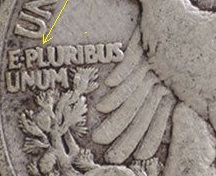
What's been said is quite right. Condition of coins does hinder the total attributive factors but on some coins there remains enough of the original "shape of a doubled letter to tell. As in this on a Walker reverse, the doubling appears as a notch above L and you while all other letters are smashed and wide appearing.

Question-For-You-Pros

Sometimes there are other markers on a coin that may remain like die cracks or die chips that can be matched to a suspect "smashed" detail.

Edited by Crazyb0
04/22/2017 9:54 pm
Pillar of the Community
stoneman227's Avatar
United States
2376 Posts
 Posted 04/22/2017  9:54 pm  Show Profile   Bookmark this reply Add stoneman227 to your friends list Get a Link to this Reply
You can start by separating the coins you search by date before even starting to look for varieties. Once you have a a pile of a certain date go to all the usual sites and study the known varieties for it . By looking at one date at a time you will begin to recognize the ins and outs of that years design. When something unusual pops up set it in another pile for further study.
That Eureka moment is going to be at different times for the different classes of doubled dies .
Just save those study piles for your future improved eye
Pillar of the Community
United States
1000 Posts
 Posted 04/23/2017  12:03 am  Show Profile   Bookmark this reply Add Druu to your friends list Get a Link to this Reply
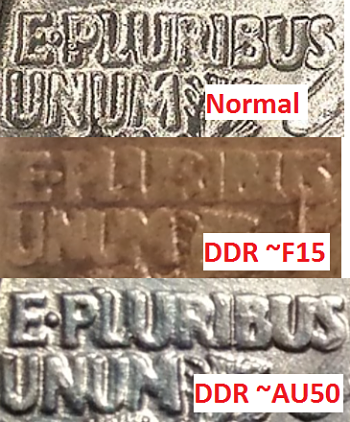
Crazyb0 gave me an idea, so here's a comparison for you. Admittedly, the 1946 Walker is a punch you in the face DDR, but here's a comparison between a normal reverse and two DDRs in various grades. The AU50 was graded here on ccf as either XF45 or AU50. The coin I labeled as F15 is my guess -- I haven't gotten it out of the 2x2 for proper pictures and opinions here yet. Based on photograde, it's in the F12 to VF20 range.
Question-For-You-Pros
  Previous TopicReplies: 5 / Views: 828Next Topic  

To participate in the forum you must log in or register.


Disclaimer: While a tremendous amount of effort goes into ensuring the accuracy of the information contained in this site, Coin Community assumes no liability for errors. Copyright 2005 - 2026 Coin Community Family- all rights reserved worldwide. Use of any images or content on this website without prior written permission of Coin Community or the original lender is strictly prohibited.
Contact Us  |  Advertise Here  |  Privacy Policy / Terms of Use

Coin Community Forum © 2005 - 2026 Coin Community Forums
It took 0.29 seconds to rattle this change. Forums